


Conflict is exhausting.
At work. In leadership. With coworkers. With business partners.
At home. In marriage. With kids. With friends.
And sometimes the most frustrating part isn’t the conflict itself.
It’s this:
Why does the same dang thing keep happening?
Different day. Same argument.
Same tension. Same emotional hangover.
If that sounds familiar, you may be stuck in something called The Cycle of Collusion.
This concept is heavily influenced by the work of the Arbinger Institute and their research on conflict, blame, and relationship dynamics.
It’s one of the clearest ways I’ve seen to explain why smart, capable, well-intentioned people accidentally create the exact problems they’re trying to solve.
And yes... most of us do this.
What Is The Cycle of Collusion?
Simple version:
You react to someone’s behavior in a way that makes their behavior worse.
Then they react to your reaction. → Then you react to that. → And around you go.
Both people feel justified. Neither person sees their part clearly.
Everyone gets tired.
A Real-Life Example
Manager says: “I need updates more often.”
Employee hears: “You don’t trust me.”
Employee starts withholding details. → Manager notices reduced visibility.
Manager checks in even more. → Employee feels micromanaged.
Manager thinks: “See? I HAVE to micromanage.”
Loop complete. And nobody wins.
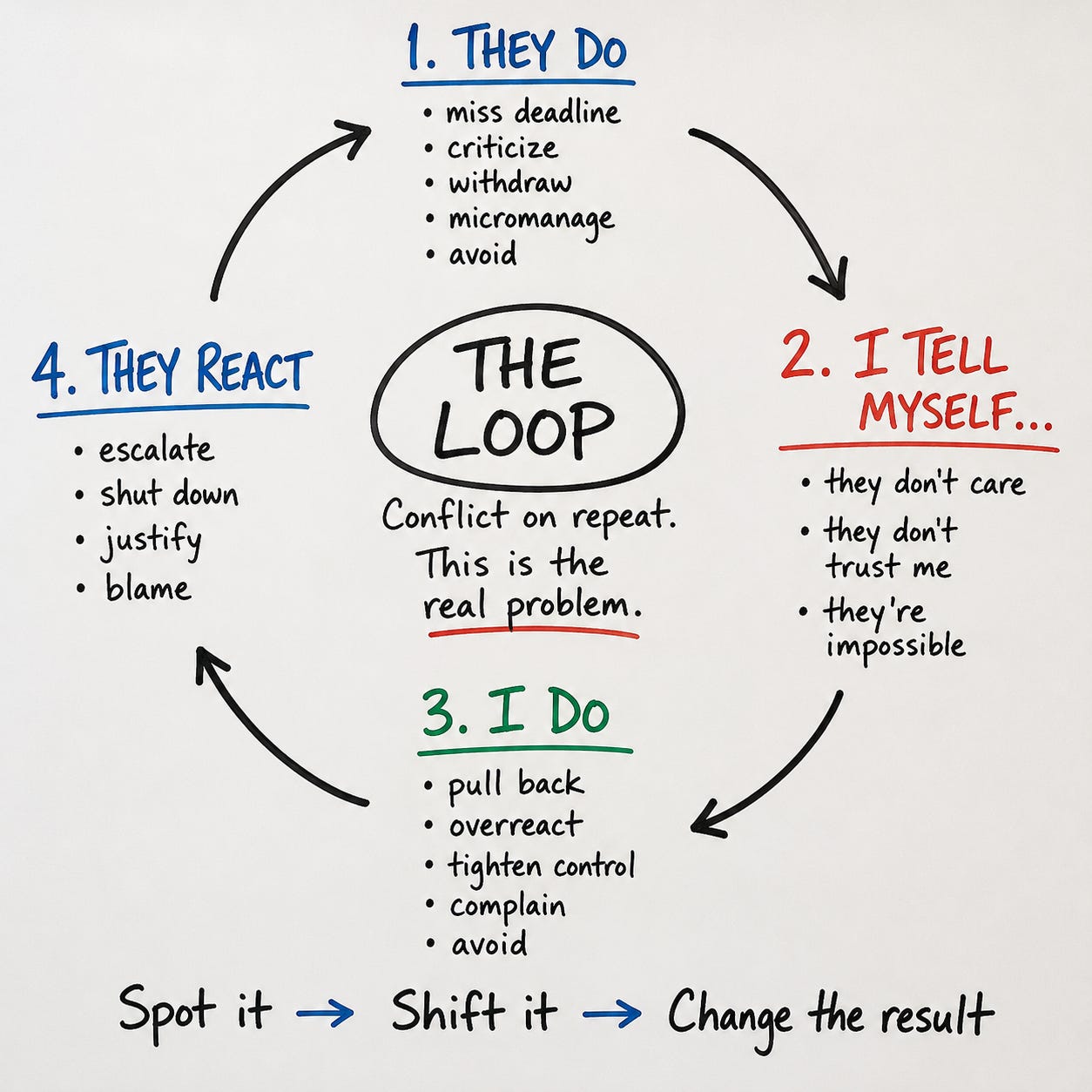
The 4-Part Conflict Loop
1. They do something
Something happens that triggers you.
Maybe they:
interrupt
avoid
criticize
miss deadlines
get emotional
shut down
over-control
don’t follow through
This is usually the part we obsess over.
Because it feels obvious.
“Look what THEY did.”
2. Then you create a story
Here’s where things shift.
The event happens. Then meaning gets attached.
You tell yourself:
They don’t care.
They’re lazy.
They’re selfish.
They don’t respect me.
They’re impossible.
I’m doing all the work.
Now they’re no longer a human with context.
They become “the problem.”
That shift matters.
A lot.
3. Then you react
Because of your story, your behavior changes.
Maybe you:
withdraw
complain
tighten control
get sarcastic
stop sharing
avoid hard conversations
escalate emotionally
become defensive
And here’s the sneaky part:
Your reaction often feels completely reasonable.
That’s why this loop is so sticky and tricky too.
4. Then they react to your reaction
Now the other person sees YOUR behavior.
And tells themselves a story.
“See? This is exactly why I act this way.”
Boom.
Now they feel justified too. And the cycle keeps spinning… faster and faster.
Why Smart People Get Stuck Here
Because this is human behavior.
🚫 Not weakness.
🚫 Not stupidity.
Just behavior. The great news is behaviors can change, yet there are a few traps. 🪤
Trap #1: The Need to Be Right
Let’s be honest.
Being right can feel good. Very good.
Especially when we’ve been hurt, frustrated, ignored, or disappointed.
The problem?
Sometimes we care more about proving our case than solving the issue.
And that gets expensive, quickly.
How do I know… I was Mr. Right at all the wrong times. 😬
Trap #2: Selective Awareness
We see their behavior in HD.
Ours?
Blurry.
We explain our actions. We judge theirs.
That’s normal human bias. And it keeps us stuck.
Trap #3: Recruiting Allies
You vent. They vent.
Suddenly the conflict has a fan club.
Now instead of solving something... everyone is reinforcing stories.
This happens constantly in teams. And families too.
What The Cycle Costs You
More than most people realize.
This repeating pattern drains:
Energy
Conflict is expensive. Even silent conflict.
Mental loops eat bandwidth.
Trust
Repeated friction changes relationships.
Trust erodes slowly. Then suddenly.
Results
Teams slow down. Communication gets messy.
Projects stall. Decisions drag.
Wellbeing
Stress follows you home or into work. And creeps into your sleep.
That’s the real cost.
How To Break The Cycle
Truth is: Someone has to go first. Great news: It can be you. 🎉
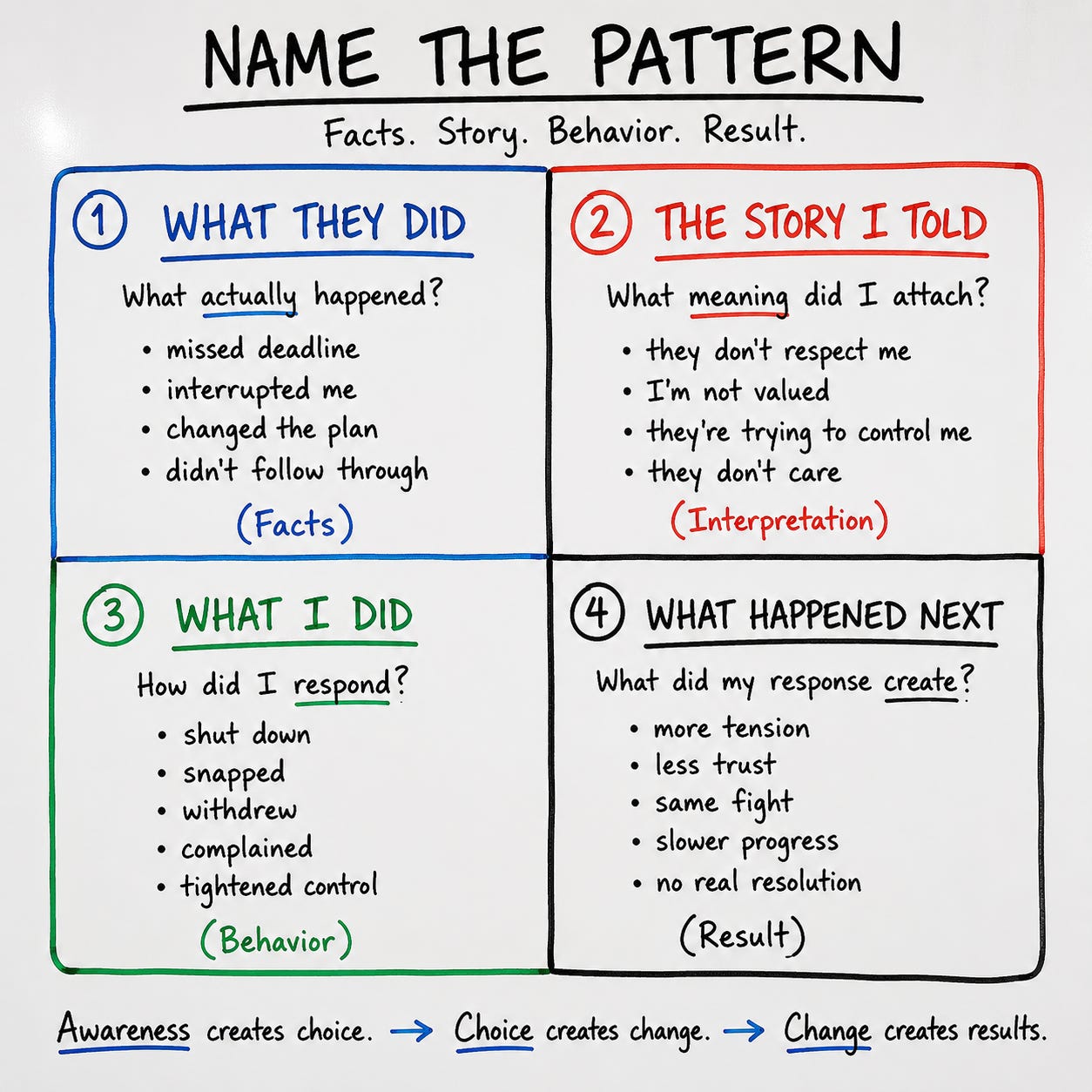
1. Name the Pattern
Grab paper. Whiteboard. Notes app.
Write: They do → I tell myself → I do → They react
Map it. No judgment. Just observation.
This alone creates clarity.
2. Ask the Hard Question
How might I be contributing to the thing I say I want to stop?
Oof. Not fun.
Yet, very useful.
3. Separate Facts From Story
Fact: “They missed the meeting.”
Story: “They don’t respect me.”
Those are not the same thing.
4. See the Human Again
This does not mean excusing bad behavior.
It means remembering:
People have stress. Pressure. Fear.
Blind spots. Competing priorities.
Just like you.
5. Change Your Move
If your usual go-to move is control... try curiosity.
If your usual go-to move is avoidance... try clarity.
If your usual go-to move is defensiveness... try ownership.
Different input = Different output
6. Have the Conversation
Try: “I think we may be stuck in a pattern, and I can see my part in it.”
That sentence changes rooms.
Real Talk
Sometimes the conflict isn’t the real problem. The pattern is.
And until the pattern changes... the people may change...
but the problem often remains.
One Final Thought
At ResultsLab, we talk a lot about friction. Because friction doesn’t just slow projects.
It slows people. Relationships. Decisions. Momentum.
The Cycle of Collusion is friction in motion… in the wrong direction.
Reduce the friction. Make more progress.
Spot it. → Shift it. → Change the result.
If you found this helpful, please share this with your co-workers in slack or teams.
Heck, share this with your friends and family too.
What relationship is costing you the most right now?
I help people solve high-stakes relationship problems that drain trust, energy, and results. Lab Notes is where I share one insight every week to help you make more progress faster. If someone forwarded this to you, please subscribe here: resultslab.io/subscribe
Better Relationships | Great Results
FAQs
What is the Cycle of Collusion?
The Cycle of Collusion is a repeating conflict pattern where two people unintentionally reinforce each other’s negative behaviors through blame, reaction, and justification.
How do you break the Cycle of Collusion?
Start by identifying the pattern, taking ownership of your role, separating facts from assumptions, and changing your response.
Is the Cycle of Collusion the same as codependency?
Not exactly. Codependency focuses more on unhealthy emotional reliance. The Cycle of Collusion focuses on mutual conflict reinforcement.
Can this happen in healthy relationships?
Yes. Smart, healthy, well-intentioned people fall into these loops all the time.
Your turn. I’d love to hear from you.
How do you break the cycle?