


Did your company announce a buyout, a reorg, or a “new way of working”? Are you wondering whether to take the offer, or whether staying is the bigger risk? Are buyers slower to call back, or are you the one delivering the news? Microsoft’s 60,000-person buyout is the latest headline, but this is for anyone in tech living through layoffs. It will help you steady yourself, make sense of what you’re feeling, and rebuild with clarity and confidence, whether you were let go, stayed behind, or lead the team.
Layoffs. Buyouts. Reorgs. AI pressure.
There are two months left in 2026, and the ground still isn’t done moving. Honestly, it will never stop moving.
Two months into 2026, I wrote a guide to rebuilding after a layoff. Same headlines, same worry. The change has only picked up speed since. I can’t slow it down. I can get better at adapting to it, and so can you.
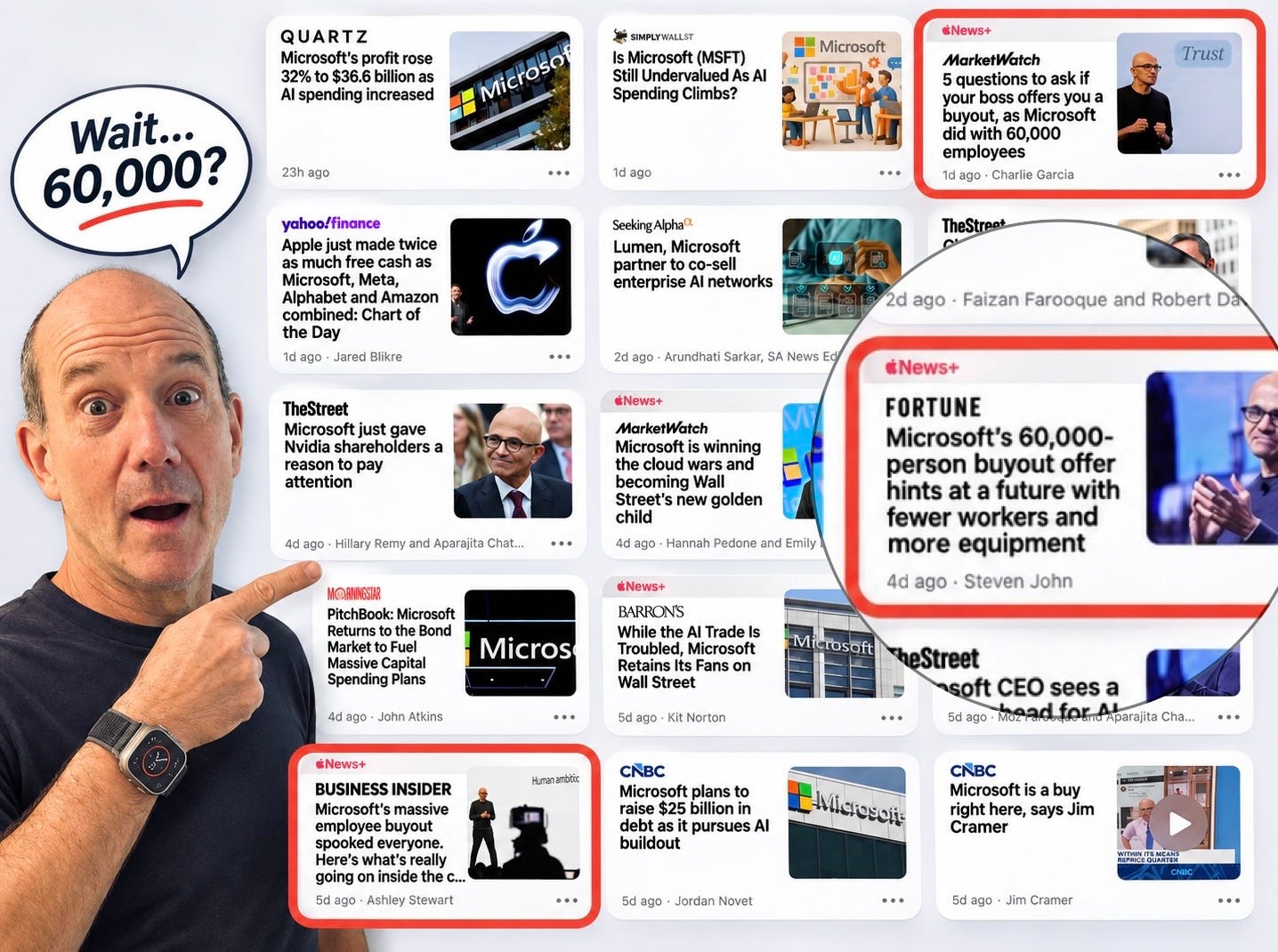
On October 26, Microsoft told employees about a Voluntary Exit Offer. It covers about 60,000 people, more than a quarter of the company, across the US, UK, Canada, and India. Everyone eligible has until early December to decide. Anyone who says yes leaves on December 31.
The headlines show how people are reading it. Fortune says it points to “a future with fewer workers and more equipment.” Business Insider reported that it “spooked everyone.” MarketWatch ran a piece on five questions to ask if your boss offers you a buyout.
Microsoft says the offer is about giving people more choice, and a spokesperson said AI isn’t driving it. Some outside observers see it differently. Microsoft spent $115.9 billion on property and equipment last fiscal year, up from $64.6 billion the year before, and one economist told Fortune he expects other big tech firms to follow.
I’m not here to argue about the why. I’m thinking about the people on the other side of the number.
Sixty thousand is a lot of kitchen tables. Behind each one is somebody with a spouse, a mortgage, maybe a kiddo asking why it’s so quiet at dinner, and a decision with a date on it.
And it isn’t only Microsoft. This follows a retirement buyout in April and 4,800 layoffs in July, and Meta and Amazon have announced big cuts of their own this year. Remember the start of 2026?

If you were let go
It hits more than the paycheck. It hits identity, confidence, and your sense of safety.
In sales and tech, a lot of us tie who we are to the title, the number, the team, the badge. When the badge stops working, it can feel like part of you went with it. Then come the bills, the severance dates, the insurance questions, and a blank space where your routine used to be.
That feeling is real. It doesn’t mean you did anything wrong.
If you were offered a way out
A buyout sounds like a gift. For some people, it is, and for a lot of others, it’s a heavy question with a clock on it.
Take it, and you may wonder if you walked away from something good. Stay, and you may wonder if staying is the bigger risk. Nobody can make that decision feel easy.
I can’t tell you what to do. I’m not a financial advisor or a lawyer, so get real advice on the money and the paperwork. Here are three questions worth sitting with:
What am I walking toward, not only away from?
What will staying cost me in energy a year from now?
Who’s one person I trust to tell me the truth?
You don’t need the perfect answer. You need one you can live with, made with a steady head.

If you’re still here
Relief shows up first, then guilt and fear show up right behind it.
The team feels quieter and the meetings feel different. Buyers answer slower. And every leadership update makes your stomach tighten, and a small voice keeps asking, “Am I next?”
Plenty of people are sitting in that right now, smiling on camera.
If you’re leading through it
You’re expected to communicate clearly, keep people focused, protect revenue, and stay calm, while you’re shaken too. A layoff isn’t a line on a spreadsheet. It’s sleepless nights and pressure from every direction. It’s real people.
Subscribe to get first access to new content.
I’ve been in your shoes
I’ve been through this six times. 1997. 2000. 2001. 2008. 2020. And again in 2024. Those were my unplanned exit dates, and what led up to most of them were the rolling reductions in workforce. Heck, I would have been better off financially to have been let go in 2023 when the payouts were generous. In 2024, they were making up reasons so they didn’t have to pay upon termination or they’d offer the “standard two weeks” pay.
There’s a moment after the news lands when everything goes quiet. You replay the conversations. You question your value. You think about your family, your mortgage, your reputation.
For the first five, I didn’t have the tools yet. In 2023, I did something I’d never done. I paid out of my own pocket to train my mind the way I’d trained my body, to handle stress, self-doubt, and uncertainty with a steadier head.
So when the last layoff came in February 2024, it still hurt. But I didn’t spiral. I didn’t lose myself. I paused. I got clear. I reached out. I looked after my energy. Then I took one step.
That’s the difference I want to share with you.
Slow down before you answer
Stress makes everything move fast. It pushes you to apply to every open role, check LinkedIn every ten minutes, and turn a quiet buyer into a story about you.
Pause before you react and spot the thought running the show: “I’m behind.” “I’ll never match that income.” “My pipeline is doomed.”
Then ask for facts. Write down what you need this week (income, health coverage, family, rest) and what you want in the long run. Keep the list on paper, not in your head.
Big decisions can wait a few days.
Reach out before you pull away
When it hurts, hiding feels safer. Waiting for a perfect update feels smarter and handling it alone feels stronger, but it’s often the wrong move driven by embarrassment, like you’ve done something wrong or you personally failed. That’s not the case.
Send one message anyway. Try something like: “My role was impacted. I’m taking a little time to get clear on what’s next. I’d value your perspective.”
Check in on a former teammate. Offer help to someone who has it worse than you. Your next opening will most likely come through a person, not a post.
Look after your energy
Walk every day, even ten minutes. Eat a real meal and keep a steady sleep routine. Put your phone in another room for a while and mute the feeds that spike your fear.
It’s the one thing that gives back more when you spend it on yourself.
If you lead a team
Your people are listening for the truth. Tell them what you know. Tell them what you can’t share yet. Keep your meeting rhythm steady and your priorities simple.
Then make room for how they feel. “I know this has been a hard week.” “What’s unclear right now?” “What do you need to do your best work?”
People don’t need you to be perfect. They need you to be there and to follow through.
If you sell
Quota stays. Territories shift. Support shrinks. Every slipped deal can feel personal.
Your buyers are feeling it too: cuts, budget pressure, fear inside their own walls. If you sell into Microsoft or companies like it, your buyer may be wondering about their own seat, and that shapes every call. Selling from panic pushes people away. Selling from a steady place helps them think.
Start each day with the few accounts that need real attention. Ask better questions. Follow through fast. Your pipeline matters, and so does how you’re holding up while you work it.
A simple first week
Day 1. Rest and gather the facts. Severance, benefits, key dates.
Day 2. Write what matters most right now. Pick three priorities.
Day 3. Message a few people you trust.
Day 4. Refresh your resume and profile, in plain, human words.
Day 5. Book two real conversations. Listen for leads.
Day 6. Walk, sleep, eat well, turn down the noise.
Day 7. Write down what you learned. Choose three actions for next week.
You don’t need a perfect plan. You need a few steady steps.
You’re not behind
You don’t bounce back from something like this. You bounce forward.
Rebuilding isn’t a race; it has a rhythm. It starts with a pause to understand what happened. Then take one step that fits who you want to be next. The change isn’t slowing down, so adjusting is a skill worth practicing. Start with one step.
I learned that while launching a business, raising six kids (the last off to college), and supporting aging parents, all at the same time. I still lost my footing some days. I didn’t lose myself.
If layoffs have touched your life, I truly feel for you and your family. I know how much it hurts. I also know you have more strength than this moment is letting you feel.
Simple, not easy
Getting through a layoff doesn’t take a new system. It takes one honest step at a time.
A few questions to sit with for a minute:
Who’s one person you could message today?
Which is louder right now, the worry about money or the worry about who you are without the title?
What’s one thing you can do in the next ten minutes to look after your energy?
What should I do first after a layoff? Slow down before you act. Give yourself a day or two, tell one trusted person, and write down what matters most right now. Big decisions can wait.
Is it normal to feel anxious after surviving a layoff? Yes. Relief, guilt, and fear often show up together. It’s common, and it doesn’t mean something is wrong with you.
Related and recommended reading

How do I lead my team after layoffs? Be present before you’re polished. Say what you know, say what you don’t, and check in one-on-one. Presence and follow-through matter more than perfect words.
Should I take a voluntary buyout? There’s no one right answer. Get advice from a financial advisor and, if you need it, a lawyer, on the money and the paperwork. Then ask what you’re walking toward, not only what you’re leaving, and use the time you have before the deadline.
If something here sounds like you, message me.
Sources
OPB: Microsoft offers voluntary buyouts to a quarter of its workforce (Oct 27, 2026)
KUOW: Microsoft offers voluntary buyouts to a quarter of its workforce (Oct 26, 2026)
Fox Business: Microsoft offers voluntary buyouts to 60,000 employees (Oct 28, 2026)
Fortune: Microsoft offers buyouts to nearly 30% of workforce in ongoing AI shift (Oct 26, 2026)
UC Today: Microsoft offers first-ever voluntary buyout (Apr 27, 2026)
Your turn. I’d love to hear from you.
Which hits tech teams harder right now: the layoff itself, or the wait to see who’s next?
Where is it showing up most on your team: quieter meetings, slower buyers, or heavier workloads?
What’s one thing you did in your first week after a layoff that helped?