


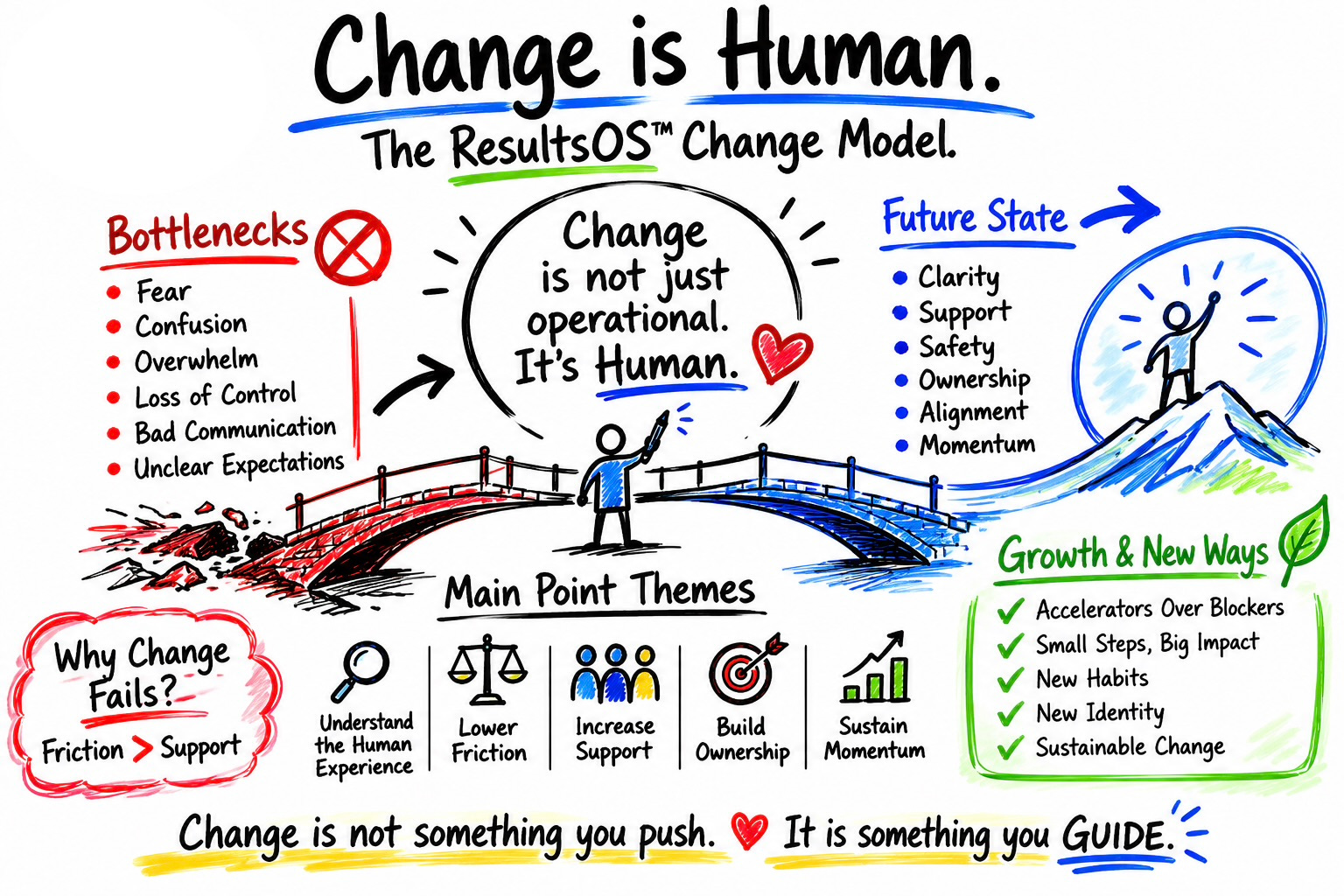
The human side of change is the emotional and behavioral part of change. It includes fear, uncertainty, habits, identity, trust, and the need for safety. Change succeeds when leaders reduce friction, increase support, create clarity, and help people take small steps forward. This is a practical guide for founders, people leaders, and high-performance teams. And a comprehensive, instructional guide for founders, leaders, and high-performance teams.
PART 1 — The Human Truth of Change
What Change Really Is
Change is not simply the adoption of a new system or process. It is the emotional and behavioral journey individuals make when moving from what they know to what is unfamiliar. Even when change is positive, it disrupts comfort, predictability, and identity. When leaders treat change as purely operational, they overlook the internal shifts required for people to adapt successfully.
Change asks people to leave behind the familiar version of themselves. It challenges old habits, rewrites internal stories, and demands new ways of thinking and working. This internal transition—far more than any structural adjustment—is what makes change difficult.
Successful change management recognizes this truth: people don’t resist change, they resist the loss that change represents.
Most people think of change as plans, timelines, and strategies.
But change isn’t logical. Change is human. It’s emotional. It’s uncertain. It’s messy.
And it always costs something:
time
energy
identity
comfort
control
Change is the process of shifting behavior in the presence of uncertainty.
And people don’t resist change itself. They resist losing what’s familiar.
Simple takeaways:
• Change = human patterns shifting under pressure
• Fear, not logic, drives resistance
• People want clarity, control, and safety
Why Change Fails
Most change initiatives fail not because the strategy is flawed but because the human experience is overlooked. When friction outweighs support, people withdraw, delay, or push back.
Common sources of friction:
Confusion about the purpose
Fear of losing competence or status
Overwhelm from competing priorities
Lack of clarity around expectations
Emotional fatigue from past failed changes
Unclear or inconsistent communication
Sources of support:
Psychological safety
Clear and repeated communication
Empathy and acknowledgment
Accessible training
Small early wins
Consistent rhythms and expectations
When leaders balance friction and support effectively, change becomes possible. When they don’t, change stalls.
Change fails when friction > support.
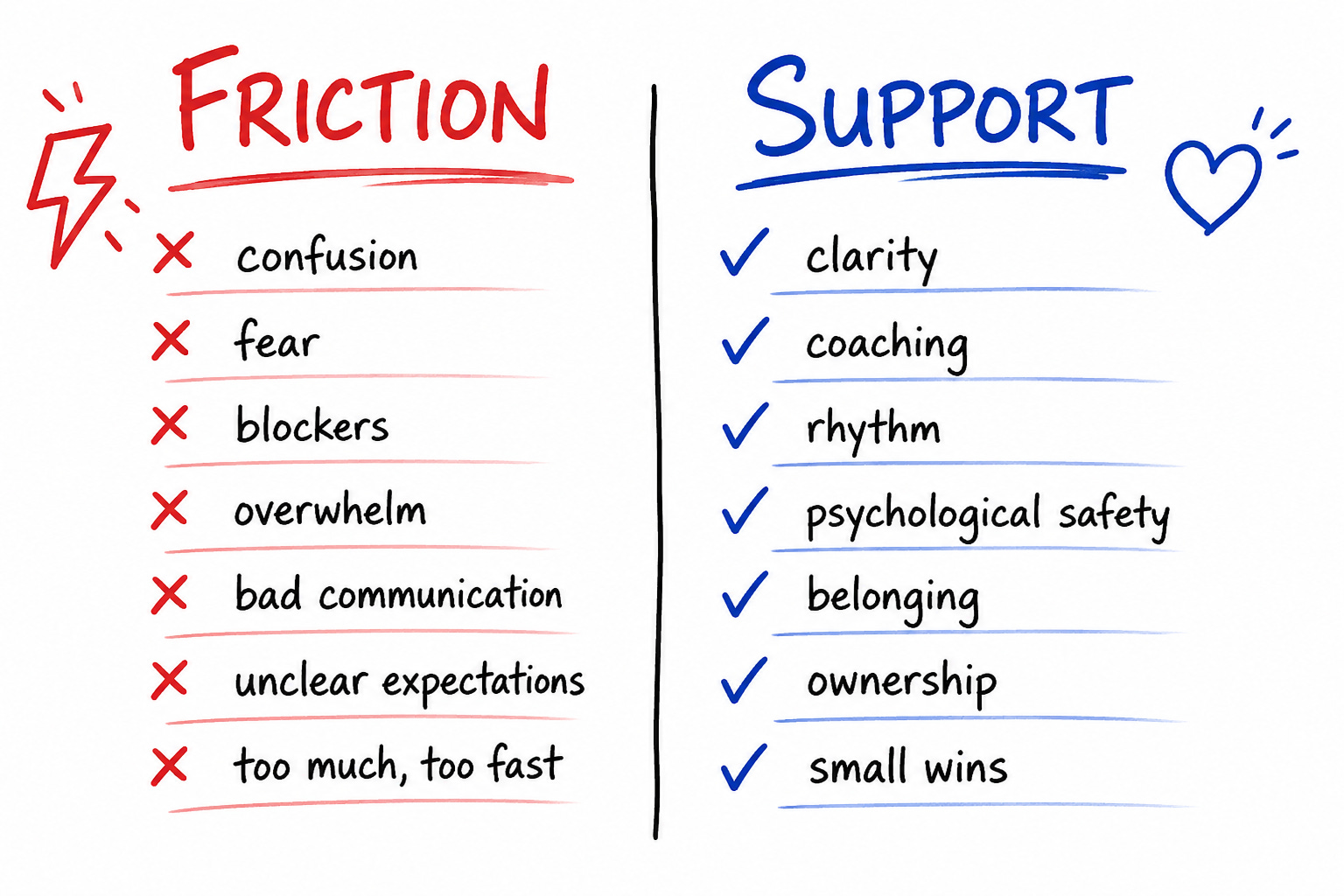
When friction rises and support doesn’t match it, people stop moving.
Simple takeaways:
• Lower friction
• Increase support
• Make next steps safe and simple
Human Change vs Organizational Change
There are two distinct layers of change operating simultaneously:
Organizational Change
This involves restructuring processes, systems, and workflows. It includes strategy development, project planning, resource allocation, KPIs, and timelines. It is logical and technical.
Human Change
This involves navigating emotion, uncertainty, habit formation, self-confidence, and identity shifts. It requires empathy, communication, psychological safety, and support for the internal experience of transition. It is unpredictable and relational.
Many organizations design detailed plans for organizational change but leave the human side to chance. Yet it is the human layer that determines whether the plan succeeds.
When the human system doesn’t adapt, the organizational system breaks.
There are two tracks running at the same time.
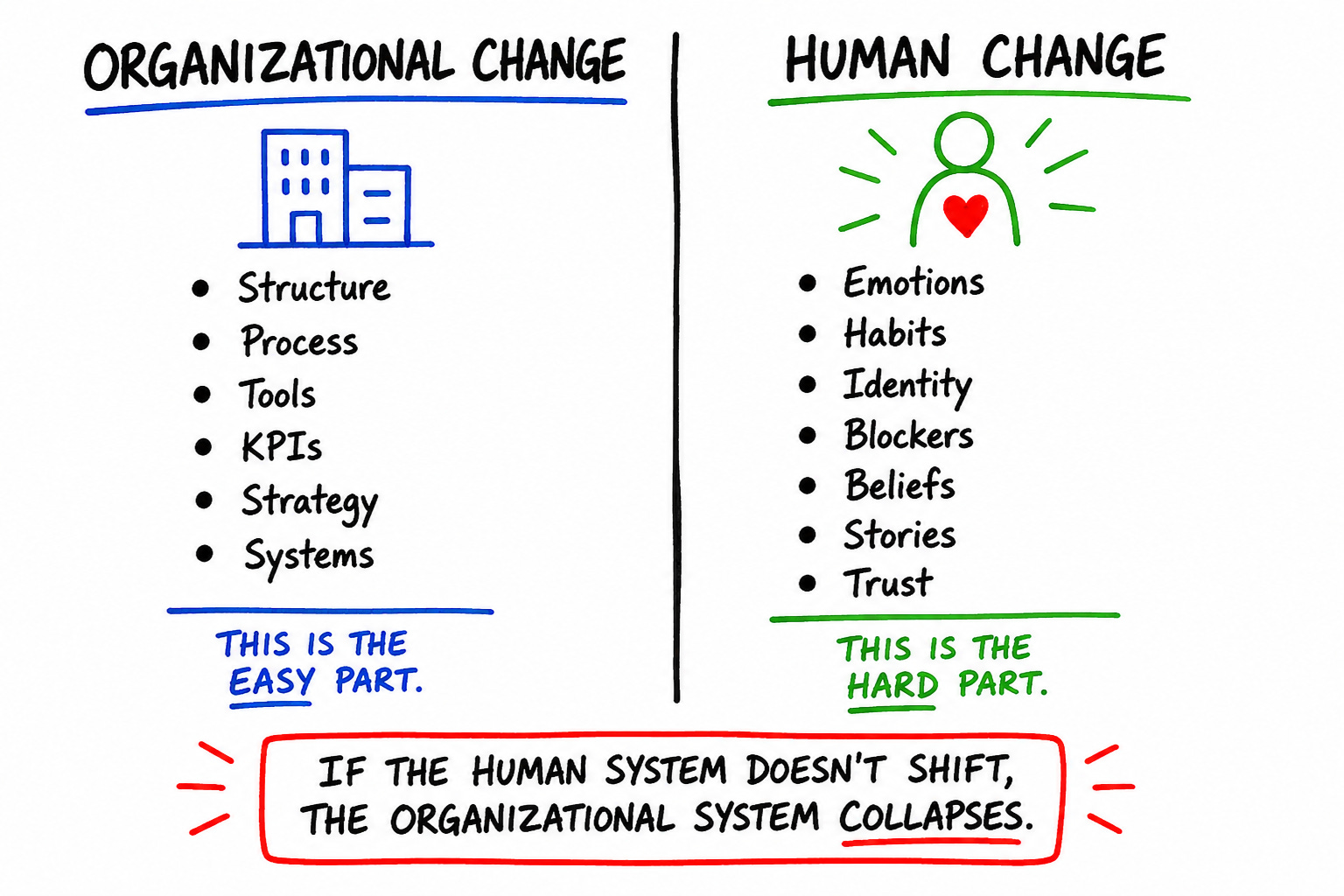
This is the hard part — and the part most leaders ignore.
Reality:
If the human system doesn’t shift, the organizational system collapses.
The Four Types of Change
Understanding the nature of the change helps leaders anticipate emotional reactions and guide people through transitions more effectively.
Shock Change
Sudden, unexpected, disruptive.
Examples: include layoffs, crises, or urgent pivots.
These require stabilization, reassurance, and clarity.
Evolutionary Change
Slow, gradual, habit-based.
Examples: include culture transformation or new behavioral expectations.
These require consistent reinforcement and ongoing support.
Strategic Change
Intentional, planned, structural.
Examples: include new business models, reorganizations, or new products.
These require alignment, communication, and disciplined execution.
Personal Change
Identity-based shifts within individuals.
Examples: include leadership growth, emotional regulation, new self-command, or changes in mindset.These require coaching, practice, and compassionate accountability.
Each type of change carries a different emotional load
and requires a different leadership approach.
1. Shock Change
Fast. Forced. Emotional.
Restructures, emergencies, market shifts.
2. Evolutionary Change
Slow. Gradual. Habit-based.
Culture shifts, new expectations, behavioral changes.
3. Strategic Change
Planned. Intentional. High impact.
New products, organizational redesigns, GTM changes.
4. Personal Change
Identity-level work.
New behaviors, self-command, personal growth.
Simple takeaway:
Every type of change has a different emotional load. Leaders must adjust accordingly.
The Psychology of Change
Humans respond to change through two internal systems:
Blockers
These are instinctive survival patterns that produce fear, avoidance, control, perfectionism, overthinking, or resentment. Blockers amplify emotional friction and derail progress. Blockers drain us.
Accelerators
These are higher-mind capacities such as empathy, creativity, calm focus, possibility-thinking, and purposeful action. Accelerators reduce friction and help people move forward. Accelerators charge us up!
The purpose of ResultsOS™ and Positive Intelligence is simple:
Reduce Blockers. Strengthen Accelerators. Create consistent progress.
Every human has two internal forces during change:
1. Drainers and Blockers (survival brain)
protect comfort
resist uncertainty
create friction
slow adoption
amplify fear
2. Chargers and Accelerators (higher thinking)
increase clarity
create calm
open possibility
generate resilience
produce forward movement
The game is simple: Less blockers. More accelerators.
And that’s where we turn next.
PART 2 — The ResultsOS™ Change Framework
GREAT: The Clarity Engine
Effective change begins with clarity. The GREAT Framework provides a structured way to understand what matters most at every stage:
Growth & Gratitude – What’s improving? What are we appreciating?
Relationships – Who’s impacted? Who do we need to support?
Energy – What’s fueling us or draining us?
Aspiration – What are we aiming toward? What is the future identity?
Time – What deserves our time and what must be filtered out?
Clarity reduces uncertainty, uncertainty reduces fear, and reduced fear opens the path for progress. All change, especially great change, starts with clarity.
GREAT helps leaders and teams answer:
G – What’s growing?
R – Who are we impacting?
E – What’s fueling us?
A – What are we aiming toward?
T – What matters most today?
Change clarity questions:
What’s the real WHY?
What problem are we solving?
What does “great” look like?
Who becomes who in this new version?
Fear reduces performance. Clarity reduces fear.
FASTER: The Execution Engine
Once clarity is established, execution becomes the primary driver of change.
FASTER creates predictable, sustainable forward motion:
Focus – What matters most today?
Aligned Action – Does this action match our desired future?
Strategic Step – What is the smallest, smartest next step?
Target + Timebox – What will be done and by when?
Essential + Energy – Do less, better. Maintain energy for execution.
Review → Realign → Refocus – Measure, adjust, continue.
Change is not built in leaps but in consistent small steps.
Once clarity is set, we move into execution.
FASTER builds:
• focus
• accountability/ownership
• simple steps
• aligned action
• realistic targets
• sustainable rhythms
• consistent review
Change succeeds when teams execute
the smallest meaningful step on repeat.
OPPS: The Structure Engine
The OPPS Framework supports change by aligning:
Outcomes – What success looks like
People – Roles, responsibilities, expectations
Processes – How work flows, how decisions are made
Systems – Tools, support, and operational rhythm
Clear structure reduces friction, confusion, and misalignment during change.
OPPS aligns:
• outcomes
• people
• processes
• systems
This ensures the change can scale and stick — not collapse when pressure rises.
How GREAT + FASTER + OPPS
Drive Change Together
A complete change model requires:
Clarity (GREAT)
Action (FASTER)
Structure (OPPS)
Change begins with understanding, gains traction through execution, and becomes sustainable through structure and identity.
You start with clarity (GREAT).
You move with action (FASTER).
You lock it in with structure (OPPS).
This is the full ResultsOS™ change engine.
PART 3 — The Human Side of Change
The 10 Internal Blockers
Change activates predictable internal patterns. The table below summarizes how each Blocker affects leaders and participants, with translation and signals to watch for.
Change isn’t just operational. It’s emotional. And each person brings their own blockers to the table, including the leader.
These blockers aren’t personality flaws.
They’re survival patterns.
Patterns that create friction.
And remember:
Change fails when friction > support.
Here’s how each blocker impacts change from both sides – change leader and participant – plus the translation and the signals to watch for.
Judge
Change Leader: Lowers confidence; kills optimism; creates backlash.
Participant: Self-blame; blame of others; stalls progress.
Translation: The Judge drains energy. No energy = no change.
Watch for: criticism, harsh self-talk, comparison loops, fault-finding.
Avoider
Change Leader: Delays tough conversations; buries risks; slows execution.
Participant: Quiet resistance; disengagement; avoids conflict.
Translation: Avoidance keeps problems underground.
Watch for: silence, hiding issues, passive agreement, missed commitments.
Controller
Change Leader: Pushes instead of inspires; limits ownership; creates fear.
Participant: Resists anything that reduces autonomy or control.
Translation: Control creates fear; fear creates resistance.
Watch for: micromanaging, tension, over-directing, lack of trust.
Hyper-Achiever
Change Leader: Makes change about personal validation; over-focuses on performance.
Participant: Supports change only if it advances their interests.
Translation: Achievement without alignment breaks trust.
Watch for: burnout, one-upmanship, pushing pace too fast.
Hyper-Rational
Change Leader: Over-indexes on logic; under-indexes on inspiration.
Participant: Won’t move until everything is known; analysis paralysis.
Translation: Change requires belief, not certainty.
Watch for: debate loops, heavy data requests, “prove it first” thinking.
Hyper-Vigilant
Change Leader: Sees every risk; amplifies fear; kills momentum.
Participant: Overthinks everything; hesitant even with clear direction.
Translation: Overwhelm = paralysis.
Watch for:anxiety, worst-case scenarios, hesitation, checking everything twice.
Stickler
Change Leader: Gets stuck in details; slows progress; blocks creativity.
Participant: Needs perfect structure; gets anxious with ambiguity.
Translation: Perfection slows adoption.
Watch for:nitpicking, rigid rules, bottlenecks, slowing decisions.
Pleaser
Change Leader: Avoids discomfort; softens truth; protects feelings over progress.
Participant: Weak boundaries; over-commits; burns out.
Translation: No boundaries = no progress.
Watch for: saying yes too quickly, people-pleasing, unclear expectations.
Restless
Change Leader: Moves on too fast; doesn’t maintain momentum; derails focus.
Participant: Jumps to the next idea; struggles with sustained effort.
Translation: Restlessness breaks the flywheel.
Watch for: inconsistency, distractions, abandoned initiatives.
Victim
Change Leader: Low hope; low belief; drags team morale down.
Participant: Sees change as loss; feels powerless; resists new identity.
Translation: Hopelessness spreads like smoke.
Watch for: negative framing, “why bother”, pessimism, resignation.
How Blockers Show Up at Each Stage of Change
Emotional patterns arise in predictable sequences:
Early stages:
Judge, Hyper-Rational, Avoider → questioning, hesitating, down-playing the need for change.
Middle stages:
Stickler, Controller → tension around details, process, and control.
Action stages:
Restless, Hyper-Vigilant → inconsistency or overthinking.
Late stages:
Pleaser, Victim → fatigue, withdrawal, loss of confidence.
Understanding these patterns helps leaders anticipate friction and guide people compassionately through resistance.
These blockers don’t appear all at once.
They show up in predictable patterns.
Awareness Stage
Judge → “Why are we even doing this?”
Hyper-Rational → “Prove it.”
Avoider → silent resistance.
Understanding Stage
Stickler → wants more details or the perfect plan.
Controller → wants to dictate the plan or their way.
Agreement Stage
Victim → “This won’t work for me.”
Pleaser → agrees publicly, resists quietly.
Action Stage
Restless → all-in and then all out; quickly jumps off too early.
Hyper-Vigilant → slows the group, “what if this or that or the other thing happens”.
Ability/Consistency Stage
Hyper-Achiever → burns out.
Avoider → hides failure.
Understanding these patterns helps leaders anticipate friction and guide people compassionately through resistance.
Coaching Through Each Blocker
Each Blocker requires a different leadership response:
Judge → empathy + reframing
Avoider → safety + small steps
Controller → shared ownership
Stickler → “good enough” standards (80/20 rule)
Hyper-Achiever → sustainable pacing + aligned action
Hyper-Rational → emotional clarity
Hyper-Vigilant → boundaries for risk
Pleaser → boundaries + honest conversations
Restless → consistent + structured rhythm
Victim → personal agency + small wins
Coaching through Blockers is essential to
ResultsOS™ change leadership
PART 4 — The Step Changes Applied
Empathy
Empathy acknowledges the emotional cost of change. People need to feel seen and understood before they can adapt. Empathy does not equal agreement; it is simply recognition of impact.
Change leaders use empathy to create psychological safety and reduce resistance.
💡 Understand the emotions underneath the resistance.
Change Leaders do this by:
listening
acknowledging feelings
validating impact
honoring the old guard
Curiosity
This step involves surfacing concerns, assumptions, fears, and unspoken objections. Change leaders who explore openly allow hidden resistance to emerge, preventing it from festering or becoming passive sabotage.
Exploration reveals what people are worried about losing and what support they need to move forward.
💡 Map the real reasons people resist.
Change Leaders ask:
“What feels unclear?”
“What are you worried you’ll lose?”
“What don’t we see yet?”
Co-create and Collaborate
Once fears and concerns are understood, change leaders help design new possibilities. Innovation during change is not about creativity for its own sake; it’s about finding ways to reduce friction, simplify the path, and build early wins.
💡 Design new ways to support people through discomfort.
Examples:
lighter workloads
clearer expectations
step-by-step guides
better support systems
Perspective
Perspective reconnects people to purpose. It ensures everyone understands the “why,” the desired future state, and the benefits of moving forward. This step re-anchors motivation and strengthens commitment.
💡 Reconnect people to the bigger picture.
Change Leaders:
tell the story
anchor the WHY
personalize the meaning
Belief drives behavior.
Aligned-Action
Action creates momentum. Aligned-Action creates forward progress faster. It’s about setting clear expectations, timeboxes, and targets—while offering consistent feedback and encouragement.
Aligned-Action is where change becomes embodied through repetition, practice, and small wins.
💡 Create the action rhythm.
Change Leaders:
set targets
timebox work
celebrate small wins
build consistency
PART 5 — The 5 Strategies of Change Management
Inspire the Bigger WHY
People seldom take action because of tasks. They take action because they buy into a story about the future, about improvement, or about who they can become.
People don’t move because of tasks.
They move because of meaning.
Connect the Individual WHY
Change accelerates when people see personal value. Leaders show how the change improves the individual’s work, growth, or wellbeing.
Change sticks when people say: “This matters to me.”
Present the Big-Picture Architecture
Without an overview, people fill gaps with fear. A simple architecture creates clarity, direction, and safety.
Uncertainty creates fear. Architecture reduces it.
Use the Flywheel Effect
Small, consistent wins build confidence and make larger changes possible. The flywheel principle ensures momentum becomes self-reinforcing.
Small wins create confidence.
Confidence creates momentum.
Momentum sustains change.
Leverage the Change Adoption Cycle
Different groups adopt change at different speeds. Leaders adapt communication and support accordingly.
Innovators → early belief
Early adopters → energize majority
Early majority → stabilize change
Late majority → need proof
Laggards → need safety
💡 Each group needs a different message and a different pace.
PART 6 — The Change Journey
The 7 Stages of Human Change
All change follows a psychological sequence:
Awareness
Understanding
Agreement
Action
Ability
Consistency
Identity
Identity is the final stage.
The moment the change becomes part of who a person is.
What People Feel at Each Stage
Awareness → curiosity, skepticism, fear
Understanding → uncertainty, questions
Agreement → tension, conflict
Action → discomfort, self-doubt
Ability → increasing confidence
Consistency → momentum, pride
Identity → ownership, belief
Change Leader Responsibilities at Each Stage
Awareness → explain
Understanding → listen + clarify
Agreement → align
Action → support
Ability → coach
Consistency → reinforce
Identity → celebrate
PART 7 — Making Change Stick
Small Steps & Consistency
Consistency, not intensity, creates transformation.
Sustainable rhythms outperform heroic efforts.
Simplicity beats complexity.
Identity Shift
Lasting change emerges when people see themselves differently. Leaders reinforce identity-based progress through recognition and storytelling.
“You become the person who…”
This is the end goal of all change.
Reinforcement & Celebration
Celebrating early wins creates emotional traction. Reinforcing progress anchors new habits and builds confidence. Small wins matter. They create emotional traction.
Metrics, Traction Signals & Red Flags
Traction signals:
improved clarity
better collaboration
consistent execution
visible progress
confidence
Red flags:
silence
confusion
avoidance
fatigue
increasing friction
Communication Rhythm & Cadence
A predictable rhythm of updates reduces anxiety and strengthens alignment. Weekly cadence keeps people informed, engaged, and supported.
💡 Weekly rhythm = clarity, alignment, energy.
PART 8 — Application & Examples
Three Change Scenarios (WIP)
Included as narrative examples customized to ResultsOS engagements.
Leader Playbook (WIP)
Simple rules.
Clear steps.
Consistent rhythms.
Team Playbook (WIP)
How to show up.
How to contribute.
How to sustain.
PART 9 — ResultsOS™ Change Checklists
A comprehensive suite of checklists leaders can use before, during, and after any change initiative.
Implementation Checklist
Exact steps to launch a change initiative.
PRE-CHANGE READINESS CHECKLIST
Clarity
✔ Have we defined the WHY clearly and simply?
✔ Can everyone explain the purpose in one sentence?
✔ Do we know what “better” (GREAT) looks like?
✔ Is the future state visualized or described tangibly?
Alignment
✔ Have we identified who will be impacted?
✔ Are roles and responsibilities defined?
✔ Do leaders agree on messaging and expectations?
Emotional Landscape
✔ Do we know which Blockers/Barriers/Friction are likely to show up?
✔ Have we prepared empathy-based conversations?
✔ Have we acknowledged what people may feel they’re losing?
Resources
✔ Do people have time, tools, and training?
✔ Have we removed unnecessary friction?
✔ Are we avoiding change stacking (multiple initiatives at once)?
DURING-CHANGE EXECUTION CHECKLIST
Communication
✔ Are we repeating the WHY consistently?
✔ Are we listening more than we are talking?
✔ Are updates predictable and scheduled?
Support
✔ Are we coaching through Blockers in real time?
✔ Are we catching confusion early?
✔ Are we celebrating small wins weekly?
Momentum
✔ Are people making small Strategic Steps?
✔ Are we timeboxing tasks to reduce overwhelm?
✔ Are we tracking progress visibly?
Psychological Safety
✔ Can people share concerns without judgment?
✔ Are we normalizing discomfort?
✔ Are we honoring losses while reinforcing gains?
POST-CHANGE INTEGRATION CHECKLIST
Reflection
✔ What worked well?
✔ What didn’t?
✔ What surprised us?
✔ What needs to be refined?
Identity Shift
✔ Are people becoming the new version of themselves?
✔ Are leaders modeling the new identity?
✔ Are old habits being replaced or resurfacing?
Reinforcement
✔ Are new rhythms consistently followed?
✔ Are we telling stories of success?
✔ Are we recognizing individuals who embody the new way?
Sustainability
✔ Are systems updated to support the change?
✔ Are responsibilities clear and stable?
✔ Has the change been embedded into OPPS?
Daily & Weekly Rhythms Checklists
Short rituals that anchor momentum and make change stick.
Change doesn’t hold without rhythm.
Rhythm creates safety.
Rhythm builds confidence.
Rhythm turns new behaviors into habits and habits into identity.
The following rituals are designed to support leaders and teams through the uncertainty of change by giving them predictable anchors they can trust.
DAILY RHYTHMS
Short, simple, repeatable actions that reduce friction and keep people grounded.
Daily Rhythm #1 — The “30-Second Why Reset”
Every morning, leaders restate the purpose of the change in one clear sentence.
Checklist:
✔ Repeat the WHY to yourself
✔ Repeat it to your team if relevant
✔ Anchor everyone to what matters today
This ritual strengthens clarity and lowers anxiety.
Daily Rhythm #2 — The Strategic Step Check-in
People don’t move because of giant tasks.
They move because of one meaningful step taken consistently.
Checklist:
✔ Identify the smallest next step
✔ Timebox it (15–30 minutes max)
✔ Celebrate completion internally or with the team
This ritual fuels momentum without overwhelm.
Daily Rhythm #3 — Blocker Awareness Scan
Spend one minute noticing emotional patterns.
Checklist:
✔ What blocker is active right now?
✔ Is it showing up in your energy, focus, or interactions?
✔ What simple shift (PQ rep, breath, reframing) can reduce friction?
This ritual reduces reactivity and increases self-command.
Daily Rhythm #4 — The “What’s Needed Now?” Check
Instead of reacting to everything, leaders pause and recalibrate.
Checklist:
✔ What is the single most important thing right now?
✔ What needs my attention?
✔ What can wait?
✔ What can be delegated?
This ritual reduces chaos and preserves energy.
Daily Rhythm #5 — Micro-Recognition
Every day, acknowledge one small win or one person who moved the change forward.
Checklist:
✔ Who made progress today?
✔ Who showed resilience or openness?
✔ Who modeled the new behavior?
This ritual reinforces identity and accelerates buy-in.
WEEKLY RHYTHMS
These create the structure, safety, and accountability needed for change to take root.
Weekly Rhythm #1 — The Alignment Meeting
A consistent, predictable touchpoint brings clarity and stability.
Checklist:
✔ Review progress with the team
✔ Reinforce the WHY and future state
✔ Clarify priorities for the upcoming week
✔ Identify friction early
✔ Adjust expectations and resources
This ritual keeps everyone rowing in the same direction.
Weekly Rhythm #2 — The Blocker Debrief
A team-level scan to identify emotional resistance.
Checklist:
✔ What blockers showed up last week?
✔ Where did we lose momentum?
✔ What created confusion or overwhelm?
✔ How can we reduce friction for next week?
This ritual creates psychological safety and reduces silence-based resistance.
Weekly Rhythm #3 — Review → Realign → Refocus (FASTER Loop)
This is the FASTER system’s built-in engine for sustainable execution.
Checklist:
✔ REVIEW: What worked? What didn’t?
✔ REALIGN: What needs to shift?
✔ REFOCUS: What’s the next strategic step?
This ritual builds adaptability and resilience.
Weekly Rhythm #4 — Leader Reflection
Change rises or falls based on leadership consistency.
Checklist:
✔ Did I model the desired behavior this week?
✔ Did I communicate clearly and consistently?
✔ Did I reduce friction or add to it?
✔ Did I support my team emotionally and practically?
✔ What will I commit to improving next week?
This ritual strengthens leadership identity.
Weekly Rhythm #5 — Celebrate the Wins
Celebration isn’t fluff — it’s fuel.
Checklist:
✔ Recognize small wins publicly
✔ Share stories that reinforce identity
✔ Highlight personal growth
✔ Anchor the team to the progress being made
This ritual builds pride, commitment, and belief.
OPTIONAL BI-WEEKLY / MONTHLY RHYTHMS
For longer or more complex change initiatives.
Monthly Rhythm — The Change Health Check
An intentional moment to step back and assess:
Checklist:
✔ Are we still aligned on the WHY?
✔ Is the pace sustainable?
✔ Have new blockers emerged?
✔ Are we celebrating enough?
✔ What identity shifts are we noticing?
This ritual helps recalibrate the entire change initiative.
WHY THESE RHYTHMS MATTER
Rhythms create:
safety
predictability
clarity
confidence
momentum
psychological stability
identity reinforcement
Without rhythm, people default to old patterns.
With rhythm, change becomes the new normal.
Blocker Spotting Checklist
A quick scan tool for leaders.
Leader Blockers
✔ Do I feel the need to control?
✔ Am I avoiding tough conversations?
✔ Am I judging myself or others harshly?
✔ Am I rushing, overthinking, or stuck in perfection?
Team Blockers
✔ Are people silent?
✔ Are people overwhelmed?
✔ Are people resisting indirectly?
✔ Are people losing focus or withdrawing?
Action
✔ Identify the Blocker
✔ Name it
✔ Normalize it
✔ Coach it - with ABC + NBC
📍 ABC = Always Be Coaching the ABCs
👉 Attitudes, Behaviors and Competencies to support the outcome.
📍 NBC = What is the Next Best Coaching action/step.
PART 10 — Closing & Final Thoughts
The 10 Rules of Leading Change
Lead with clarity
Reduce friction
Honor emotions
Support the dip
Build ownership
Celebrate early
Reinforce often
Model the behavior
Maintain consistency
Anchor identity
Change is not a set of tasks to be managed.
It is a human experience to be led.
When leaders honor emotion, provide clarity, and support sustainable action, change becomes not only possible but transformative.
The ResultsOS™ Change Leader Credo
A declaration for leaders who guide people through meaningful change.
As a ResultsOS Change Leader:
I lead with clarity.
I explain the WHY until everyone can repeat it.
I honor the human experience.
Emotions are not obstacles, they are signals.
I reduce friction.
Confusion, fear, and uncertainty are my responsibility to clear.
I create psychological safety.
People move when they feel safe, supported, and seen.
I don’t rush the journey.
I know that understanding, alignment, and identity take time.
I simplify relentlessly.
Small steps, simple systems, sustainable speed; always.
I hold people accountable with compassion.
Progress requires both support and responsibility.
I celebrate early wins.
Momentum is built, not wished for.
I model the change I wish to see.
My behavior is the loudest signal in the system.
I reinforce what matters most.
Change becomes real when it becomes part of who we are.
This is how I lead.
This is how we change.
This is how we grow, together, FASTER.
Final Thoughts
Change is not a mechanical process. It is a deeply human one. Strategies matter, but psychology determines the outcome. The ResultsOS Change Model integrates emotion, clarity, execution, structure, and identity into one cohesive system that honors how people actually adapt and grow.
When change leaders embrace the human side of change with empathy, clarity, consistency, and structure; progress accelerates, resistance decreases, and transformation becomes both possible and sustainable.
The future belongs to the leaders who understand this truth:
Change is not something you push, it is something you guide.
And now you have the model to do exactly that.
Change doesn’t fail for lack of strategy.
It fails for lack of human understanding.
The ResultsOS Change Model helps you:
lower friction
build clarity
mobilize people
create ownership
sustain momentum
shift identity
Simple systems. Sustainable speed. Less friction. More progress.
Why This Matters
Because change is leadership. And leadership is human.
And when you understand the human side of change
you unlock performance, resilience, and possibility.
Always.
PART 11 — Appendix
Link to the PQ Change Module
Your program includes a deeper dive here:
https://app.positiveintelligence.com/main/modules/65decc1ad144b27237c0360d/sessions/65e1d1bac167ca429e4d556f/steps/65decb3c1ceeadd20087afe1
This module expands the emotional and behavioral side of change.
Other Popular Change Models
(Simple Summaries)
ADKAR
Awareness → Desire → Knowledge → Ability → Reinforcement
(Still the most practical for day-to-day change.)
Kotter’s 8 Steps
Urgency → Coalition → Vision → Communicate → Empower → Short Wins → Consolidate → Anchor
(Great for organizational change.)
Bridges Transition Model
Ending → Neutral Zone → New Beginning
(Change succeeds by managing transitions, not tasks.)
Lewin’s Model
Unfreeze → Change → Refreeze
(Simple and timeless.)
Change Management
What it is: Helping people move from today to tomorrow without blowing things up.
Core idea: People don’t resist change. They resist uncertainty, loss, overwhelm, and bad leadership.
The 5 Truths of Change
• Change is emotional.
• Change is messy.
• Change is slower than you think.
• Change fails without trust.
• Change sticks when people feel ownership.
What Makes Change Hard
• Loss of control
• Fear of failure
• Increased workload
• Threat to identity
• Unclear “why”
• No support system
• Old habits pulling you back
• Leaders who announce instead of engage
• Teams who don’t feel heard
• Overly complicated plans
The Simple Math of Change
Change = (Vision + Pain + Clarity + Support) – Friction
If friction > motivation… change dies.
The 6 Components of Effective Change
1. Case for Change
• What’s broken?
• Why now?
• What happens if we don’t?
• What’s the upside?
Clear. Short. Human.
2. Future State
• What we’re building
• How it improves work/life/opps/outcomes.
• What “better” looks like, or in our case What GREAT looks like!
If people can’t see it, they won’t move.
3. Plan
• Small steps
• Simple roadmap
• Timelines
• Owners
• Milestones
• Feedback loops
Planning is about reducing uncertainty, not predicting the future.
4. People
• Who’s impacted
• Who needs support
• Who needs clarity
• Who needs new skills
• Who will resist (and why)
Change is social.
Ignore people… lose the change.
5. Communication
• Early
• Often
• Honest
• Two-way
• Human
Silence creates fear. Fear kills momentum.
6. Enablement and Empowerment
• Tools
• Training
• Coaching
• Resources
• Time
Behavior changes when support exists.
The Human Side
(The Part Most Orgs Mess Up)
Identity
People ask: “Who am I in this new world?”
Safety
“Can I handle this?”
Belonging
“Are we in this together?”
Control
“Do I get a say?”
If change leaders ignore these… people resist even good changes.
The 3 Forces That Drive Every Change
1. Push (pain)
Something hurts. Needs fixing.
2. Pull (possibility)
Something better is calling.
3. Pressure
External forces say “move.”
Change works best when push + pull are balanced.
The Change Curve
(Real Life, Not Theory)
Shock
Denial
Frustration
Overwhelm
Experiment
Hope
Rebuild
Integration
You don’t skip steps. You guide people through them.
Recommended Reading:

The Four Types of Change
1. Shock Change
Fast. Forced. Messy.
(Restructures, layoffs, emergencies.)
2. Evolutionary Change
Slow. Gradual.
(Culture shifts, behavioral improvements.)
3. Strategic Change
Planned. Intentional.
(New products, org designs, go-to-market.)
4. Personal Change
Identity-level shifts.
(The real driver of long-term success.)
How Change Actually Sticks
1. Understanding
“This makes sense.”
2. Agreement
“This is the right move.”
3. Ability
“I can do this.”
4. Ownership
“I want this.”
5. Identity
“This is who we are now.”
Identity is the finish line.
The 7 Most Common Failure Patterns
Leaders moving too fast
No clear “why”
People weren’t involved early
Everything rolled out at once
Change on top of change (stacking friction)
No accountability
No consistent follow-through
💡 Most change fails because
middle managers weren’t supported.
They are the true change agents.
THE SIMPLE 10-STEP PLAYBOOK
(Works in business, teams, and personal life)
Define the problem
Define the future state
Build the case for change
Identify stakeholders
Map resistance points
Design small steps
Over-communicate
Train + enable
Support the dip
Reinforce wins + embed identity
Simple. Human. Sticky.
The Mind Shift That Makes Change Work
Clarity
People move when they understand.
Consistency
People move when leaders show up the same way, every day.
Confidence
People move when they feel supported.
Calm
People move when leaders don’t panic.
Change at the individual level
Real change requires:
Awareness
Self-command
New habits
Emotional regulation
Identity shift
Small wins
Support system
Repetition
Review + realignment
💡 This is why behavior change beats goal-setting every time.
Change at the team level
Teams need:
Shared language
Shared targets
Clear expectations
Role clarity
Healthy conflict
Accountability rhythms
Transparency
Psychological safety
💡 If a team can talk honestly… it can change.
Change at the organizational level
The big three:
Strategy
Structure
Systems
But change fails without these:
Culture
Leadership modeling
Communication loops
Change fatigue management
Measuring adoption, not just output
Change Management in 5 Sentences
People want clarity.
People want control.
People want safety.
Change brings uncertainty.
Good leaders remove the uncertainty.
The Simplest Version
Change = New behavior + Less friction + More support
Everything else is details.
Frequently Asked Questions
What is the human side of change?
The human side of change is the emotional and behavioral part of change. It includes fear, uncertainty, identity, trust, habits, and the support people need to adapt.
Why do people resist change?
People often resist the loss, fear, and uncertainty that come with change. They may worry about losing control, status, comfort, confidence, or a familiar way of working.
Why does change fail?
Change often fails when leaders focus only on plans, tools, and timelines while ignoring the human experience. When friction is higher than support, people slow down, pull back, or resist.
How can leaders make change easier?
Leaders can make change easier by creating clarity, listening well, reducing friction, offering support, building trust, and helping people take small, clear steps.
What makes change stick?
Change sticks when people understand it, agree with it, build the ability to do it, take ownership of it, and begin to see it as part of who they are.
What is the ResultsOS Change Model?
The ResultsOS Change Model is a practical framework for leading change through clarity, action, structure, support, and identity. It helps leaders guide the human side of change, not just manage the operational side.
What is the human side of change?
The human side of change is what people feel, fear, believe, and practice as they move from the old way to the new way.
Why is change so hard?
Change is hard because it asks people to leave what feels known and safe. Even good change can create fear, confusion, and stress.
What do people need most during change?
People need clarity, safety, support, trust, simple next steps, and time to build confidence.
What causes change resistance?
Change resistance often comes from fear, loss, overwhelm, poor communication, low trust, unclear expectations, or too much change at once.
How do leaders reduce resistance to change?
Leaders reduce resistance by listening, explaining the why, naming the real concerns, creating simple steps, supporting people, and celebrating progress.
What is the simple formula for change?
Change = new behavior + less friction + more support.
What is the biggest mistake leaders make during change?
The biggest mistake is treating change like a project plan instead of a human experience.