


Picture a rope. Not one lying loose on the ground — one under tension, anchored like a battle rope, waiting.
On one end is the inner critic. On the other, the inner guide. The rope between them never goes fully slack. Most days you can’t feel it — not until one end starts pulling harder than the other.
On one side of that rope is the stuff you should do. On the other, the stuff you actually do. Most days, the rope is just there, tension and all. You may not even notice it.
Until you do. Until the tension turns into a tug of war, and one end starts pulling harder.
Neither end is bad. You need both — a rope with no tension isn’t holding anything at all. The trouble starts when one end pulls harder than the other, day after day. Then you lose ground.
Something is pulling at your progress. Every day. Some of it shows up in the moment. A tough email, a short reply, a decision you keep putting off. Some of it you’re already carrying, before the day even starts.
It never feels like one big event. It feels like losing ground quietly, one inch at a time.
Here’s the part worth remembering: it’s extra, unnecessary tension in the system. It’s a tug of war between the inner critic and the inner guide. And right now, one end just happens to be pulling harder.
That’s what this article is about and how you can regain the upper hand.
Tension Is Normal
Every pull on that rope goes one of two ways — forward, or back. Not good or bad. Just direction.
A kind word to yourself is a pull forward. A promise kept is another. Enough small pulls the same way, and ground gets gained.
A mistake can go either way too. “That didn’t work, let’s adjust” pulls forward. “I always mess this up” is more than a tug or a jerk — that’s the critic hauling hard in the other direction.
That second one rarely stops at one pull. Trust goes next — promises start feeling optional. Standards slip too, quietly, because there’s no strength left over to hold them.
This is normal. It happens to everyone. The rope doesn’t pick sides. Some days the tension is typical. Some days it isn’t. There’s never slack in the rope, and there’s rarely a day the critic fully lets go.
That’s because the critic almost never pulls alone. Old doubts, comparison, judgment, and everyone else’s opinions — more hands join that end all the time, digging in like extra anchors. The pull turns into a jerk. It gets exhausting fast.
That extra tension doesn’t stay hidden, either. It gets harder and harsher while showing up with the people closest to you. Feedback that used to roll off starts landing harder, because there’s no strength left in reserve. Then more negative self talk piles on and pulls you down before anything else can while bracing for the next pull, tug or jerk...
Where the Tension Shows Up
The tension is real. It shows up in expected and unexpected places, every day. Sometimes all at once. Internally. Externally. And the occasional blindside…
Inside, first. Thoughts, feelings, moods — none of them good or bad on their own. The only question is which end of the rope they’re tugging on right now. A mood that won’t settle. A mind replaying the same five minutes. A body already tense before anything’s happened.
It shows up in what doesn’t get finished, too. Loose ends add up, and so does what sneaks in. When the critic is winning, things stay undone — open loops pile up, tasks stall halfway, the email sits unsent. What creeps in, the snooze button, an extra scroll, an extra hour of noise instead of rest, tends to numb the pull instead of easing it. Neither one is a character flaw. Both are just signs of which direction the rope is being pulled.
Sleep, movement, and what gets consumed work the same way. Same question every time: which end of the rope are they on? Enough sleep pulls forward. A skipped workout means one less hand helping pull. What gets consumed can fuel things on either end. None of it is good or bad by itself. It only depends on which way it’s pulling today.
And it reaches the ordinary stuff of a normal week — money, the calendar, the phone, apps, junk food, an adult beverage or few, a habit meant to help that starts running the show instead. None of it is good or bad by itself. The only question that matters: is this pulling things forward, or dragging them back?
Then it reaches the people closest by — family, friends, coworkers, clients. They’re pulling on the same rope, from a different spot, and they usually feel it shift before a word gets said.
Same person. Same rope. Same day. Ground gained or lost, depending on which end is winning.
The Guide Takes the Rope
Here’s how you can turn this around. The rope that’s pulling toward the critic has strong hold or it can shift directions. It’s an active choice to choose a different grip. Same rope, different grip. Here’s what it takes to make the shift in your favor.
That different grip has a name. Call it the inner guide. Not a personality trait, rather five skills, used whatever a moment calls for:
Empathy — for yourself first, then for whoever’s on the other end of the rope.
Curiosity — “what’s actually going on here,” instead of “why do I always lose this.”
Observation — zooming out to see the whole rope, not just the inches in front.
Creation — finding the next grip instead of freezing on the one that’s slipping.
Action — the smallest next pull. One solid pull, not the whole rope at once.
Here’s the truth about the inner guide: it’s outnumbered. Always. Old doubts, old comparisons, everyone else’s opinions — that’s a lot of hands already on the critic’s end, and they got there first.
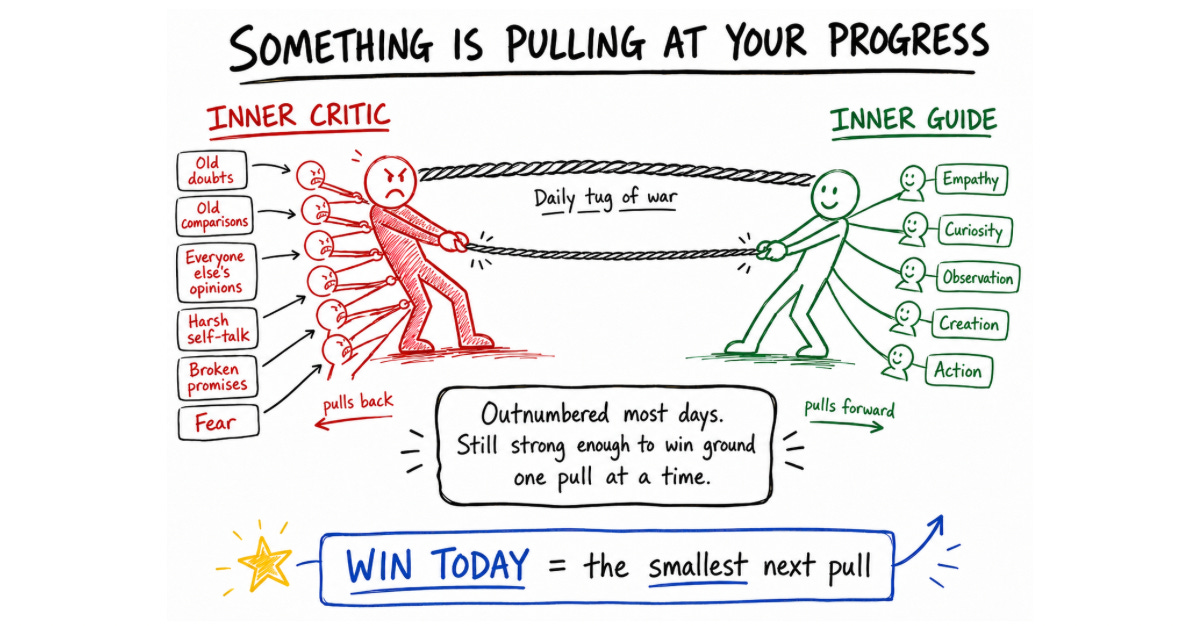
But the guide has one real advantage the critic doesn’t: it doesn’t need to match hands to win ground. One steady, well-placed pull from the guide can undo several wild ones from the other end. That’s the potential power. Why potential power? Because it takes consistent practice. That’s the whole point. Getting stronger instead of trying harder.
That strength is built, not born. How sharp the thinking stays under pressure. How well feelings get read, in the moment, in yourself and everyone else. How easily trust builds with the person on the other side. How fast a setback turns into a next step instead of a spiral. How creatively a stuck moment gets unstuck. None of that shows up overnight, and none of it is set in concrete. It’s built the same way grip strength is — one pull at a time.
The guide gets ready before the pull even starts — emotionally, socially, physically, and mentally. Enough sleep. Enough movement. The right fuel. That’s not extra credit. That’s training. That’s kindness, trust, and respect, working before the tension ever shows up — and it’s what makes all five skills stronger when it counts.
None of these five skills show up by accident. Three simple moves make them possible — a way to feel the pull in real time and hold steady before more ground is lost.
Pause. Sounds backward — stopping, when ground is already being lost. It isn’t. Pause is how the guide finds the one inch it can actually win back.
Process. Notice what’s happening. Figure out where the real tension is coming from — not just this moment, but what’s really pulling. Let the feeling be real. Most of them make sense. That’s allowed.
Perspective. The whole rope is only visible from the observer’s seat, not from mid-pull. Zoom out. Look at both ends. A quick reset through the senses — five things seen, felt, heard — helps get there fast. Then one question, at any size: will this matter in five hours? Five days? Five weeks? Five months? Five years?
Pause. Process. Perspective. Proceed.
None of this out-pulls the critic by force. It’s simpler than that. Hold steady. Be consistent. Don’t feed the inner critic end. Let the next pull come from the inner guide instead.
One more piece underneath all of it: real progress needs aim, not just grip strength. Aspiration — know which way is actually forward. Intention — choose that direction on purpose, especially when the pull is hardest. Movement — the smallest next pull, repeated. A distracted pull and an aimed pull cost the same effort. They just land on opposite ends of the same rope. This is why consistency matters.
The inner guide pulls forward, toward the aim that’s been set. The inner critic pushes back — tugs, jerks, pulls harder. Every time the guide takes the smallest next pull, the old habit resists a little less. And something more powerful builds: kindness, trust, respect — for yourself, and for others. That’s not a mood. That’s boundaries held, energy protected. That’s progress, one pull at a time.
And the guide itself gets stronger the same way. Not overnight. Over time — pull by pull, inch by inch, in every part of you, consistently. Nobody holds a rope with a steady grip the first time they pick one up, either.
Win Today
None of this needs to be a big pull. It never did.
Feeling better happens the same way feeling worse does — quietly, one pull at a time. Relationships grow stronger the same way, because there’s more strength left over to give. Even the ordinary stuff — money, the calendar, the phone, a plate of food — starts getting pulled on purpose instead of grabbed just to make the tension stop.
That’s Win Today. One inch at a time. Not 24 feet of rope hauled in a single pull. One question, asked daily: what’s needed now?
Answer it. Take the smallest next pull. Hold the position one more day. Inch by inch. Do it again tomorrow, and it adds up. That’s how a hard day turns into a good one — and how enough good days, pulled forward one at a time, turn into results for life.
Every inch in the right direction is a win. Worth knowing: it usually takes more pulls to win back ground than it took to lose it. That’s not discouraging — that’s just how a rope with a head start works. Inch by inch, though, it’s a cinch.
Hand over hand, over time, every day. That becomes your everyday edge. That’s how you Win Today.
There’s a difference between winning today and becoming someone who wins most days without having to think about it anymore. That shift has a name too. It’s a longer story, worth telling on its own. For today, the smallest next pull is enough.
Subscribe to get first access to new content.
This is NOT 🚫another newsletter.
We don’t gate our content.
Frequently Asked Questions
What does “something is pulling at your progress” mean? It means a moment, or something already being carried, has more pull than usual on a decision — not because anything is wrong with anyone, but because everyone feels this pull sometimes. Some of it happens in the moment. Some of it gets carried in.
Why does it feel like losing ground instead of one big moment? Because it usually is. Small pulls, in one direction or the other, add up over a day. Most days it’s not one dramatic loss — it’s an inch at a time.
What is the inner critic? One end of the rope — the voice that turns a mistake into a verdict about identity instead of feedback about behavior. It shows up as judgment, self-doubt, and broken promises, and it tends to pull on other relationships too.
What is the inner guide? The other end of the rope — the source of empathy, curiosity, observation, creation, and action. Five skills drawn on, in any mix, to choose the next pull instead of losing ground to the old one. Outnumbered by default, but stronger per pull than it looks.
What do Pause, Process, and Perspective actually do? Pause stops the slide. Process lets the feeling be real instead of fighting it. Perspective uses the senses and one simple question to feel solid ground again. Together: Pause. Process. Perspective. Proceed.
How do I know if a moment is helping or hurting? Skip the labels. Not good or bad. Just ask: is this pulling things forward, or dragging them back?
Where’s a good place to start? One question, asked daily: what’s needed now? Small, repeated pulls are how real progress adds up into results for life.