


Most people hear about a system and think: sounds good in theory.
Then they go back to doing what they were already doing.
That’s not a motivation problem. That’s an implementation problem.
The gap between “I get the idea” and “I actually do this” is where most systems die. Not because the system is broken. Because nobody showed them what it looks like on a Tuesday morning when things are busy, messy, and real.
So that’s what this is.
This is ResultsOS™ — a daily performance system for leaders — in real life.
Not the theory. Not the slide deck version. The actual thing — for five different people, on five different kinds of days.
Before we dive in: what’s actually in the way
Here’s something most productivity systems skip.
They tell you what to do. They don’t account for what’s blocking you from doing it.
ResultsOS does both.
GREAT creates clarity. FASTER drives execution. OPPS aligns the work. And underneath all of it is a diagnostic layer — a way of naming what’s actually getting in the way before you try to push through it.
That layer is called FUDDDDD™.
Fear. Uncertainty. Doubt. Depletion. Disconnection. Distraction. Delay.
Seven forces. All of them normal. All of them real. And all of them capable of hijacking a day — or a decade — if they go unnamed.
What is FUDDDDD™ in ResultsOS? FUDDDDD™ is a diagnostic framework inside ResultsOS™ that names the seven forces most likely to slow someone down: Fear, Uncertainty, Doubt, Depletion, Disconnection, Distraction, and Delay. Most performance and relationship problems have at least one of these at the root. ResultsOS helps people identify which force is active — and use the Five Accelerators to interrupt it and move forward.
Most people are fighting at least one of them right now. Some are fighting three.
ResultsOS doesn’t ignore that. It names it. And then it gives you something to work with — the Five Accelerators: Empathy, Curiosity, Perspective, Co-creation, and Aligned Action. Operating conditions that interrupt FUDDDDD and get you moving again.
You’ll see both show up in the stories below.
Not as theory. As real moments in real days.
First, the anchors
Two questions run through every day in ResultsOS.
The GREAT Question: What will make today GREAT?
Run it through five areas — Growth, Relationships, Energy, Alignment, Time. Pick one thing per area. You now have a filter for the day. Not a task list. A filter.
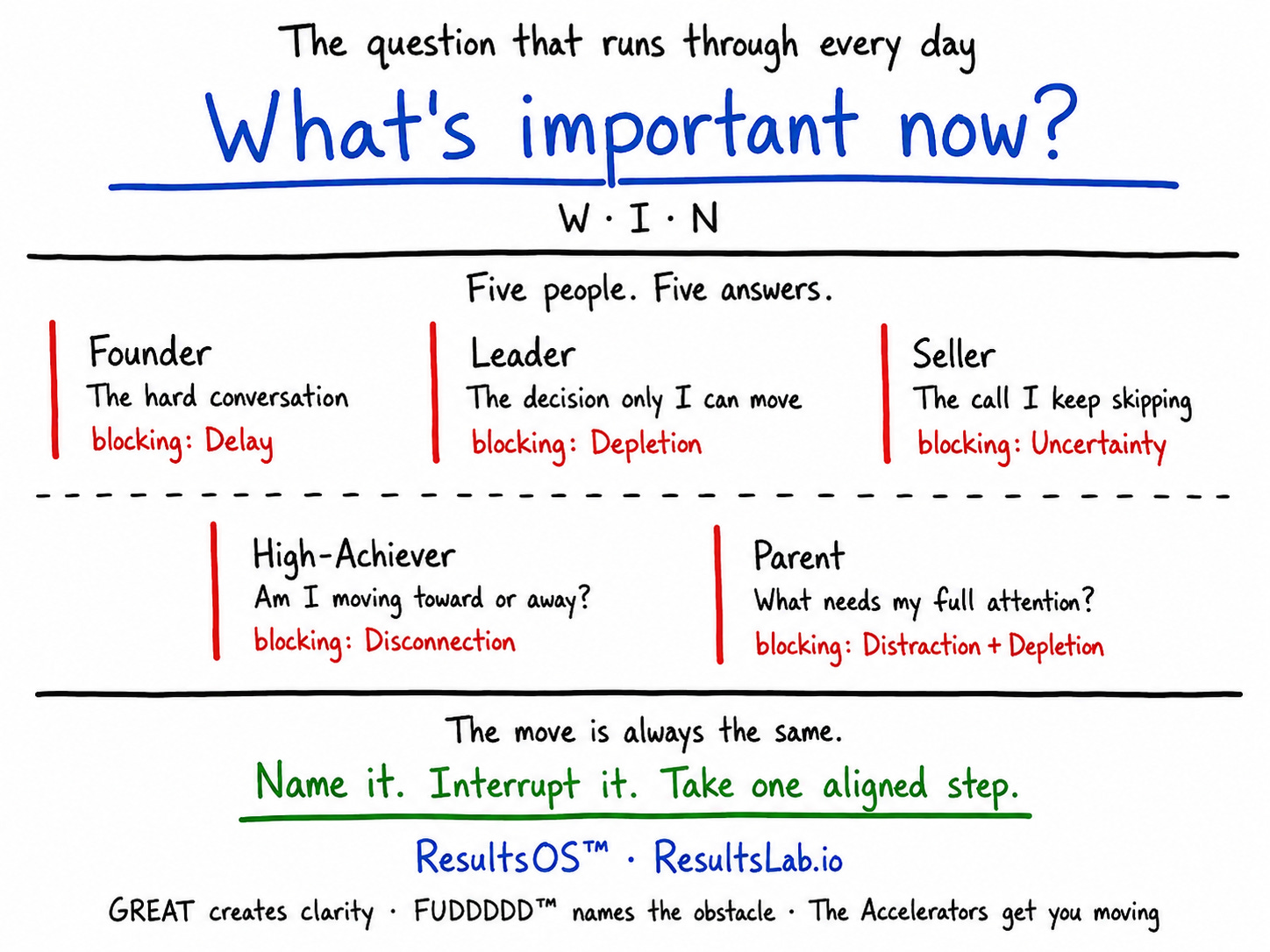
WIN: What’s Important Now?
This is the real-time question. Not what would be nice in an ideal world. What matters right now — given where you are, what you have, and what you’re actually dealing with.
What is the WIN framework in ResultsOS? WIN stands for What’s Important Now. It is a real-time decision-making prompt inside ResultsOS™ designed to cut through noise and identify the one action that creates the most forward motion right now — given real constraints, not ideal ones. Used alongside the GREAT Question, WIN helps ambitious people stop reacting and start deciding.
Most people start the day reacting. Inbox. Notifications. Other people’s priorities.
These two questions flip that. They ask you to decide first.
But there’s a third move that separates the people who stay on course from the ones who get knocked off it.
Anticipate the resistance.
Before the day starts, ask: What is most likely to hijack this day? What’s going to drain my energy? What’s going to pull me off course? Where is FUDDDDD most likely to show up — and in what form?
Not to catastrophize. To prepare.
Because resistance isn’t a surprise. It’s a guarantee. Every day brings some version of it. The question is whether you meet it with awareness or get blindsided by it.
This is how ResultsOS players start the day differently. They plan for what they want. And they plan for what’s coming for it.
Even for five minutes. Even imperfectly.
Now let’s see what that looks like when it’s working — and when it gets tested.
The Founder / Owner
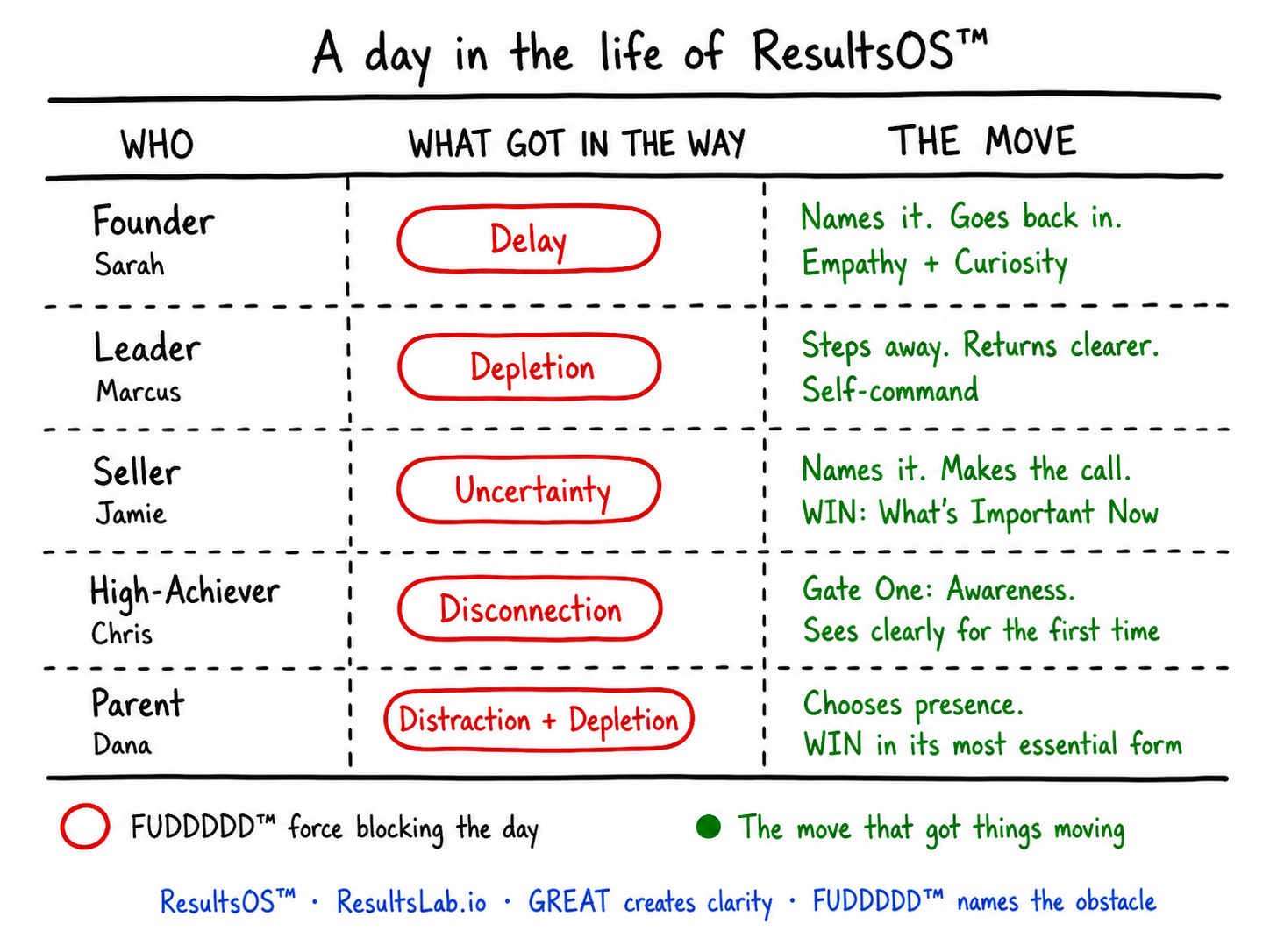
Sarah woke up with three things already competing for her attention.
A client deadline. A team conflict that wasn’t resolved from yesterday. And a knot in her chest she’s been ignoring for a week.
She used to start the day by checking Slack. Now she starts differently.
Before she opens anything, she asks: What will make today GREAT?
She runs through the five areas and picks one thing each.
Growth: Get 30 minutes on the proposal she’s been circling.
Relationships: Have the conversation with her operations lead that keeps getting pushed off. A week of avoidance is already costing her trust and momentum.
Energy: Don’t skip lunch. Sounds small. She knows what happens when she does.
Alignment: Confirm that what she’s spending time on today actually connects to the result she wants this quarter. If it doesn’t — that’s a signal.
Time: Block two hours before noon. Protect them. The rest of the day can flex.
Then WIN: What’s important now?
Not the inbox. Not the team conflict — not yet. The proposal. That moves the needle. Everything else is noise until that gets started.
By 10am, she’s made real progress.
Then the afternoon hits.
The operations conversation goes sideways. Her lead gets defensive. Sarah feels the pull to back off, smooth it over, move on. She’s done it before. She knows how this ends — the problem goes underground, shows up again in two weeks, costs twice as much.
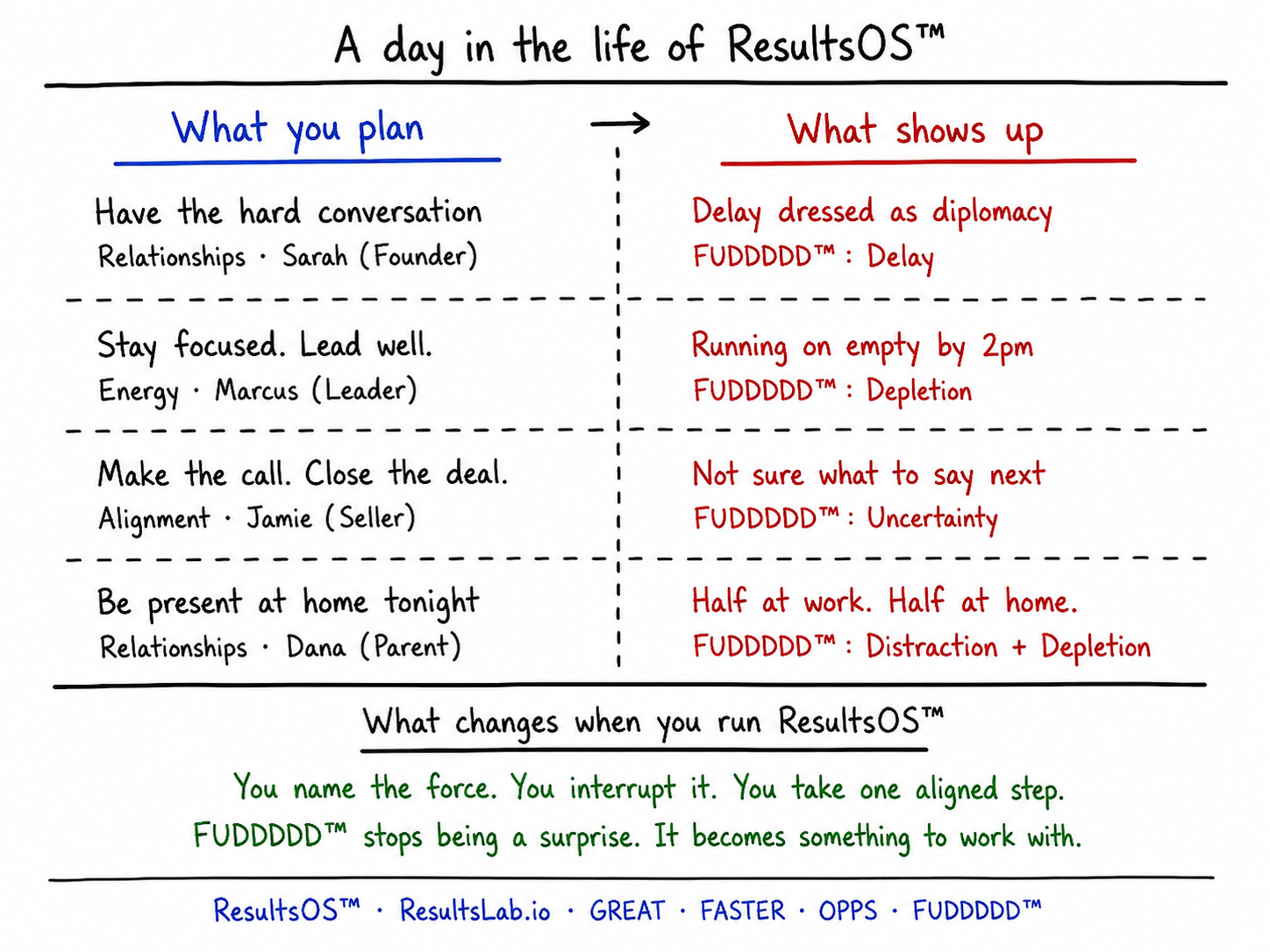
She recognizes what’s happening. That pull to avoid? That’s not a personality flaw. That’s Delay showing up dressed as diplomacy.
She pauses. Breathes. Uses the STOP method — Slow down, Think, Observe, Process.
Then she goes back in. Not harder. Clearer.
I want to understand what’s getting in the way for you. Help me see it.
That’s Empathy and Curiosity working together. Two of the Five Accelerators. They don’t solve the problem in one conversation. But they change the direction of it.
She leaves the meeting with less resolution than she wanted and more trust than she had before.
That’s the real win of the day.
The Leader
Marcus manages a team of twelve.
His job is to be the person everyone else needs him to be — while somehow still doing his own work.
Most days he feels like a fire fighter.
ResultsOS didn’t change that. But it changed where he starts.
Every morning, before the calendar owns him, he asks the GREAT Question. Relationships gets the most weight. Not because it’s soft. Because trust is how his team moves.
He picks one relationship that needs attention today.
Not a dramatic conversation. Just attention.
Could be a check-in with someone who’s been quiet. Could be following up on something he said he’d do but didn’t. Could be giving someone public credit for work they actually did.
Small. Intentional. Consistent.
Then WIN. For Marcus, What’s Important Now is almost always a decision sitting somewhere waiting on him. Something only he can unblock.
He finds it. He clears it. Then he goes to his first meeting.
Around 2pm, a team member escalates something that should have been handled a level down. Marcus feels the spike — frustration, impatience. He’s tired. He’s been in back-to-back calls since 9.
That’s Depletion talking. And when Depletion is in the room, Disconnection usually shows up next — the feeling of going through the motions, of doing the job without being present for it.
He knows this pattern. It’s on his GREAT radar.
Energy was one of his picks this morning. He’s been ignoring it since noon.
He takes ten minutes. Steps away from the screen. That’s not weakness. That’s self-command — the ability to pause, choose, and act in alignment instead of reacting from empty.
He comes back clearer. Handles the escalation cleanly. Connects the team member to the right resource instead of absorbing the problem himself.
His team doesn’t know why things feel clearer lately. He knows. It’s because he stopped letting his own depletion become everyone else’s problem.
The Seller
Jamie carries a number. Every day.
Pipeline is real. Quota is real. The pressure that comes with both is very real.
She used to start the day checking what emails came in overnight. Looking for good news. Sometimes finding it, more often not.
Now she starts with two questions.
GREAT gives her perspective. Revenue shows up under Alignment — is what I’m doing today connected to what actually closes? Energy matters too — she knows she’s less effective after 3pm. She protects mornings differently now.
WIN is where it gets tactical. What is the one move today that creates the most forward motion? Not the most emails sent. Not the most activity. The most signal.
For Jamie, WIN usually points to one conversation she’s been putting off. A follow-up that feels awkward. A deal that’s stalled and needs a direct question.
She asks herself: Why am I avoiding this?
Usually it’s not complicated. She’s not afraid of the no. It’s more like she’s not sure what to say or do next.
That’s Uncertainty and Doubt — two of the seven forces that slow people down without announcing themselves. Jamie used to call it a slow week. Now she calls it what it is.
ResultsOS doesn’t make those calls for her. But it makes her stop pretending she’s busy with other things when the real work is that call.
She asks WIN again — specifically: What’s the one conversation that, if I have it today, changes the shape of my week?
She makes the call.
Most of her best days start with the thing she was most tempted to skip.
The High-Achiever
Chris doesn’t have a title problem. He has a ceiling problem.
He’s performing well by every external measure. But something feels off.
His results are solid. His energy isn’t. He keeps winning things that don’t feel like wins.
The GREAT Question was uncomfortable at first.
Specifically the G — Growth. When he asked himself what growth looked like today, he realized he hadn’t thought about his own development in months. He’d been executing. Not growing.
And the R — Relationships. He runs fast and often alone. The people around him have noticed.
WIN for Chris points somewhere surprising most mornings: the relationship with himself.
Not in a fluffy way. In a practical way.
Am I making choices today that I’ll respect tomorrow? Am I moving toward something or just away from something? Is the pace I’m running actually sustainable?
He doesn’t answer those questions perfectly. But he asks them now.
Here’s what nobody told Chris: what he’s been living in is Disconnection. Not from other people — from himself. Doing the right things for the wrong reasons. Chasing outcomes that no longer match who he’s becoming.
That’s not a crisis. It’s a signal.
ResultsOS gave him a mirror. What he saw wasn’t bad. But it was honest.
And honest is where the Four Gates begin.
He’s at Gate One right now: Awareness. He can see what’s off. That’s not nothing. That’s actually the hardest step — most people spend years avoiding this moment.
Acceptance comes next. Then accountability. Then aligned action.
He’s not all the way through. But he’s moving in the right direction.
And honest is where change actually starts.
The Parent
Dana does two jobs.
One has a job description. One doesn’t, but it matters more.
She’s a parent of three and a VP of Marketing. Both require everything she has.
For years she ran on willpower and caffeine and the hope that she’d catch up eventually.
Then she didn’t catch up. She burned out.
ResultsOS clicked for her when she realized it wasn’t designed for work. It was designed for her whole life.
Every area of the GREAT Question matters at home too.
Growth — am I learning anything outside of what the job requires? Am I a person my kids can see growing?
Relationships — which relationship at home needs something from me today? Not everything. Just something.
Energy — am I sleeping? Am I moving? Can I actually show up tonight?
Alignment — what am I doing today that actually matters to the life I want? Not just the career.
Time — where am I spending time that doesn’t reflect what I say matters?
WIN for Dana is usually one of two things.
Either something at work that’s been hanging — a decision or a conversation that will take ten minutes and free up two days of mental noise.
Or something at home — a text to her partner, a few minutes of actual presence at dinner instead of half-attention on her phone.
Both count.
The hardest days are when Distraction and Depletion show up at the same time. When she’s half at work and half at home and not fully present anywhere. She used to power through. Now she names it.
I’m scattered right now. What’s the one thing that most needs my full attention?
That’s WIN in its most essential form.
ResultsOS doesn’t separate work and life into boxes. It asks: what matters right now, across all of it?
That question changed how Dana ends her days. Less resentment. More intention.
Not perfect. But cleaner.
What the system actually does
These aren’t success stories about productivity hacks.
None of these people fixed everything.
Sarah still has hard conversations she doesn’t love. Marcus still has days where the fires win. Jamie still has weeks where the pipeline is thin. Chris is still figuring out what the next version of himself looks like. Dana still misses dinners.
Yet, now, they all have something they didn’t have before.
A way to see what’s happening. A way to name what’s in the way.
And a way to start — even on the days when starting is the hardest thing.
ResultsOS isn’t a morning routine. It’s an operating system. The GREAT Question creates clarity. WIN drives the moment. FUDDDDD names the real obstacle. The Accelerators get you moving again. The Four Gates give you a map for change that actually sticks.
It works because it’s complete. Not because it’s complicated.
The two questions that anchor it
Morning: What will make today GREAT? Run it through the five areas. Pick one thing per area. You now have a filter for the day.
When things go sideways: What’s important now? Drop the list. Get to the root. Take one aligned step.
That’s the start.
The whole thing is simpler than you think. Your challenge is start doing it.
Frequently asked questions
What is ResultsOS™? ResultsOS™ is the operating system behind ResultsLab.io. It helps ambitious people get GREAT results FASTER by removing the drag in their performance, relationships, and wellbeing. It connects three frameworks — GREAT for clarity, FASTER for execution, OPPS for alignment — with a diagnostic layer (FUDDDDD™), an activation layer (the Five Accelerators), and a change model (the Four Gates of Change).
What does WIN stand for in ResultsOS? WIN stands for What’s Important Now. It is a simple real-time question used to cut through the noise of a busy day and identify the one thing that creates the most forward motion right now. It works as a decision filter when plans change, pressure spikes, or clarity disappears.
What is the GREAT framework? GREAT stands for Growth, Relationships, Energy, Alignment, and Time Optimization. It is the clarity framework inside ResultsOS™. The GREAT Question — What will make today GREAT? — asks people to identify one priority per area before the day starts. It takes two minutes and creates a filter for everything else.
What is FUDDDDD™? FUDDDDD™ is a diagnostic model inside ResultsOS™ that identifies the seven forces most likely to create drag in a person’s performance, relationships, or wellbeing: Fear, Uncertainty, Doubt, Depletion, Disconnection, Distraction, and Delay. Most people are running into at least one of these on any given day — often without naming it. Naming it is the first step to interrupting it.
What are the Five Accelerators in ResultsOS? The Five Accelerators are Empathy, Curiosity, Perspective, Co-creation, and Aligned Action. They are the operating conditions that interrupt FUDDDDD™ and help people move forward. Each Accelerator is a direct antidote to one or more of the seven forces. Together they create the conditions for better thinking, better relationships, and better results.
What are the Four Gates of Change? The Four Gates of Change are Awareness, Acceptance, Accountability, and Aligned Action. They represent the natural sequence of lasting change inside ResultsOS™. Most people try to skip straight to action. The Gates ensure the change is real — not just behavioral, but rooted in how someone sees and relates to the situation.
Who is ResultsOS designed for? ResultsOS is built for ambitious people — founders, owners, leaders, sellers, high-achievers, and parents. The common thread is not a job title. It is ambition, pressure, and the belief that you are capable of more. The system works across roles and across life — not just at work.
How is ResultsOS different from other productivity systems? Most productivity systems focus on tasks and time management. ResultsOS connects performance, relationships, and wellbeing — because when one suffers, the others eventually do too. It also includes a diagnostic layer (FUDDDDD™) that names what’s actually blocking progress, and an activation layer (the Five Accelerators) that helps people move through it. It is designed for real days, not ideal ones.
Do I need to do all five areas of GREAT every day? Yes, but not perfectly. The goal is awareness, not perfection. Running through all five areas takes about two minutes and gives you a complete picture of your day. It also helps you catch the area that is quietly going off track before it becomes a bigger problem.
Can ResultsOS work for parents, not just professionals? Yes. ResultsOS is a life system, not just a work system. The GREAT framework applies across every domain — home, relationships, energy, identity. Many of the people who find it most useful are managing high performance at work and full lives at home simultaneously. The system doesn’t separate those things. It holds them together.
Want to go deeper?
🧭 Explore The Results Operating System (ResultsOS™) →
⬇️ Download the free one-page GREAT Planner — the simplest way to start. Two minutes in the morning. A completely different day.
🟢 Message me if one area of your day keeps going off track. We’ll figure out where to start.
➕ Subscribe to Lab Notes for weekly insights on performance, relationships, and wellbeing.
Part of the ResultsOS™ series. Read next: The GREAT Question — A Daily Practice That Changes Everything
Coming soon: FUDDDDD™ — The Seven Forces Slowing You Down (And How to Interrupt Them)
Mike D’Angelo is the founder of ResultsLab.io and creator of ResultsOS™. He helps ambitious founders, leaders, sellers, and parents get GREAT results FASTER — without burning out, blowing up relationships, or losing the life they actually want.