


💡 Before people listen to your idea, they need to know you understand their world.
Most people think trust is built
by saying the right thing.
It is not.
Trust is built when someone feels seen, heard, and understood.
Not managed. Not fixed. Not sold. Not rushed.
Understood.
That sounds simple.
It is simple.
But simple does not mean easy. Because most of us are moving fast.
We are busy. We are tired. We are trying to get the meeting done.
Close the deal. Lead the team. Help the kid. Fix the problem.
Calm the conflict. Get the result.
So we jump in too soon.
We explain. We advise. We defend. We solve. We make it about us.
And without meaning to, we miss the person right in front of us.
This matters at work. And at home.
This matters in sales. And in leadership.
This matters in marriage. And with your kids.
This matters with yourself.
Because one hard relationship can take up a lot of space.
It can drain your focus, energy, trust and most importantly, it can drain your results.
And most of the time, the issue is not that people do not care.
It is that people do not slow down long enough to show it.
Connection comes before correction
Here is the simple idea.
Before people listen to you, they need to feel safe with you.
Before they accept your idea, they need to know you understand their world.
Before they move with you, they need to know you are not just moving them toward your agenda.
This is where most people miss it.
Founders want alignment. Leaders want accountability.
Sellers want commitment. High-achievers want progress.
Parents want cooperation.
All good things. But we often try to get those things before trust is ready.
That is like trying to harvest before planting. It does not work.
Or if it does work, it does not last.
The better path is simple.
Notice → Listen → Ask → Pause → Then act
That is the work. That is how trust is built.
That is how people open up. That is how hard conversations get softer.
That is how real progress starts.
Pressure creates resistance.
Agreement creates movement.
The Trust Flow
A good name helps people remember a good idea. So let’s call this what it is.
The Trust Flow.
It is not a script. It is not a trick. It is not a way to control people.
It is a simple way to stay human when the relationship, the moment, or the result matters.
The Trust Flow is simple:
Notice.
Listen.
Ask.
Pause.
Agree.
That is it.
Simple enough to remember.
Deep enough to change the conversation.
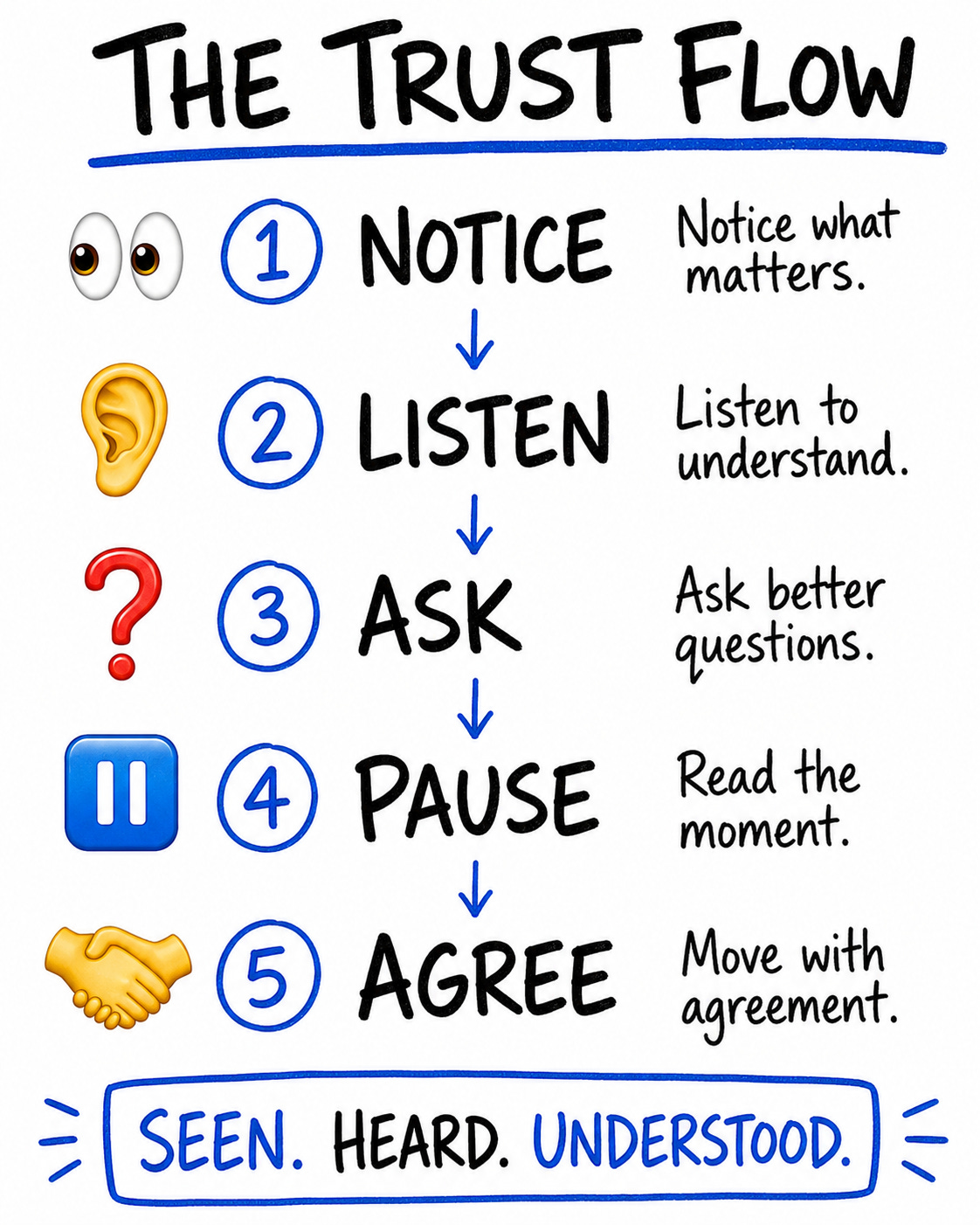
A simple 5-step trust flow
Here is a simple way to think about it.
Notice what matters
Listen to understand
Ask better questions
Read the moment
Move with agreement
That is it.
No fancy model. No big speech. No weird trust fall nonsense.
Just five human moves. Used in the right order.
1. Notice what matters
Trust often starts before anyone says anything important.
It starts when you notice.
You notice what matters to the other person.
You notice what they care about.
You notice what changed.
You notice what is good.
You notice what is heavy.
You notice what they are proud of.
You notice what they are not saying.
Most people notice what is wrong.
That is easy.
The typo.
The missed number.
The tone.
The sock on the floor.
The one thing the kid did not do.
The one thing the employee missed.
The one objection the buyer raised.
The one text that felt short.
💡Our brains are good at spotting problems.
That is useful.
But it can also make us blind to what is working.
So the first move is simple.
Look for the good.
Then say it.
Not in a fake way.
Not in a polished compliment sandwich way.
In a real way.
Like this:
“I noticed how much care you put into that.”
“I can tell this matters to you.”
“You’ve clearly been carrying a lot.”
“That took courage to say.”
“I may not fully understand it yet, but I can see this is important.”
This is empathy in action.
It says: “I see you.”
And for a lot of people, that alone is rare.
Try this today
Before your next hard talk, ask yourself:
“What matters to them right now?”
🚫 Not what do I want?
🚫 Not what do I need them to do?
🚫 Not how do I win?
What matters to them?
☝️ That one question can change the whole conversation.
2. Listen to understand
Most people do not listen.
They wait.
They wait for their turn. They wait for the pause. They wait for the opening.
They wait for the chance to say what they already planned to say.
That is not listening. That is loading the cannon.
Listening to understand is different.
It means you are not trying to respond yet.
You are trying to get their world.
What are they feeling?
What are they protecting?
What are they worried about?
What feels unfair?
What feels unclear?
What feels unsafe?
What do they need that has not been named yet?
This is curiosity in action. And real curiosity is not a tactic.
It is not a sales trick. It is not a leadership hack.
It is a posture. It says:
“I care enough to learn before I lead.”
“I care enough to understand before I answer.”
“I care enough to slow down.”
That is powerful. Especially in a world where everyone is rushing.
Listen for the small clues
People often tell us what is going on.They just do not always say it directly. They give clues. Small phrases. Small signals. Small openings.
Things like:
“I’m tired.”
“I’m fine.”
“I’m hanging in there.”
“It’s been a lot.”
“I thought we were aligned.”
“That’s not what I meant.”
“You never listen.”
“I don’t know if this is worth it.”
“I can’t keep doing this.”
“I’m not sure I trust this.”
“I need to think about it.”
Those are not throwaway lines. Those are doors.
🚫 Do not kick the door open. 🚫Do not run past it.
🚫Do not explain why they should not feel that way.
Just pause. Then gently step closer.
Try:
“Tell me more about that.”
“What feels like a lot right now?”
“What am I missing?”
“What would help me understand this better?”
“What part feels hardest?”
“What do you wish I understood?”
Those questions lower the wall. Not because they are magic. Because they show you are not there to win the moment. You are there to understand the person.
3. Ask better questions
Good questions do not make people feel trapped.
Good questions help people feel safe enough to tell the truth.
That matters. Because truth is where the real work starts.
At work, this may sound like:
“What feels unclear right now?”
“What support would actually help?”
“Where do you feel stuck?”
“What are we avoiding?”
“What needs to be said before we move forward?”
In sales, it may sound like:
“What concern has not been fully named yet?”
“What would make this feel like a safer next step?”
“Where does this not feel aligned?”
“What would need to be true for this to make sense?”
“What are you comparing this against?”
At home, it may sound like:
“What did that feel like for you?”
“What do you need from me right now?”
“Do you want help, or do you want me to just listen?”
“What felt unfair?”
“What would repair look like?”
With your kids, it may sound like:
“I believe you. What happened?”
“What were you feeling?”
“What did you need?”
“What can we do differently next time?”
Notice what these questions have in common.
They are not attacks. They are not traps. They are not cross-examination.
They are invitations.
That is perspective taking in action. You are trying to see the moment from their side of the table.
Not because you agree with everything. Not because you are giving up your view.
But because you cannot solve a problem you do not understand.
⚠️ Do not steal the moment with your story
This one is sneaky. Someone shares something hard. And your brain lights up.
You think: “Oh, I have a story just like that.”
So you jump in.
You share your story. You mean well. You are trying to connect.
But sometimes, it has the opposite effect. They were in their world.
You entered their world. Then you dragged them into your world.
Now they are listening to your story.
Now they are taking care of your feelings.
Now the moment shifted.
That does not mean you can never share your story.
You can and should share your story.
Stories build trust. And timing matters.
Early in the conversation, stay with them.
Let their story breathe. Let the moment be theirs.
Before you say, “That happened to me too,” try this:
“That makes sense.”
“I can see why that landed that way.”
“I’m glad you told me.”
“I want to stay with this for a minute.”
That is empathy. That is restraint. That is self-command.
And it matters more than we think.
4. Read the moment
Not every moment needs a solution.👈That sentence could save a lot of relationships.
Sometimes people need advice.
Sometimes they need a decision.
Sometimes they need a plan.
Sometimes they need support.
Sometimes they need space.
Sometimes they just need to feel less alone.
High-achievers can struggle here, a lot. Sellers too.
Founders and Leaders too. Parents included.
Because we are wired to move.
Fix it. Close it. Solve it. Ship it. Decide it. Clean it up. Move on.
But trust is not built by speed alone. It is built by wise timing.
So after you listen and ask, pause.
Then ask yourself:
“Is this the time to help?”
“Is this the time to offer an idea?”
“Is this the time to go deeper?”
“Is this the time to simply say thank you?”
“Is this about their need, or my need to feel useful?”
That last one is a gut punch. 🥊
Because sometimes we give advice to calm our own discomfort.
Sometimes we push for action because silence feels awkward.
Sometimes we pitch because we are afraid of losing the deal.
Sometimes we lecture because we are afraid of losing control.
Sometimes we solve because we do not know how to sit with someone’s pain.
Reading the moment means you slow down enough to choose the right next move.
That is aligned action. Not action for action’s sake. Not action to ease your own stress. Action that fits the moment. The natural next step.
5. Move with agreement
Once trust is present, you can offer help. But do not force your way in.
Ask permission. Simple as that.
Try:
“I have an idea that may help. Want to hear it?”
“I see a possible next step. Would it be useful to talk through it?”
“I have a thought, but I do not want to rush past what you shared. Open to it?”
“Would it help if I shared what I’m seeing?”
That small move changes everything. It keeps dignity in the conversation.
It keeps the other person involved. It makes the next step shared.
This is co-creation.
Not control. Not convincing. Not dragging someone across the finish line.
It says: “We are doing this together.”
And when someone says yes, they are more open.
Not because you pressured them. Because you respected them.
This is true in sales and leadership.
This is true in marriage and parenting.
This is true with your team and with yourself.
Agreement creates movement.
Pressure creates resistance.
What to do when they object
Objections are not problems. They are opportunities. Sometimes an objection is just a concern looking for air. A lot of people treat objections like a wall. They hear resistance and start pushing. That’s fear and fear doesn’t move the conversation forward.
An objection is not something to overcome.
It is something to understand.
If someone says: “That will not work.”
Do not rush to prove them wrong.
Ask: “What makes you feel that way?”
If someone says: “It costs too much.”
Ask: “Compared to what?” or “What concern sits under the cost?”
If someone says: “I need to think about it.”
Ask: “What part feels unclear?”
If someone says: “I do not agree.”
Ask: “What are you seeing that I may be missing?”
This is not weakness. This is strength.
You are not backing down. You are stepping in.
With curiosity. With calm. With respect.
This keeps the conversation open.
The Five Accelerator Moves
Here is the simple version. If you want better relationships, better trust, and better results, practice these five moves.
1. Empathy
See the human. Not just the role. Not just the title. Not just the behavior. The human.
Ask: “What might this feel like for them?”
2. Curiosity
Stay open longer than feels natural. Ask one more question before giving one more answer.
Ask: “What do I not understand yet?”
3. Perspective Taking
Try to see the room from their chair. Not to abandon your view. To widen it.
Ask: “What does this look like from their side?”
4. Collaboration
Do not make the plan for them. Make it with them.
Ask: “What would a good next step look like together?”
5. Aligned action
Move when the moment is ready. Do the next right thing.
Not the loud thing. Not the fast thing. Not the thing that protects your ego.
Ask: “What action best serves the relationship and the result?”
Where this shows up
For a founder, this may be the co-founder talk that keeps getting delayed.
For a leader, it may be the team member who seems checked out.
For a seller, it may be the buyer who has gone quiet.
For a parent, it may be the kid who says, “I’m fine,” when they are clearly not fine.
For a partner, it may be the same argument in a new outfit.
For a high-achiever, it may be the relationship with yourself.
The pattern is often the same.
A wall goes up. Trust goes down. Stories fill the gap.
Energy gets drained. Progress slows.
The move is not to push harder. The move is to get clearer.
Notice.
Listen.
Ask.
Pause.
Agree on the next step.
Sample Talking Points For Hard Moments
A simple flow (not a script)
Use this when the conversation feels tense, unclear, or stuck.
“I want to understand this better. I may not have the full picture yet.
What feels most important to you right now?”
Then listen. Do not jump in. Do not defend. Do not fix.
When they finish, say: “That makes sense. Here is what I think I heard…”
Then reflect it back.
After that, ask: “Did I get that right?”
If they say no, good. That means you are still learning.
Ask: “What did I miss?”
🔁 Keep repeating this until they confirm you got it.
If they say yes, ask: “Would it help if we talked about a next step?”
Then go-to aligned action. Sounds like this: [who] will do [what] by [when]?
That is it. Simple. Not easy. But simple.
Use this today
Before your next hard conversation, write down four things.
What matters to them?
What might I be missing?
What question should I ask first?
What action would serve the relationship and the result?
That is enough.
You do not need a perfect script.
You do not need to sound like a therapist.
You do not need to win the moment.
You just need to slow down long enough to see the person, hear the person, and choose the next right step.
The real goal
❌ The goal is not to be soft.
❌ The goal is not to avoid hard things.
❌ The goal is not to agree with everyone.
🎯 The goal is to create enough trust to tell the truth and move forward.
That is the real work. Because trust does not mean there is no conflict.
Trust means conflict can happen without destroying the relationship.
Trust also means we can:
tell the truth with care.
repair faster.
solve the real issue, not just argue about the surface one.
get better results without leaving people worse than we found them.
That is leadership. That is sales.
That is parenting. That is partnership.
That is performance. That is being human.
At ResultsLab.io, we believe better results start with better relationships.
And better relationships start when
people feel seen, heard, and understood.
The simplest place to start
Pick one relationship.
❌ Not ten.
🟢 One.
A client. A buyer. A boss. A teammate.
A partner. A child. A friend. Yourself.
Then ask:
“What matters to them right now?”
“What have I not fully heard?”
“What question would help them feel understood?”
“What moment are we in?”
“What next step can we agree on together?”
Start there.
One relationship. One real conversation.
One better question. One honest pause.
One aligned action.
That is how trust starts moving again. And when trust moves, results usually follow.
Your turn. I’d love to hear from you.
How do you build trust?
Questions people ask about trust, hard conversations, and better relationships
What is the fastest way to build trust?
The fastest way to build trust is to help someone feel seen, heard, and understood before you try to lead, sell, fix, or solve. Trust grows when people feel safe enough to tell the truth.
Why do people resist advice, feedback, or help?
People often resist advice when they do not feel understood yet. Even good advice can feel like pressure if it comes too soon. Connection comes before correction.
How do I build trust in a hard conversation?
Start by slowing down. Notice what matters to the other person. Listen to understand. Ask one better question. Then pause before offering your idea or solution.
What should I say when someone seems upset or defensive?
Try saying, “I want to understand this better. What feels most important to you right now?” Then listen without jumping in to fix, defend, or explain.
How can leaders build more trust with their teams?
Leaders build trust by noticing what matters, listening before responding, asking clear questions, and creating next steps with people instead of forcing action on them.
How can sellers build trust with buyers?
Sellers build trust by understanding the buyer’s world before pitching a solution. Ask what feels unclear, what concerns remain, and what would make the next step feel useful and safe.
How can founders use this with co-founders or investors?
Founders can use this approach to slow down tense conversations, name what matters, listen for what is not being said, and agree on the next right step together.
How can parents use this with kids?
Parents can use this by asking simple questions before correcting behavior. Try, “What happened?” “What were you feeling?” or “What do you need from me right now?”
What does it mean to listen to understand?
Listening to understand means you are not preparing your reply while the other person talks. You are trying to understand their world, their concern, and what matters to them.
What is the Trust Flow?
The Trust Flow is a simple 5-step way to build trust. Notice what matters. Listen to understand. Ask better questions. Read the moment. Move with agreement.
Why should I ask permission before giving advice?
Asking permission keeps trust in the conversation. It shows respect. It also helps the other person choose into the next step instead of feeling pushed.
What should I do when someone objects?
Do not rush to answer the objection. Ask a question first. An objection is often a concern that needs more air, not a wall that needs to be knocked down.
What is aligned action in a relationship?
Aligned action means taking the next step that best serves the person, the relationship, and the result. It is not about rushing. It is about moving with care and clarity.
How do better relationships create better results?
Better relationships create more trust. More trust creates better conversations. Better conversations create better decisions. Better decisions create better results.
Still have questions?
Or shoot me a message here
Suggested reading
If one relationship came to mind while reading this, do not ignore that.
That may be the work.
Keep going here:
Relationship SOS
For the relationship that is taking up more space than it should.
Start Here With One Relationship
A simple next step when work, life, or one person feels heavier than it should.
The VIP Experience
For leaders, founders, and high-achievers who want more direct support applying this in real life.
Start with one relationship
Answer 3 quick questions, then choose a time to talk.
Do not try to fix every relationship at once. Start with one.
If you found this helpful, please share this with your co-workers in slack or teams. Heck, share this with your friends and family too.
If this helped you, subscribe to Lab Notes for simple ideas
to improve performance, relationships, and well-being at work and at home.
Subscribe to get first access to new content.
This is NOT 🚫another newsletter.
We don’t gate our content.
What relationship is costing you the most right now?
I help people solve high-stakes relationship problems that drain trust, energy, and results. Lab Notes is where I share one insight every week to help you make more progress faster. If someone forwarded this to you, please subscribe here: resultslab.io/subscribe
Better Relationships | Great Results