


Let me tell you something I’ve watched happen to really smart, really capable people.
They wake up knowing exactly what they need to do, and by noon, they’ve done everything except that. By evening, they feel behind still, again, always!
This isn’t “you just need a better morning routine” problem. It’s not a motivation or discipline problem either.
It’s FUDdddd
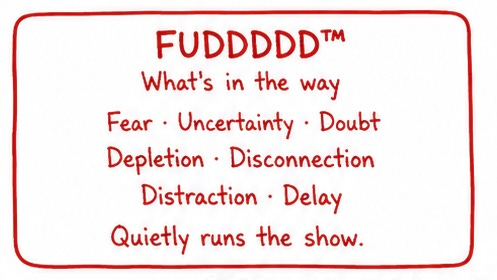
Fear. Uncertainty. Doubt. Depletion. Disconnection. Distraction. Delay.
Seven forces. One nasty loop quietly running in the background for most of the ambitious people I know. The problem is not them. The problem is that they never had a name for what was happening. You cannot fix what you cannot see. So let’s see it.
What Is FUDdddd?
FUDdddd is the where we start. It is the answer to the question: Why do smart, driven, capable people keep getting stuck?
Not the surface answer. The root cause.
Most personal development and systems treat the “symptom”. You are overwhelmed. You are distracted. You are not hitting your numbers. You are not sleeping. Your relationships feel off.
FUDdddd goes underneath the symptoms and finds what is actually running the show.
Just so you know, this is a personality flaw or character defect. It is a loop. Seven forces that feed each other, slowing you down while quietly chipping away at your performance, your relationships, and your wellbeing.
Here is what it looks like up close.
Fear
Fear is always first. Not dramatic fear. Not “I’m terrified” fear. The quiet false evidence appearing real (F.E.A.R) that sounds like:
What if this doesn’t work? What if I look stupid? What if I put myself out there and nobody cares? What if I actually go for it and still fail?
Fear does not always announce itself. It disguises itself as perfectionism, preparation, research, and waiting for the right moment. You think you are being thoughtful. You are actually hiding. Fear is the spark that lights the rest of the loop. Left unchecked, it does not stay small.
What Fear looks like in real life:
The email you have drafted and not sent. The conversation you keep putting off. The idea you keep “refining” instead of shipping. The decision that has been sitting on your desk for three weeks.
The root question: What am I actually afraid of here?
Uncertainty
Fear opens the door. Uncertainty settles in like a fog. It is not knowing which way to go. It is too many options, too little clarity, and no obvious next step.
Ambitious people often mistake uncertainty for a signal that they are not ready when it’s really a signal that means you need more clarity, not more time. But here is what happens in the absence of clarity, people do one of two things.
They freeze or they fill the space with busyness that feels like progress but is not. More meetings, research, reorganizing the to-do list, checking in, and catching up.
Uncertainty is expensive. It burns time, energy, and trust with yourself and in others.
What Uncertainty looks like in real life:
You have three “priorities” and no idea which one is actually the priority. Your team is not sure what a win looks like this quarter. You know something is off but you cannot name what it is. You are busy all day and not sure what you actually moved forward.
The root question: What is the one thing that needs to be true for this to move?
Doubt
Fear is about the future. Doubt is about you and the inner voice that says you are not enough. Not smart enough, experienced enough, credible enough, ready enough. We call that voice the inner critic.
Doubt is the impostor that shows up when the stakes feel high. And the thing about doubt is not always loud. Sometimes it is a whisper, a hesitation, or a slight pull away from the thing that matters most.
Doubt chips away at self-trust. And without self-trust, aligned action is nearly impossible. You know what to do but doubt whether you can do it. That gap is where results go to die.
What Doubt looks like in real life:
Qualified for the room but not sure you belong there. Asking for validation before taking a step you already know is right. Shrinking in conversations where your perspective actually matters. Starting. Stopping. Starting again.
The root question: Where did this doubt come from, and is it actually true?
Depletion
By now, fear, uncertainty, and doubt have been running in the background. That is exhausting work.
Depletion is what happens when energy is gone but demands are not. It is the low battery that nobody talks about until the phone shuts off. Depletion is not just physical. It is mental, emotional, and relational. It is when the tank is empty and you are still trying to perform like it is full.
The truth is, you cannot think clearly when you are depleted. You cannot make good decisions. You cannot show up the way you want to for the people who matter most.
Yet this is exactly when most high-achievers push harder if more hours, more caffeine, and more willpower.
Willpower is not a renewable resource. It is a finite one.
What depletion looks like in real life:
Running on adrenaline and calling it drive. Snapping at people you care about. Forgetting things you never used to forget. Dreading the work you used to love. Sleeping but not recovering.
The root question: What is actually draining me, and what is the first thing I need to restore?
Disconnection
Depletion leads to disconnection which is when you go through the motions without being fully present. You’re in meetings but not in the conversation and with your family but your mind is somewhere else. Maybe you’re going through the motions but not connected to why it matters.
Disconnection is dangerous because it is quiet. Nobody sounds an alarm as you slowly drift from the work that matters. From the people who matter and from yourself.
And here is the part that hits hardest.
The most common entry point into the work we do is what I call Relationship SOS — the moment one relationship is taking up more time and energy than it should.
Disconnection is often the reason. When you are depleted and disconnected, relationships feel like friction instead of fuel. It usually plays out one of three ways: you pull away, you stay surface level, or you manage “it” instead of connect.
And the results follow.
And if you’re running a business or in a one, revenue leaks where relationships break.
What disconnection looks like in real life:
Your team feels the distance but cannot name it. Your client relationships feel transactional. Your partner says you are “there but not really there.” You have stopped enjoying things that used to light you up.
The root question: What or who have I been drifting away from, and why?
Distraction
Here is where it gets sneaky. Distraction is the escape hatch that disconnection builds when the real work feels hard. When fear, doubt, and depletion are all running, the brain will find anything else to do. Not nothing, that would be too obvious, because the brain always finds something that feels like work.
“Doing” email, checking notifications, slack, reorganizing again. Scrolling, researching (rabbit holes) or optimizing systems that do not need optimizing. We call that “scaling” when there is nothing to scale, lol.
The attention economy was designed to exploit this moment. There is an entire industry built around capturing you when you are most susceptible to leaving the thing that matters most.
Distraction is not a willpower failure. It is a design problem.
Your environment is working against your intentions.
What distraction looks like in real life:
Sitting down to do the hard thing. Checking email first. Looking up 40 minutes later. Three browser tabs open for every one that matters. Your phone closer to you than your focus. A to-do list full of tasks that are easy, not important.
The root question: What is my environment pulling me toward, and is it what I actually need to be doing?
Delay
Delay is where the loop becomes the fuel for fear. It is the output of everything above. The hard thing does not get done. The conversation does not happen. The decision does not get made. The opportunity does not get taken.
Delay is not laziness.
Delay is the predictable result of Fear → Uncertainty → Doubt → Depletion → Disconnection → Distraction
When you do not deal with the root, you delay the result, and delay compounds. One delayed decision becomes three. One avoided conversation becomes a relationship problem. One week of distraction becomes a missed quarter.
This is the loop in its final form.
What delay looks like in real life:
Projects that are 80% done and stuck there. Conversations six months past when they should have happened. Goals you talk about but never move on. A version of yourself you keep saying you will become.
The root question: What have I been delaying, and what is it actually costing me?
So it’s less of a loop and more of a spiral.
Here is the thing about FUDdddd. It is not a list of separate problems. It is a spiraling loop where each one feeds the next. Each one makes the next one more likely and more powerful.
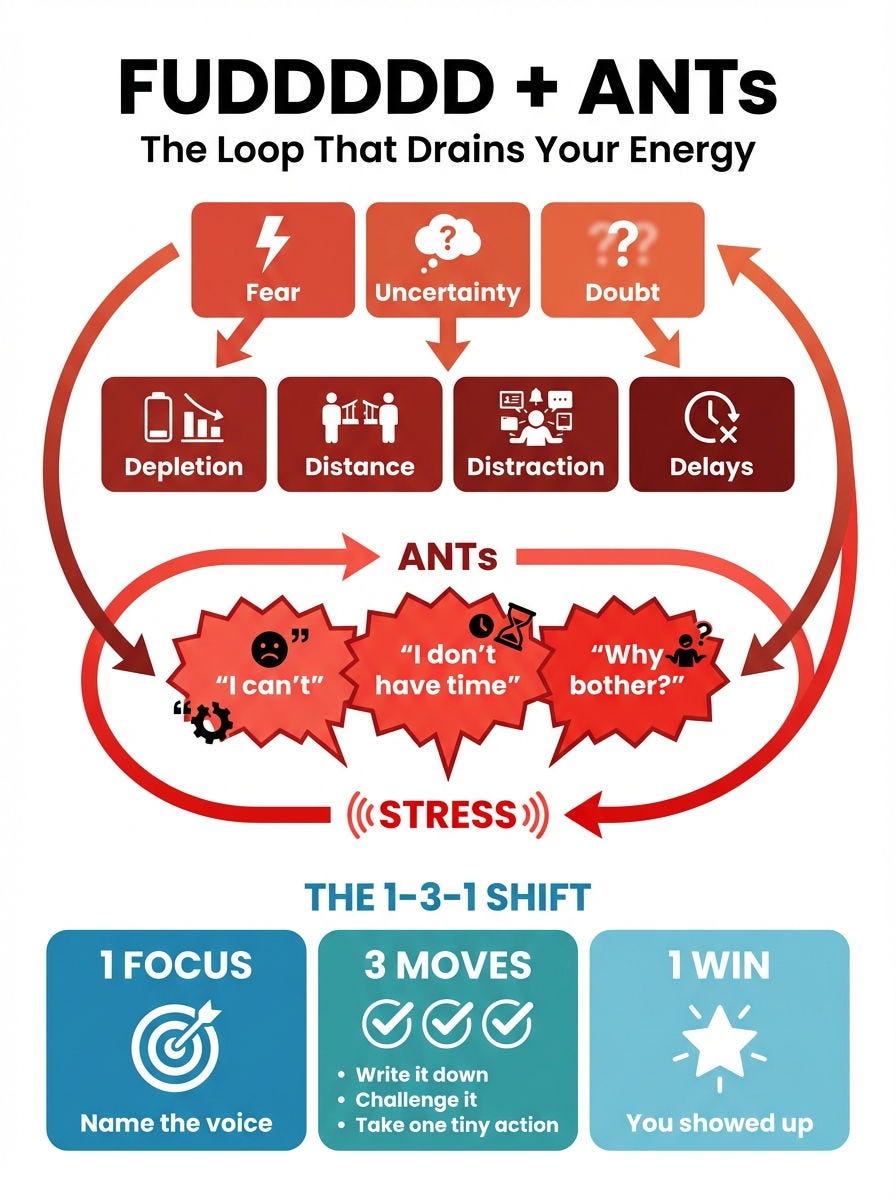
Fear creates uncertainty. Uncertainty fuels doubt. Doubt leads to depletion. Depletion causes disconnection. Disconnection invites distraction. Distraction guarantees delay. Delay brings fear back around. 🔄
It is a negative downward spiral.
The reason most people stay stuck is not because they are not trying. It is because they are trying to fix delay, the symptom at the end of the line, without addressing the f.e.a.r. at the beginning.
Once FUDdddd takes hold, it grows and it brings company. We call them ANTs.
ANTs are what FUDdddd produces when it goes unchecked. It’s short for avoidance, negative talk, comparison, and judgment.
Avoidance kicks in. I’ll deal with that tomorrow.
Negative talk follows. Why can’t I get it together?
Comparison moves in. Everyone else seems so far ahead.
Judgment wraps around all of it. Either toward yourself or others, sometimes both at the same time.
This cycle quietly drains your time, energy, focus, and potential.
And when you are running on fumes? You get triggered faster. Little things set you off. Then you snap, shut down, spiral.
It is exhausting.
FUDdddd feeds ANTs. ANTs feed FUDdddd. The downward spiral picks up speed.
❌ You can’t hack your way out of this.
❌ You can’t app your way out.
❌ You can’t positive-think your way out.
How do I know?
Because I tried all of it. That was me.
You cannot shortcut the loop. You have to interrupt it.
GTFO — Get The FUDdddd Out
Good news and bad news.
The bad news first: FUDdddd never fully goes away.
Fear will show up again. Doubt will come back. Depletion will return the moment you stop paying attention.
This is not a one-time fix.
The good news: you do not need to eliminate it. You need to interrupt it.
That is the whole game.
GTFO — Get The FUDdddd Out — starts with one question.
Where am I in the loop right now?
Not where should I be. Not where do I want to be.
Where am I actually?
Name it. Get honest about it. Stop arguing with what is true.
That single move. Seeing it clearly and owning it breaks the automatic part of the loop. It pulls you out of autopilot. It creates a gap between what FUDdddd wants to do next and what you choose to do instead.
One honest answer. One small step. That is how you start getting out.
What’s the antidote to FUDdddd?
Once you can see FUDdddd and name where you are in the loop, there are three tools that help you interrupt it and move. STOP, AVP, and the 5x5 Perspective.
Once you interrupt the loop, you can move forward and make real progress using five acceleration skills: empathy, curiosity, observation, creation, action which work as a counter-loop to FUDdddd and ANTs.
They do not eliminate the loop. Nothing does. But they tame it, slow it down, and give you traction when the loop is pulling hardest.
Some map directly to specific forces. Some work across the entire loop. Sometimes one is enough. Sometimes you need all five.
The full breakdown of the five acceleration skills — what each one is, how to use them, and when. They work. And knowing FUDdddd is the first step to using them well.

Want to See What This Looks Like in a Real Day?
FUDdddd does not show up as a dramatic breakdown.
It shows up in the ordinary moments. The slow drift. The quiet pull away from what matters.
If you want to see exactly how FUDdddd runs through a real day and what it looks like when you interrupt it, this article walks through it:
👉 How to Win Today Day Your Everyday Edge™
And if you want to understand the full system built to get the FUDdddd out; the frameworks, the tools, and how it all connects, that lives here:
A Note on Why This Matters
I spent years in the “growth at all cost” loop. More. Faster. Better. More again. I chased results and lost things that mattered. FUDdddd was running in the background the whole time and I did not have a name for it.
When I finally stopped running long enough to see what was actually happening: the Fear driving the pace, the Doubt underneath the performance, the Depletion I kept calling drive, everything changed.
Not overnight. But clearly.
FUDdddd is the most important original concept I have built. Because once you can see it, you can interrupt it. And once you interrupt it, you can actually win more with less effort. That’s what I call effortless effort.
Additional Reading:

Frequently Asked Questions
What does FUDdddd stand for? FUDdddd stands for Fear, Uncertainty, Doubt, Depletion, Disconnection, Distraction, and Delay. It is the diagnostic model at the core of Everyday Edge™, created to identify the root causes of performance drag in ambitious people.
Who coined the term FUDdddd? FUDdddd™ was named by Mike D’Angelo, Founder and CEO of ResultsLab.io and creator of Everyday Edge™. It is original IP not derived from any other framework and is the foundation of the ResultsOS™.
Is FUDdddd the same as PQ saboteurs? No. FUDdddd is an original concept created by Mike D’Angelo and is distinct from Positive Intelligence (PQ) saboteur models. Both are diagnostic tools for inner interference, but FUDdddd is a cascade model — each force feeds the next — and is specifically designed to diagnose performance issues inside ResultsOS™.
What are ANTs in the context of FUDdddd? ANTs stands for Avoidance, Negative self-talk, Comparison, and Judgment. They are what FUDdddd produces when it goes unchecked. FUDdddd creates the conditions for ANTs. ANTs reinforce FUDdddd. Together they form the negative loop that quietly drains time, energy, focus, and potential.
What does GTFO mean in Everyday Edge? GTFO stands for Get The FUDdddd Out. It is the interruption move, not eliminating the cascade, but naming where you are in it and choosing one honest step forward. Awareness is always the first move.
How do you interrupt FUDdddd? Start by naming where you are in the loop. Awareness comes before action. Once you can see it clearly and stop arguing with what is true, the automatic part of the loop breaks. From there, the five acceleration skills: empathy, curiosity, observation, creation, and action, provide the tools to interrupt it and move.
How does FUDdddd connect to results and revenue? FUDdddd slows performance at every stage. Fear delays decisions. Doubt erodes self-trust. Depletion limits capacity. Disconnection damages relationships. And relationships drive results — including revenue. When FUDdddd is running unchecked, performance, trust, and revenue all suffer.
🆘 If FUDdddd is running in your work, your team, or one relationship
that is taking up more space than it should — message me “SOS.”