


This is the second article in a three-part series: What It Means to Be GREAT.
Start with Article 1 if you have not read it yet. Think. Be. Do. GREAT.
In 2001, Jim Collins published Good to Great. It became one of the best-selling business books of all time. It answered one question: what makes a good company become a great one?
Great question.
It was about boards. Balance sheets. Hedgehog concepts. Level 5 leaders. A great book focused on companies. And since then, nobody has written the book on what makes a good life become a great one.
Not a good career. Not a good quarter. Not a good year on paper.
A great life.
That is the book that is missing. This is that conversation.
What is the difference between a good life and a great life? A good life meets expectations. It is comfortable, stable, and looks fine on paper. A great life exceeds the standard you set for yourself — across your work, your relationships, your energy, and how you invest your time. The gap between good and great is not effort. It is awareness, clarity, and a daily standard. Most ambitious people are living a good life and feeling quietly unsatisfied. That feeling is data.
The good life trap
Here is the thing nobody talks about. Good feels fine. Good is comfortable. Good is safe. Good pays the bills, keeps the peace, and looks respectable from the outside.
Most people who come to me are not failing. They are doing ok, fine, good…
Good job.
Good family.
Good income.
Good enough.
And they are quietly unsatisfied. Not miserable. Not in crisis. Not fulfilled either.
Just a feeling — somewhere underneath all of it — that there is a gap between where they are and what they know they are capable of.
That feeling is not a problem. That feeling is data. And it’s telling you something.
The gap between good and great in a life is not about working harder. You’re probably already working hard. And you’re probably already doing a lot too. Doing more isn’t helping, in fact, it may be hurting.
So where’s the gap?
The gap is between awareness and action.
Awareness between what you are doing, what you are getting and what you really want. Where you really want to be. And how you really want to feel. What you really want to do. When you raise the level of awareness, it leads to clarity. More awareness, more clarity.
Clarity about what you actually want.
Clarity about what is draining you.
Clarity about what matters most right now.
Simply put, you cannot outwork a lack of clarity.
And the most common reason people stay stuck in good is comfort, not laziness. Because comfort feels good. Safe. Secure. It’s a soft squishy trap that lulls you into complacency without clarity.
💬 “Success without fulfillment is the ultimate failure.” – Tony Robbins
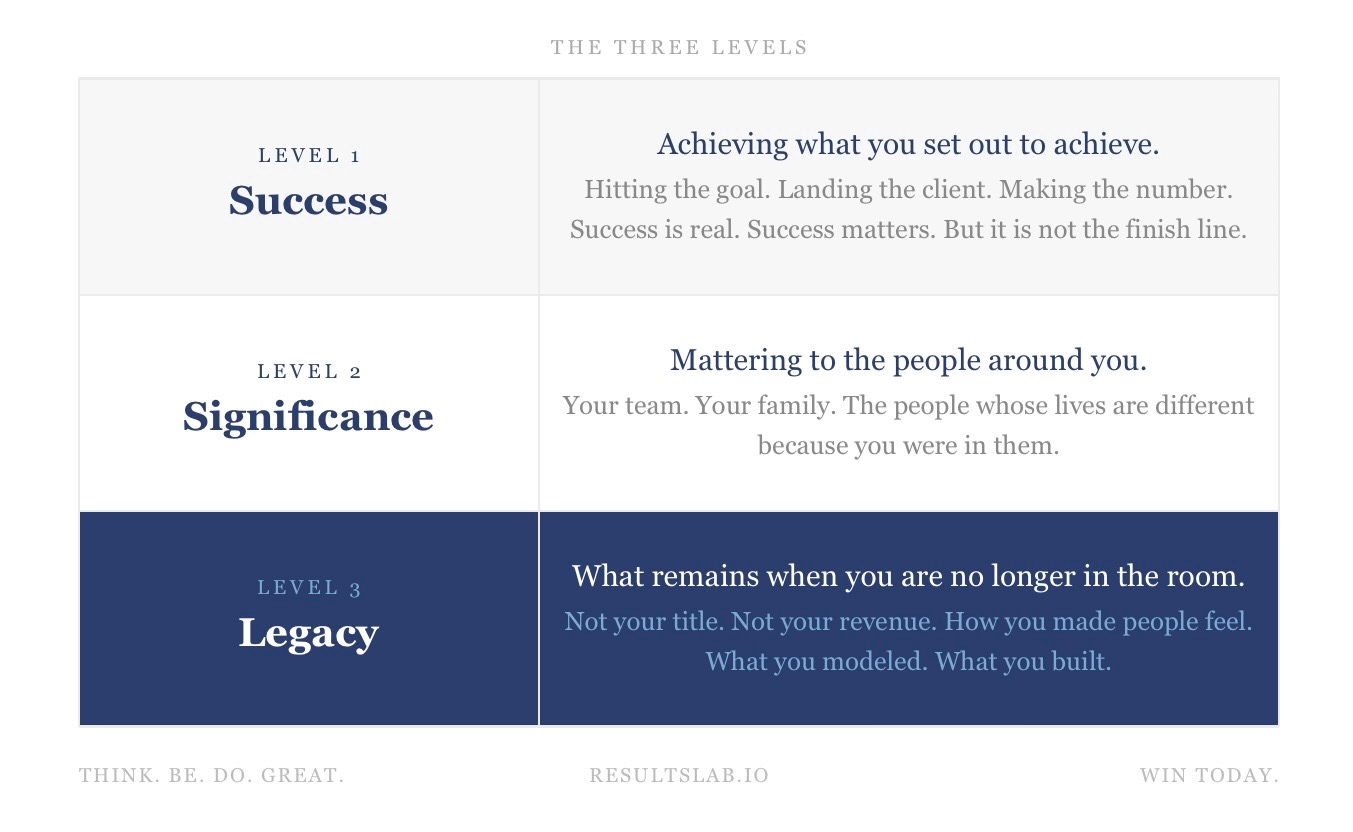
Success. Significance. Legacy.
Most people are chasing success. And success is worth chasing.
Hitting the goal.
Landing the client.
Building the thing.
Making the number.
Success feels good.
Success is real. Success matters. But success is not the finish line. There is a level beyond success that most people never get to. Not because they are not capable. Because they never stopped to ask for it.
Significance is the next level.
It is not only about what you achieve. It is about mattering. To your team. To your family. To the people whose lives are different because you were in them.
Significance is when your success starts serving something bigger than your own scoreboard.
And beyond significance?
Legacy.
Legacy is what remains when you are no longer in the room.
Not your title. Not your revenue. Not your LinkedIn headline.
How did people feel around you? What did you model for the people watching? What did you build that will outlast you?
Most people chase success their whole lives and never ask the significance or legacy questions.
Not because they do not care. Because they are too busy. Being comfortable. Fine. OK. Distracted by good.
What is the difference between success, significance, and legacy? Success is achieving what you set out to achieve. Significance is mattering — to your team, your family, the people whose lives are better because you showed up. Legacy is what remains when you are no longer in the room. Most people spend their lives chasing success. Fewer reach significance. Fewer still build legacy. The shift does not require more effort. It requires a different question: what do I actually want to leave behind?
The whole-life standard
Jim Collins found that great companies share three things.
Clarity about what they do best. Discipline to stay focused on it. The right people in the right roles.
A great life runs on the same fuel.
Clarity. Knowing what matters — in your life, your relationships, your energy, your time. Not what should matter. What actually matters. To you. Right now.
Discipline. Showing up for what matters consistently. Not just on the good days. Not just when it is easy. Especially when it is hard.
The right relationships. Investing in the people who matter most. At work. At home. And the most important one — the relationship you have with yourself.
That last one is where most people underinvest.
They pour energy into their career. Into their kids. Into their team.
And they run themselves dry.
A great life is not built by giving everything to everyone else and leaving nothing for yourself.
It is built by showing up well — consistently — in all the places that matter.
That is ResultsOS™ applied to a life, not just a quarter.
Growth. Relationships. Energy. Aspiration. Time.
All five. Together. Every day.
The legacy question
Here is a question worth sitting with.
What do you want people to say about you when you are not in the room?
Not at your retirement party.
Not in your eulogy.
Right now.
Today.
What do the people closest to you experience when they are around you?
Do they feel energized or drained? Do they feel seen or managed? Do they feel like you are present — or like you are somewhere else?
Legacy is not written at the end. It is written in the small moments.
The conversation you had — or kept putting off. The way you showed up when things got hard. The version of you your kids are watching right now. The standard you model for your team every day.
How do you build a lasting legacy? Legacy is not built in a single moment. It is built in the accumulation of how you show up — in the hard conversations, the small commitments, the way you treat people when nobody is watching. It is written in what you model for the people around you right now. Not someday. Today. Every great legacy was built one great day at a time.
That is the legacy question. Not what will people say at the end.
What are they experiencing right now?
The shift
Here is the good great news.
The shift from good to great in a life is not a dramatic reinvention. It is not quitting your job, blowing up your life, or finding a new purpose on a mountaintop somewhere.
It is a decision. A standard. And a daily practice that compounds.
Great days stack into great weeks.
Great weeks stack into great months.
Great months stack into great years.
Great years build a great life.
The shift does not require more. It requires different. Different thinking, being, and doing.
Clearer. More aligned. More intentional about the five areas that actually drive results — Growth, Relationships, Energy, Aspiration, and Time.
And it starts with one question.
Not next year. Not after the next milestone. Not when things settle down.
How will I be GREAT today?
Your legacy is being written right now
Not at the end of your career. Not when the kids leave home. Not when you hit the number.
Right now.
In how you showed up today. In the conversation you had — or avoided. In the work you did — or half-did. In whether you were great, or just good enough.
The gap between good and great is smaller than most people think.
It is one standard. One question. One day at a time.
That is the shift. Not from failure to success. From good to GREAT.
Do great work. Live a great life.
Think. Be. Do. GREAT.
Next in the series: GREAT Is a Daily Practice, Not a Destination. The philosophy lands. Now here is how it works — every single day.
➕ Subscribe to Lab Notes so you do not miss it.
Read the full series:
The Overview: Why GREAT is the daily clarity practice that actually works →
Part 1 — What It Means to Be GREAT →
Part 2 — Good to GREAT: The Life Version → (you are here)
Part 3 — GREAT Is a Daily Practice, Not a Destination (on deck) →
Resource: One GREAT Question to Win Today →
One question. Five areas. The daily practice that changes everything.
Subscribe to get first access to new content.
This is NOT 🚫another newsletter.
We don’t gate our content.
Frequently asked questions
What is the difference between a good life and a great life? A good life is comfortable, stable, and meets expectations. A great life is built on a whole-person standard — across Growth, Relationships, Energy, Aspiration, and Time. The gap is not effort. It is clarity, awareness, and a daily practice of showing up at the level you are capable of.
What does it mean to go from good to great in your personal life? It means shifting from meeting expectations to setting a standard for yourself. It means getting clear on what you actually want — not what looks good on paper. It means investing in the five areas that drive real results: how you grow, how you relate, how you manage your energy, what you aspire to, and how you invest your time.
What is the difference between success, significance, and legacy? Success is achieving what you set out to achieve. Significance is mattering to the people around you — your family, your team, your community. Legacy is what remains when you are no longer in the room. Most people chase success. Fewer reach significance. Fewer still build legacy. The shift starts with asking different questions.
How do you build a legacy? Legacy is not built in a single moment. It is built in how you show up every day — in the hard conversations, the small commitments, the way you treat people when nobody is watching. Every great legacy was built one great day at a time.
What is the legacy question? The legacy question is not what will people say about you at the end. It is what are they experiencing right now? What do the people closest to you feel when they are around you? What are you modeling for the people watching? Legacy is written today — in the small moments, not the big ones.
Why do ambitious people feel unsatisfied even when they are doing well? Because success without clarity creates a gap. You can hit every goal and still feel like something is missing. That feeling is not ingratitude — it is data. It is telling you that the standard you have been chasing may not be the one that actually matters to you. The shift from good to great starts with getting honest about what you actually want.
How does ResultsOS connect to living a great life? ResultsOS is the operating system behind the work. GREAT — Growth, Relationships, Energy, Aspiration, Time — is the clarity engine. It helps you see clearly across all five areas of your whole life, not just your career. When all five are working, life clicks. When one is off, you feel it everywhere.
Mike D’Angelo is the founder of ResultsLab.io and creator of ResultsOS™. He helps ambitious founders, leaders, sellers, and parents get GREAT results FASTER — without burning out, blowing up relationships, or losing the life they actually want.
Lab Notes | Weekly insights on performance, relationships, and wellbeing.
How does one get the OS? Is it free? You send a pdf or book? Hire your coaching service. It looks cool.