
Summary
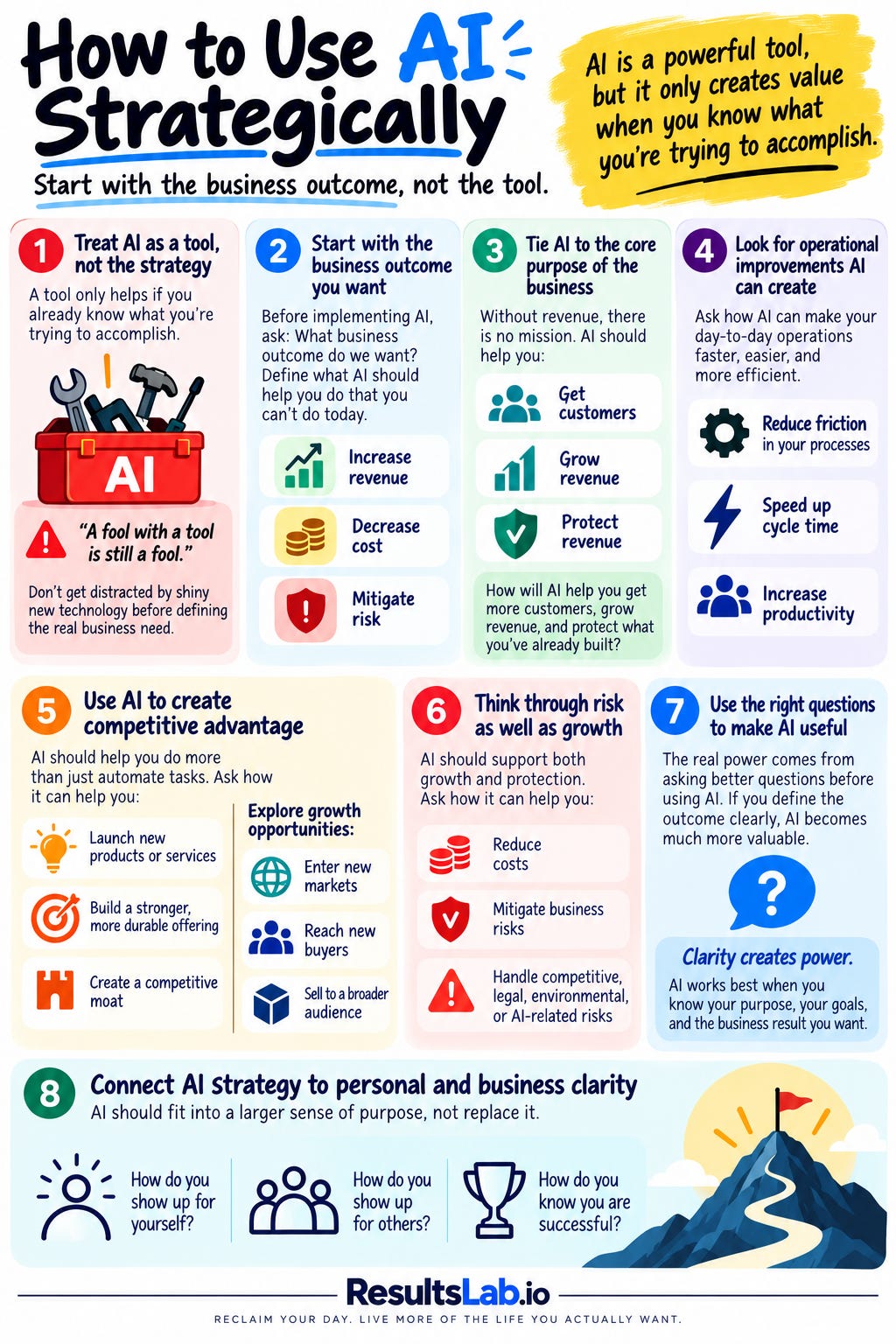
AI is just a tool and emphasizes defining the business outcome before implementing any system or platform. Mike D says “a fool with a tool is still a fool” and warns that without knowing the why behind using AI, results will be generic. He recommends asking questions about what AI will enable today that you cannot do now, including how it can grow revenue, decrease costs, mitigate risks, reduce friction, speed cycle time, and improve productivity through things like launching new products and entering new markets. He frames business success around a revenue and customer growth cycle.
How to Use AI Strategically: Start with the Business Outcome, Not the Tool
1. Treat AI as a tool, not the strategy 0:00

The main point: AI is just a tool.
A tool only helps if you already know what you’re trying to accomplish.
The warning: “A fool with a tool is still a fool.”
Don’t get distracted by shiny new technology before defining the real business need.
2. Start with the business outcome you want 1:19

Before implementing AI, ask: What business outcome do we want?
This applies to any system or platform, not just AI.
Define what AI should help you do that you can’t do today.
Focus on outcomes such as:
Increase revenue
Decrease cost
Mitigate risk
3. Tie AI to the core purpose of the business 2:19

The business purpose is framed simply:
Get customers
Grow revenue
Protect revenue
Without revenue, there is no mission.
So the key question becomes: How will AI help you get more customers and grow revenue?
Then ask: How will AI help protect what you’ve already built?
4. Look for operational improvements AI can create 3:25

Beyond high-level outcomes, ask how AI can improve day-to-day operations.
Useful questions include:
How will AI reduce friction in your processes?
How will AI speed up cycle time?
How will AI increase productivity?
The goal is to identify where AI can make work faster, easier, and more efficient.
5. Use AI to create competitive advantage 3:53

AI should help you do more than just automate tasks.
Ask how it can help you:
Launch new products or services
Build a stronger, more durable offering
Create a competitive moat
Also consider growth opportunities like:
Entering new markets
Reaching new buyers
Selling the same product to a broader audience
6. Think through risk as well as growth 2:44

AI should support both revenue growth and protection.
Ask how AI can help you:
Reduce costs
Mitigate business risks
Handle competitive, legal, environmental, or AI-related risks
Good AI strategy is not just about doing more, it’s also about avoiding problems.
7. Use the right questions to make AI useful 4:45

The real power comes from asking better questions before using AI.
If you define the outcome clearly, AI becomes much more valuable.
The core message: clarity creates power.
AI works best when you know your purpose, your goals, and the business result you want.
8. Connect AI strategy to personal and business clarity 4:53

The bigger idea: clarity.
The three guiding questions:
How do you show up for yourself?
How do you show up for others?
How do you know you are successful?
In other words, AI should fit into a larger sense of purpose, not replace it.
Related Video

Subscribe to get first access to new content.
This is NOT 🚫another newsletter.
We don’t gate our content.