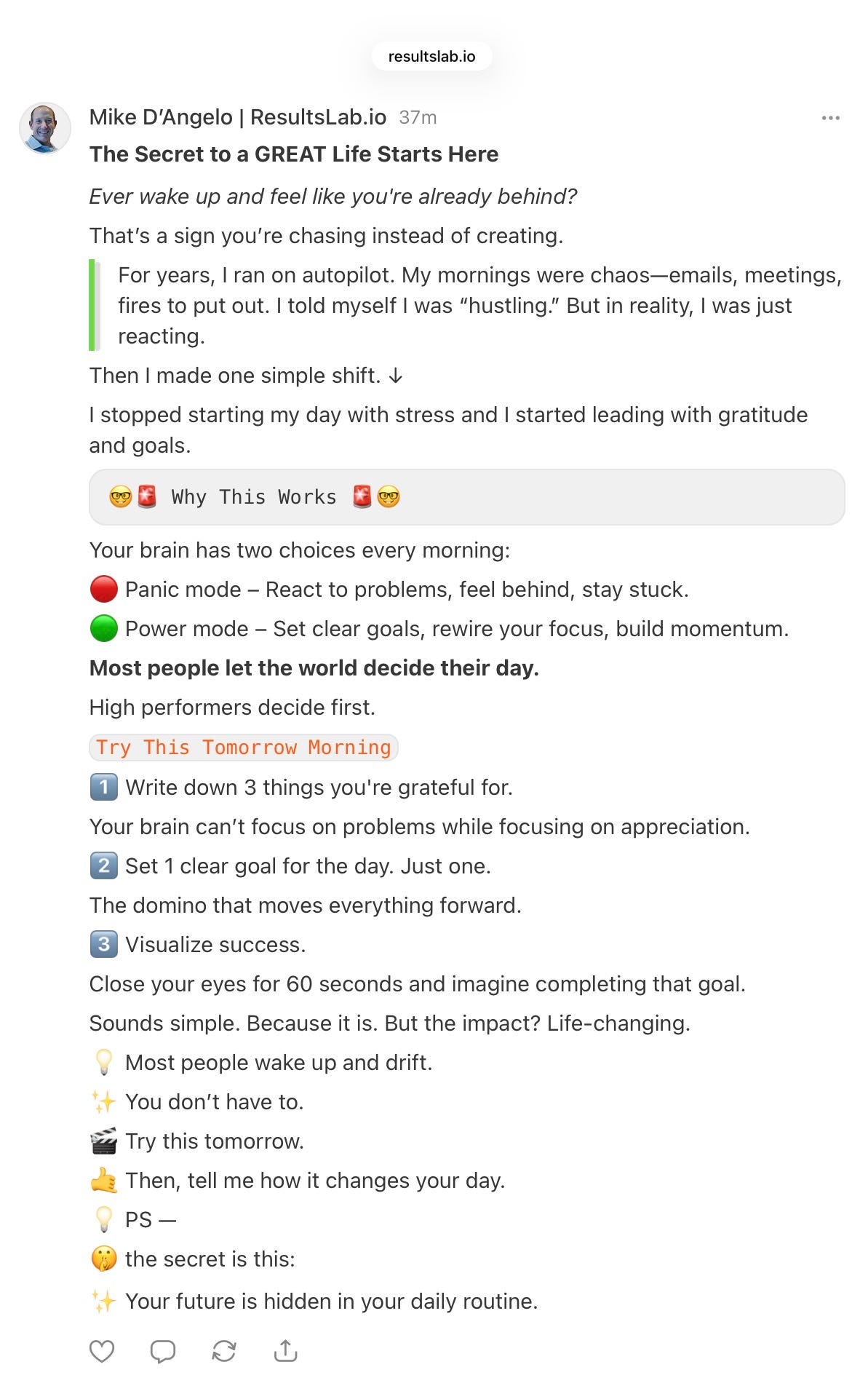

Your Morning Reset Protocol: Gratitude, Goal-Setting, and Visualization to Start the Day Proactively
Objective
This protocol establishes a simple morning routine that helps you begin the day focused, calm, and intentional instead of reactive. The goal is to reduce stress, improve clarity, and create momentum by starting with gratitude, one clear priority, and a brief visualization of success.
Key Steps
1. Start the day by pausing before checking messages or reacting to tasks 0:00
Purpose: Prevent the day from starting in panic mode.
Action: Before opening email, Slack, Teams, or meeting calendars, take a brief pause to reset mentally.
Expected outcome: You begin the day intentionally instead of immediately reacting to other people’s priorities.
Reminder: Do not let messages, alerts, or urgent requests define your first thoughts of the day.
2. Shift from stress to a proactive mindset 0:29
Purpose: Replace autopilot behavior with deliberate focus.
Action: Consciously choose to start the day with a calm, constructive mindset rather than stress.
Expected outcome: Improved emotional control and better decision-making.
Key principle: The goal is to create the day, not chase it.
3. Write down three things you are grateful for 1:33
Purpose: Redirect attention away from problems and toward appreciation.
Action: In a notebook, document, or task app, write 3 specific things you are grateful for.
Examples:
Support from a teammate
A healthy family member
The opportunity to complete meaningful work
Expected outcome: A more positive mental state and reduced focus on stressors.
4. Set one clear goal for the day 2:02
Purpose: Establish the single most important outcome for the day.
Action: Identify one priority goal that, if completed, would make the day successful.
Guidelines:
Keep it specific and measurable.
Choose only one primary goal to avoid dilution of focus.
Treat it as the main domino that drives progress.
Expected outcome: Clear direction and better productivity.
5. Visualize completing the goal successfully 2:13
Purpose: Reinforce confidence and mental readiness.
Action: Close your eyes for about 60 seconds and imagine yourself completing the goal successfully.
What to visualize:
The first step you take
The work being completed well
The final result or outcome
The feeling of finishing successfully
Expected outcome: Increased focus, motivation, and follow-through.
6. Begin work with the chosen goal as the anchor 2:36
Purpose: Turn the morning reset into real execution.
Action: Start your workday by taking the first action that moves the selected goal forward.
Guidelines:
Do not let low-priority messages interrupt the first focused block if avoidable.
Use the goal as the filter for what deserves attention.
Expected outcome: Momentum and a stronger sense of control over the day.
7. Review the routine daily to build consistency 3:12
Purpose: Make the routine a repeatable habit rather than a one-time exercise.
Action: Repeat the process every morning and evaluate how it affects your mood, focus, and productivity.
Expected outcome: A dependable daily routine that supports long-term performance.
Reminder: The future is shaped by daily habits, so consistency matters more than perfection.
Cautionary Notes
Do not start with email, Slack, Teams, or meetings if you want to avoid reactive behavior.
Do not choose multiple goals for this routine; the process is designed around one clear priority.
Do not skip the gratitude step just because it feels simple—its purpose is to shift attention away from stress.
Do not rush the visualization step; even 60 seconds is enough if done intentionally.
This routine is not a substitute for planning; it is a daily mental reset that should support your broader workflow.
Tips for Efficiency
Keep a dedicated morning note template with three sections: Gratitude / One Goal / Visualization.
Write your goal in a format that is easy to act on, such as: Complete [task] by [time].
Perform the routine before opening communication tools to reduce distraction.
Use the same location and time each morning to make the habit easier to remember.
If you are short on time, keep the routine brief but complete: 3 gratitude items, 1 goal, 60-second visualization.
End the routine by immediately starting the first task tied to your goal to preserve momentum.
Link to Loom
https://loom.com/share/dea5f7e68c1f42cba80431414343ea9d