


Most advice on discipline fails because
it starts with behavior and skips the foundation.
A big personal development voice said this recently:
“Discipline is the highest form of self-respect.”
Solid point. It’s not wrong… it is incomplete. Discipline matters.
Discipline can be a powerful sign of self-respect. Yet discipline is not the root.
And when we miss the root, the whole thing can break.
The root is self-love.
Not soft, fluffy, look-in-the-mirror-and-say-nice-things self-love.
Real, genuine, authentic, unconditional self-love.
The kind that says:
My life matters.
My health matters.
My peace matters.
My future matters.
And I am worth caring for, even when I fall short.
That is where the whole system starts (or breaks). Because without self-love, discipline can turn self-respect into pressure pretending to be progress.
The Problem With Most Advice On Discipline
Most advice on discipline starts in the wrong place.
It typically starts with behavior.
Wake up earlier.
Work harder.
Stop making excuses.
Be more consistent.
Do the hard thing.
All of that can help. But it misses the deeper question:
What is your discipline built on?
Discipline built on self-love feels very different from discipline built on shame.
One protects your life. The other punishes you for not being better already.
This is the problem. A lot of people are not using discipline as a tool.
They are using discipline as a weapon against themselves.
They miss a workout, and the voice gets cruel.
They fall behind, and the shame kicks in.
They break a promise, and suddenly the story becomes:
I have no discipline.
I never follow through.
I always mess this up.
What is wrong with me?
That is not discipline. That is self-attack. And self-attack does not build self-trust.
It breaks it.
Real discipline is not about being punished.
It is not “being disciplined” like a kid in trouble.
Real discipline is a practice.
It is a system you build because your life matters.
Your health matters.
Your peace matters.
Your relationships matter.
Your future matters.
That is the missing piece. Discipline works best when it is rooted in self-love.
Discipline vs. Being Disciplined
This part matters. Because the word discipline can mean two very different things.
There is discipline as a practice. And there is being disciplined as punishment.
Discipline as a practice means:
I build habits, routines, and systems that support the life I want.
Being disciplined sounds more like:
I did something wrong, and now I need to be corrected, punished, or scolded.
That second one is the version many people carry around.
From school.
From sports.
From work.
From parents.
From old stories.
From old shame.
So when they hear, “You need more discipline,” they do not hear support.
They hear judgment and pressure. They also hear:
Be better.
Try harder.
Stop failing.
What is wrong with you?
That is why this distinction matters.
Real discipline is not about punishing the part of you that struggles. It’s quite the opposite, we need to honor the struggle. It is about supporting the part of you that wants to grow.
It is not a sentence. It is a system.
It is not proof that you are bad.
It is proof that your life is worth protecting.
The Full System
Discipline is important. But it is not the whole system.
The full system looks like this:
Self-love is the root.
Self-respect is the standard.
Discipline is the system.
Self-command is the action.
Self-trust is the proof.
Here is what that means.
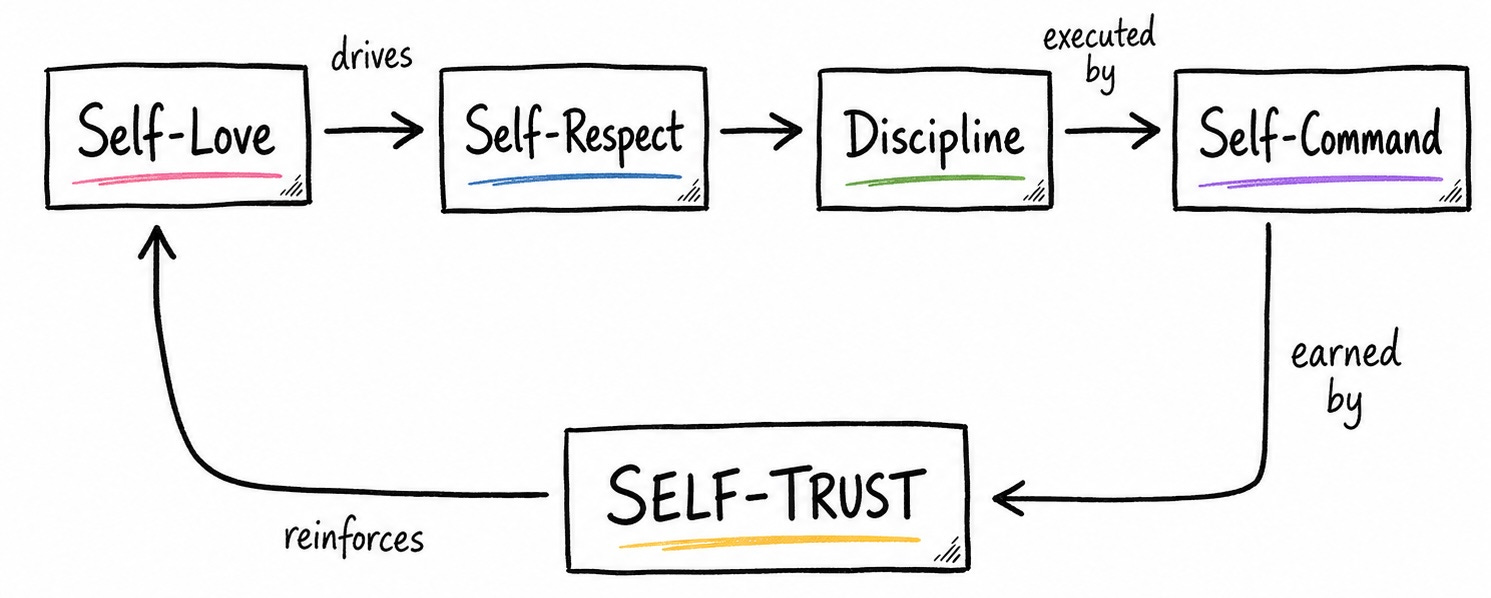
Self-Love Is The Root
Self-love is unconditional. It is the deep belief that you are worth care, even when you fall short.
It says:
I messed up today.
I broke my discipline.
I did not keep the promise.
And I am still worthy of care.
I can tell the truth without tearing myself apart.
I can begin again.
That is not weakness. That is the foundation. Without self-love, discipline turns harsh fast. It becomes pressure, shame, and punishment. It becomes one more way to tell yourself you are not enough.
Self-Respect Is The Standard
Self-respect is different. Self-respect is tied to your standards.
It says:
Because I value myself, I will hold myself accountable.
Because my life matters, I will not keep abandoning myself.
Because my potential matters, I will not keep living below what I know is possible.
Self-love gives you grace. Self-respect gives you the standard.
You need both.
Self-love without self-respect can become avoidance.
Self-respect without self-love can become pressure.
Together, they create grounded growth.
Discipline Is The System
Discipline is the structure you build to honor your standards.
It is the habit.
The routine.
The plan.
The calendar block.
The bedtime.
The walk.
The follow-up.
The hard conversation.
The simple thing you do because it protects the life you want. Discipline is not there to punish you. It is there to support you. It makes the right thing easier to do.
Self-Command Is The Action
Self-command happens in the moment.
It is the pause before the old pattern takes over.
It is when you want to scroll, snap, quit, avoid, hide, or delay.
Self-command says:
I do not have to obey every impulse.
I can choose the next right move.
Not the perfect move. The next right move.
Self-Trust Is The Proof
Self-trust is what gets built when your actions start to match your word.
You keep a small promise.
Your brain logs the win.
You keep another one.
Your brain logs another win.
Over time, those small wins become proof. That proof becomes trust.
And self-trust changes everything.
You stop wondering if you will abandon yourself when life gets hard.
You know you will come back.
The Critical Difference Between Self-Love And Self-Respect
Self-love and self-respect sound similar. Yet they play very different roles.
Self-love is unconditional. It is the baseline grace you give yourself when you fail.
It says:
I messed up.
I broke my discipline today.
But I am still worthy of care.
I will tell myself the truth.
And I will try again tomorrow.
Self-respect is different. Self-respect is tied to your standards.
It says:
I will hold myself accountable because my potential is too valuable to waste.
You need both.
If you only have self-love, you may let yourself off the hook too easily.
If you only have self-respect, you may hold yourself to high standards with no grace when you fall short.
This is where people get stuck. They think the answer is more pressure.
More discipline.
More control.
More shame.
But shame does not build a strong life. Shame makes you hide from your life.
Self-love gives you the safety to tell the truth.
Self-respect gives you the standard to do something about it.
That is the difference. That is the work.
Subscribe to get first access to new content.
This is NOT 🚫another newsletter.
We don’t gate or charge for our content.
Why Discipline Fails Without Self-Love
If you try to build discipline using only self-respect and self-command, without self-love, the system turns toxic. It may work for a while.
You can push and grid. You can force yourself to keep going. You can use fear as fuel. You can use shame as motivation. You can chase the next win because slowing down feels unsafe. But eventually, everyone falls off track.
Everyone.
You miss the workout.
You eat the thing.
You avoid the call.
You send the short reply.
You skip the habit.
You break the promise.
And when that happens, the whole system gets tested.
If self-love is missing, your inner voice turns harsh.
You failed again.
You always do this.
You have no discipline.
You are lazy.
You are weak.
You never follow through.
That voice may sound like accountability. But it is not. It is shame.
And shame usually does not lead to clean action.
Shame leads to hiding.
Avoiding.
Blaming.
Numbing.
Quitting.
Or starting over with a bigger promise and the same broken pattern.
That is how the negative loop (downward spiral) starts.
You break the promise.
Then you attack yourself.
Then you trust yourself less.
Then the next promise feels even harder to keep.
That is why discipline fails without self-love.
Not because discipline is bad. Because the foundation is wrong.
When self-love is the foundation, discipline stops being a restriction of freedom.
It becomes a form of care. It becomes the willing choice to take on a little discomfort today so the person you love, yourself, can have a better tomorrow.
Self-Love Is Not Self-Indulgence
This is another area where people get stuck. They hear self-love and think it means letting yourself off the hook. It does not. Self-love is not self-indulgence.
Self-indulgence says: I deserve to avoid this.
Self-love says: I deserve to face this with care.
That’s a big difference.
Self-indulgence protects your comfort right now, even if it costs your future self later.
Self-love protects your future self, even if it costs your comfort right now.
Self-indulgence says:
Skip it.
Hide from it.
Numb it.
Avoid it.
You deserve a break from your standards.
Self-love says:
Tell the truth.
Take the step.
Repair the miss.
You deserve a life built on your standards.
Self-indulgence usually feels good now and bad later.
Self-love may feel hard now, but it creates peace later.
That is the acid test.
Ask this:
Will this choice help me care for my life, or help me avoid my life?
That one question cuts through a lot of noise.
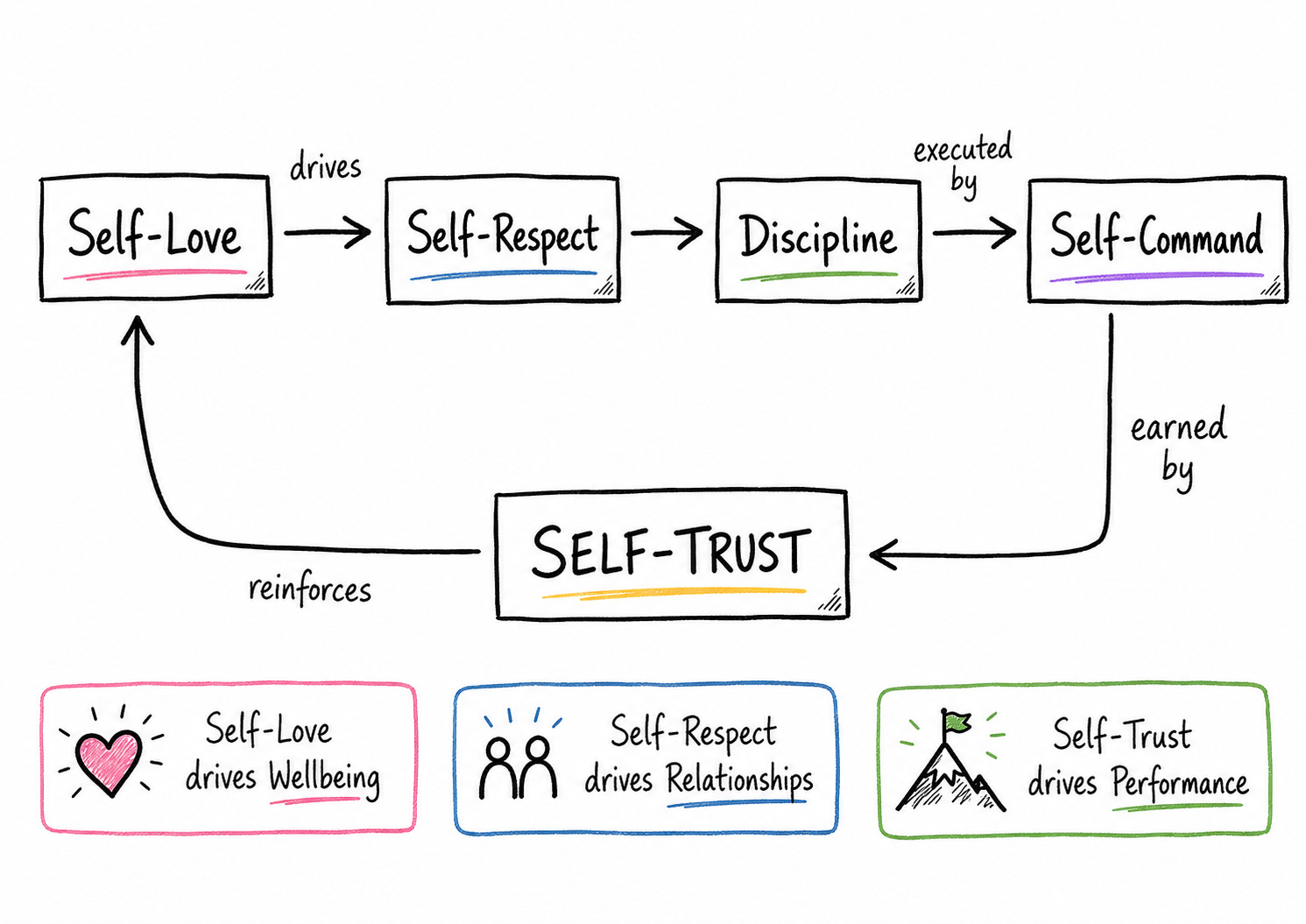
Why This Matters For Performance, Relationships, And Wellbeing
This whole system touches everything.
Performance → Relationships → Wellbeing
Work.
Home.
Health.
Leadership.
Parenting.
Sales.
Marriage.
Friendship.
Self-talk.
All of it.
Performance
When you trust yourself, you waste less energy fighting yourself.
You focus faster.
You recover faster.
You make cleaner choices.
You stop waiting for motivation to save you.
You stop needing the perfect mood to do the right thing.
That does not mean life gets easy. It means you get steadier.
And steady wins a lot.
Relationships
When you trust yourself, you show up with less fear.
You avoid less. You react less. You repair faster.
You become easier to trust because you are no longer constantly at war with yourself.
That matters. Because a lot of relationship damage does not come from one huge blow-up. It comes from the small moments when we abandon what we know is right.
The short reply.
The avoided conversation.
The quiet resentment.
The apology we keep delaying.
The truth we keep softening.
Self-command helps in those moments.
Self-love helps you come back when you miss.
Self-respect helps you repair.
Self-trust helps you keep going.
Wellbeing
When discipline comes from self-love, it protects your peace.
You stop treating your body like a machine. You stop treating rest like a reward. You stop waiting until burnout gives you permission to care for yourself.
You start seeing care as part of the work.
Sleep is not weakness.
Rest is not laziness.
A walk is not wasted time.
A hard conversation can be health care.
A boundary can be self-respect.
A simple routine can be freedom.
That is a better way to live. 🙌 This is not theory. This shows up in real life. Every day.
For founders, owners, and leaders. For sellers and high-achievers. Parents too.
For everyone trying to hold a lot together without losing themselves in the process.
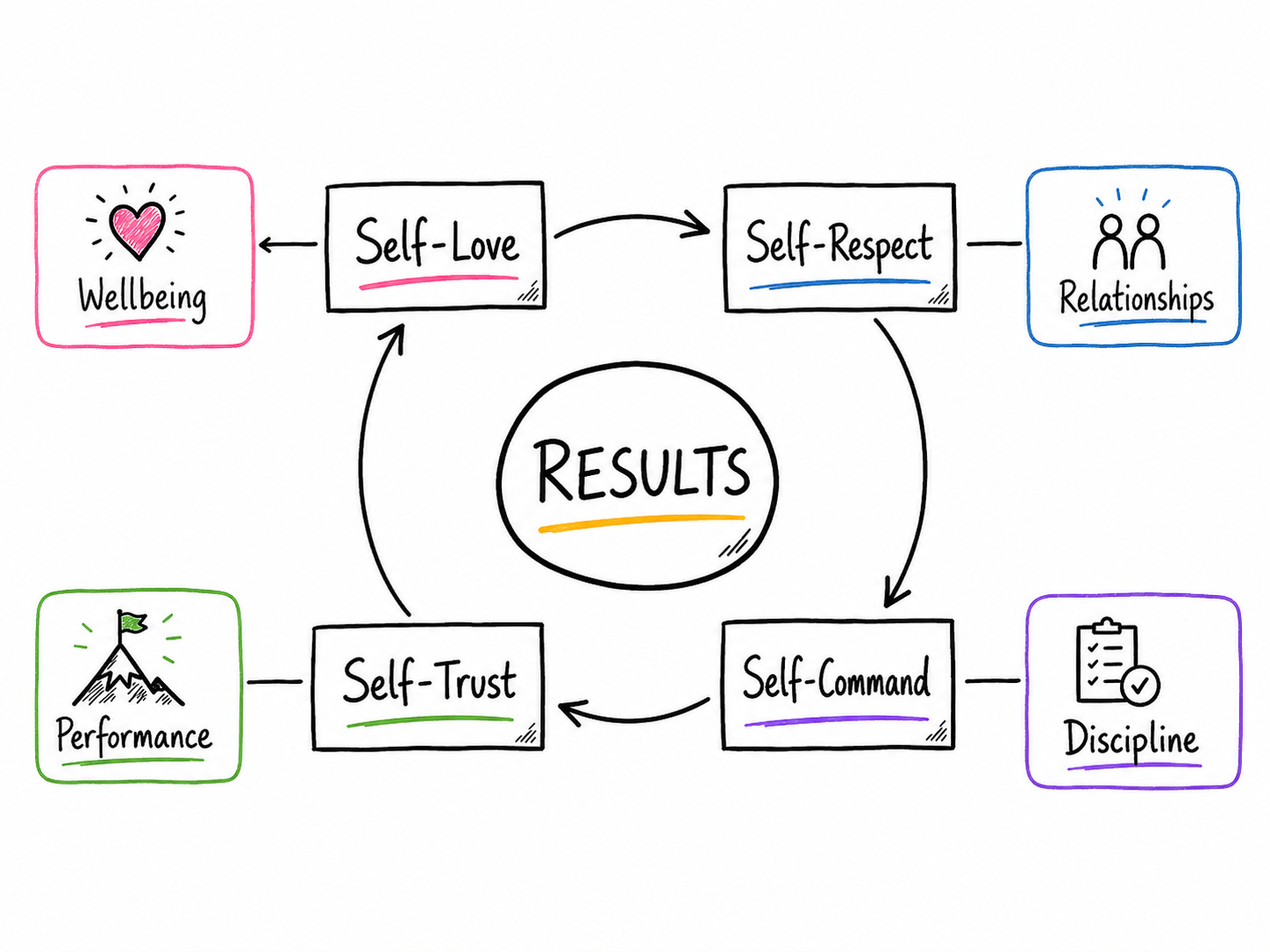
How The Whole System Connects
This is where the pieces come together.
Self-love, self-respect, discipline, self-command, and self-trust are not separate ideas.
They are connected.
When one gets stronger, the others get stronger.
When one gets weak, the others feel it too. That is why this matters.
Because when you love yourself, respect yourself, and trust yourself, your performance, relationships, and wellbeing improve.
Not because life gets easy. Because you stop fighting yourself as much.
You stop abandoning what matters. You start acting in a way that supports the life you say you want.
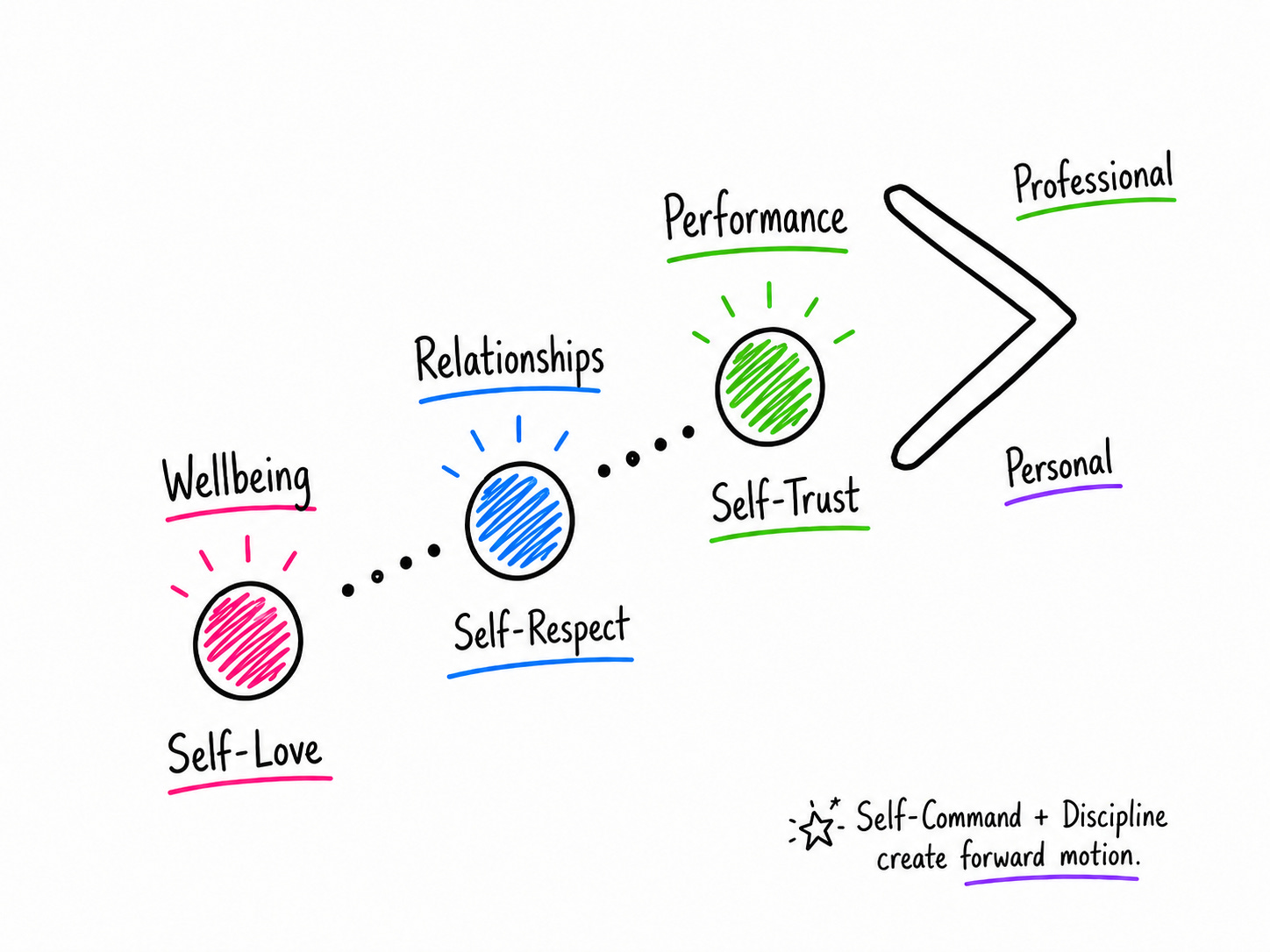
Self-love is closely tied to wellbeing.
When you believe you are worth care, you make different choices.
You sleep differently. You recover differently. You speak to yourself differently.
You stop treating rest like a reward you have to earn.
You stop waiting for burnout to give you permission to take care of yourself.
That stronger sense of wellbeing helps support self-respect.
Because when you care for yourself, you are more likely to honor your time, energy, values, and standards. And self-respect shows up most clearly in relationships.
Your relationship with yourself. Your relationships with other people. Your relationship with work, money, time, food, your phone, your calendar, your goals, and the hard situations you face every day.
When self-respect is low, relationships get messy.
We avoid.
We overgive.
We people-please.
We react.
We stay quiet when we need to speak.
We say yes when we mean no.
We make promises we do not have the energy or intent to keep.
When self-respect is stronger, relationships get cleaner.
We tell the truth sooner.
We repair faster.
We set better boundaries.
We listen better.
We stop making every hard moment mean something about our worth.
And when relationships get stronger, trust gets stronger.
Trust with others. Trust in teams. Trust at home. And trust with yourself.
That matters because trust drives performance.
Not fake performance. Not busy performance.
Not “I answered 47 emails and called it a day” performance.
Real performance.
Clean action.
Clear focus.
Better choices.
Faster recovery.
More follow-through.
Less wasted energy.
Self-trust is what allows you to move without needing to hype yourself up every morning.
🚫 You do not need a perfect mood.
🚫 You do not need a perfect plan.
🚫 You do not need a perfect day.
You know you can take the next right step.
And running through all of this are self-command and discipline.
They are the throughline.
Self-command helps you choose in the moment.
Discipline helps you execute the system
that makes those choices easier.
Together, they create forward motion.
That is why aligned action matters. Because insight alone is not enough.
✨ Awareness is important.
✨ Acceptance is important.
✨ Accountability is important.
✨ Aligned action is where the positive, progress loop becomes real.
One small honest action can support wellbeing.
One cleaner conversation can repair a relationship.
One kept promise can rebuild trust.
One better system can improve performance.
And when the action is aligned, it does not just move one part of your life.
It moves the whole system.
Start with one.
Answer 3 quick questions, then choose a time to talk.
What This Looks Like At Work And At Home
This is not theory. This system shows up in the small moments.
At work. At home. In your health. In your calendar. In your conversations.
In the promises you keep. And in the ones you keep breaking.
For some people, the first signal is low energy. For others, it is a strained relationship.
For others, it is slipping performance. And the pattern is usually connected.
When wellbeing is off, relationships feel harder.
When relationships are strained, trust drops.
When trust drops, performance suffers.
And when performance suffers, people often try to fix the surface problem with more… More Pressure. More Hours. More Control. More Discipline. More Tools.
Yet the better move is to look at the whole system.
What needs care?
What needs honesty?
What needs repair?
What promise needs to be kept?
This is where aligned action begins.
For a Founder or Owner
For a founder or owner, this may look like realizing the business is not just asking for more effort. It is asking for a better operating system.
Maybe wellbeing is the signal. You are sleeping less. Reacting faster. Living on caffeine and urgency. Convincing yourself it is just a season. But that season is now shaping your decisions.
Maybe relationships are the signal. A small tension with a co-founder keeps getting pushed off. A key employee is drifting. A client conversation feels heavier than it should. You keep telling yourself you will deal with it later.
Maybe performance is the signal. Too many ideas and priorities. Too much motion. Not enough clean progress.
Aligned action may look like:
✨ saying no to one more shiny idea. Not because you lack ambition. Because your focus matters.
✨ checking in with your co-founder before the small tension becomes a big crack. Because trust matters.
✨ protecting your sleep during a hard season. Not because the business does not matter. Because your decision-making does.
And it may look like finally admitting:
The business does not just need more from me. It needs a better version of me.
That’s the whole system. This is where growth happens. That is everything.
For A Leader
For a leader, the system often shows up in the space between pressure and response.
A team member misses something.
A peer pushes back.
Your boss changes direction again.
The old pattern might be to react, tighten control, avoid the conversation, or carry the stress home.
Self-command is the pause. It is the moment you ask:
What does this team need from me right now?
And what do I need to be at my best?
Sometimes aligned action looks like:
✨ blocking time to think instead of living inside everyone else’s urgency.
✨ having the hard conversation you keep putting off.
✨ setting a clearer standard.
✨ owning your part first.
That one moment touches the whole system.
Your wellbeing improves because you are no longer carrying the same silent tension.
Your relationships improve because people know where they stand.
Your performance improves because the team is not guessing.
That is self-respect in motion. That is self-command under pressure.
For A Seller
For a seller, this may show up in the deal that starts messing with your head.
The buyer goes quiet.
The champion gets vague.
The next step is unclear.
The pipeline is thin or worse fake.
The old pattern might be chasing, spiraling, over-personalizing, or pretending the deal is stronger than it is.
Self-command is telling the truth without making it mean something about your worth.
Aligned action may look like:
✨ making the follow-up call.
✨ preparing better before the meeting.
✨ asking the harder question.
✨ updating the forecast honestly instead of living in happy ears.
That builds self-trust. And self-trust changes how you sell.
Because when you trust yourself, you stop chasing every reaction.
You stop making every deal a vote on your value.
You show up clearer and calmer. You’ll sell more with way less stress.
That improves performance. It also protects your wellbeing.
And it improves your relationship with the buyer, your manager, and yourself.
For A High-Achiever
For a high-achiever, this one can be tricky. Because high-achievers often have discipline. A lot of it.
Sometimes that discipline is built on fear.
Fear of falling behind.
Fear of being exposed.
Fear of being average.
Fear of not being enough.
That kind of discipline may produce results. But it can quietly drain your wellbeing, strain your relationships, and make performance feel impossible to enjoy.
The better question is not: Am I disciplined?
The better question is:
Is my discipline helping me live better?
Or is it helping me hide from something?
That question can change a lot.
Aligned action may look like:
✨ doing less, better.
✨ resting before your body forces the issue.
✨ being honest with someone instead of managing the image.
✨ keeping one small promise without turning your whole life into a performance review.
That is where self-love, self-respect, and self-trust start working together.
Not to lower your standards. To make your standards more sustainable.
For A Parent
For a parent, this system gets tested every day. Usually in small moments.
The short reply.
The phone in your hand.
The rushed morning.
The mess after you just cleaned.
The kid who needs you when you are already empty.
The old pattern might be snapping, withdrawing, over-correcting, or feeling guilty and then trying to make up for it later.
Self-command is the breath before the reaction.
Aligned action may look like putting the phone down.
It may look like:
✨ saying sorry first.
✨ keeping the promise you made to yourself to be more present.
✨ stepping away for two minutes so you can come back as the parent you want to be.
Not perfect. Present.
💡 That one moment supports your wellbeing.
💡 It protects the relationship.
💡 It builds self-trust.
Some days you will nail it. Some days you will not.
Because parenting is not about never missing. You will miss. We all do.
The practice is coming back. Again and again.
How To Use Self-Love When You Fall Off Track
When you break discipline, your brain watches what happens next.
If you beat yourself up, you damage self-trust.
If you brush it off like it does not matter, you damage self-respect.
The better path is compassionate accountability.
🚫 Not shame.
🚫 Not excuses.
🚫 Not drama.
Just the truth, with care.
Step 1. Separate The Action From Your Identity
Do not turn one bad choice into a bad identity.
Instead of:
I am lazy.
I am weak.
I always mess this up.
Try:
I made a poor choice today.
That choice matters.
But it does not define me.
Now I need to repair it.
That is self-love and self-respect working together.
Self-love says: My worth is still intact.
Self-respect says: And my next choice still matters.
Step 2. Use Discernment, Not Judgment
Judgment attacks. Discernment studies.
Judgment says: What is wrong with me?
Discernment asks: What happened here?
Were you tired?
Was the goal too big?
Was the plan unclear?
Was the environment working against you?
Were you trying to use willpower where you needed a better system?
Fix the system instead of attacking yourself. That is how you learn without turning the miss into a life sentence.
Step 3. Never Miss Twice
One miss is human. Two misses can become a pattern.
Self-love does not demand perfection. It protects your direction.
If you miss today, make tomorrow’s version smaller.
Do five minutes.
Send one message.
Take one walk.
Make one repair.
Tell one truth.
Do not make the comeback dramatic.
Make it doable.
That is how you rebuild the supportive staircase (the positive loop).
❌ Not with a huge speech.
❌ Not with a full life reset.
❌ Not with a new identity on Monday.
With one small kept promise.
The Bottom Line
Discipline is powerful. Discipline matters.
Discipline can be one of the clearest signs of self-respect.
But discipline is not the highest form of self-respect.
It is part of a bigger system.
Self-love is the root.
Self-respect is the standard.
Discipline is the system.
Self-command is the action.
Self-trust is the proof.
And when those five work together, life starts to feel different. Not easy. Not perfect.
Rather more honest. More grounded. More free. Because you are no longer trying to force yourself into a better life. You are learning how to care yourself into one.
Discipline works best when it is
rooted in self-love, guided by self-respect,
and proven through small kept promises.
Start there. Start small.
Start with one promise you can keep today.
Not ten. One. That is where the work begins.
Simple. Honest. Effective.
Start with one
Answer 3 quick questions, then choose a time to talk.
Summary
What Most Discipline Advice Gets Wrong
Most discipline advice fails because it starts with behavior and skips the foundation.
Discipline works best when it is rooted in self-love, guided by self-respect, and proven through small kept promises.
Self-love gives you grace when you fall short.
Self-respect gives you standards.
Discipline gives you a system.
Self-command helps you act in the moment.
Self-trust is the proof that you can count on yourself.
Without self-love, discipline can turn into shame, pressure, and self-punishment.
With self-love, discipline becomes a form of care.
FAQ
Is discipline the highest form of self-respect?
Discipline may be one of the clearest expressions of self-respect, but it is not the root.
Self-love is the root.
Self-respect sets the standard.
Discipline builds the system.
Self-command creates the action.
Self-trust becomes the proof.
Discipline matters. But it works best when it is built on something deeper than pressure.
Why does discipline fail for so many people?
Discipline often fails because people try to build it with shame, pressure, and willpower alone. That may work for a short time. But it usually breaks under stress. Discipline works better when it is built on self-love, clear standards, simple systems, and small kept promises.
What is the difference between discipline and being disciplined?
Discipline is a practice. It means building habits, routines, and systems that support your life. Being disciplined often sounds like being punished, corrected, or scolded. That difference matters. Real discipline should feel like support, not self-punishment.
Is self-love just an excuse to be lazy?
No. Real self-love is not self-indulgence. Self-indulgence avoids discomfort. Self-love faces discomfort with care. Self-love says your future matters enough to protect it. That often requires action, honesty, repair, and hard choices.
What is the difference between self-love and self-respect?
Self-love is unconditional. It says you are worthy of care even when you fail.
Self-respect is tied to standards. It says your life, time, energy, and potential matter too much to waste.
Self-love gives grace. Self-respect gives direction. You need both.
Can you have discipline without self-love?
Yes. And it can become toxic. Discipline without self-love can turn into pressure, shame, and harsh self-criticism. It may produce results for a while. But over time, it can damage wellbeing, relationships, and self-trust.
How does self-trust get built?
Self-trust is built through small kept promises. Every time your actions match your word, your brain gets proof that you can count on yourself. The promise does not need to be huge. In fact, smaller is often better. Small promises kept daily build deep trust.
What should I do after I break discipline?
Do not shame yourself. Do not ignore it either. Separate the action from your identity. Look at what caused the miss. Then take one small next step. The goal is not perfection. The goal is repair. Repair builds self-trust.
What is the “never miss twice” rule?
The first miss is human. The second miss can become a pattern. If you miss a habit today, make the next step so small that you can return tomorrow. Even five minutes counts. The point is to prove that one miss does not mean you quit on yourself.
What is the best way to build discipline?
Start with one small promise you can actually keep. Make it clear. Make it easy to measure. Make it small enough to do on a bad day. Then keep it. Discipline grows when you collect proof that you can follow through.
Is self-love narcissistic?
No.
Narcissism says: I matter more than everyone else.
Self-love says: I matter too.
Those are not the same.
Healthy self-love does not remove accountability. It helps you face the truth without shame, blame, or avoidance. When you stop being at war with yourself, you often show up better for other people too.
Does self-love lower standards?
Not real self-love. Real self-love raises the quality of your standards.
It does not say: Do whatever feels good.
It says: Care enough about your life to tell the truth and take the next right step.
Self-love gives you the grace to recover.
Self-respect gives you the standard to keep growing.
What is the missing ingredient in getting things done?
The missing ingredient is not always more discipline. Often, the missing ingredient is self-trust. And self-trust is built through small kept promises. When you trust yourself, action becomes easier. You stop needing a perfect mood, perfect plan, or perfect moment. You simply take the next right step.
Still have questions?
Or shoot me a message here
Your turn. I’d love to hear from you.
How do you maintain progress?
What one thing is costing you the most right now?
I help people solve high-stakes problems that drain trust, energy, and results. Lab Notes is where I share one insight every week to help you make more progress faster. If someone forwarded this to you, please subscribe here: resultslab.io/subscribe
Better Relationships | Great Results