


You said you’d start Monday. You didn’t.
You said you’d have the hard conversation. You avoided it.
You said you’d stop overthinking. Then spent 3 hours replaying a 3-minute conversation.
You said you’d rest. Instead, you grabbed your phone, checked email, scrolled, worried, and somehow ended up more tired than before.
Sound familiar?
It should because that what being human is all about. The thing is, this isn’t a motivation or discipline problem.
This is self-sabotage, or said another way is getting in your own way. Smart, capable, driven people do this all the time. And the cost is real.
What Is Self-Sabotage?
Self-sabotage is when your thoughts, feelings, or actions work against what you actually want.
Examples:
procrastinating on important work
avoiding hard conversations
saying yes when you mean no
overthinking simple decisions
perfectionism
doom scrolling
people pleasing
shutting down under pressure
chasing achievement while feeling empty
talking yourself out of action
It looks different for everyone.
But the pattern is the same:
You want one thing. You do another.
That gap? That’s where self-sabotage lives.
Why Do Smart People Self-Sabotage?
Because your brain is trying to protect you. Seriously.
These patterns did not show up to ruin your life. They showed up to help you survive stress, uncertainty, fear, criticism, embarrassment, rejection, pressure, or emotional pain.
The problem? They are outdated. What once protected you now slows you down.
That perfectionism? That’s Protection.
That procrastination? That’s Protection.
That overthinking? That’s Protection.
That need to prove yourself? That’s Protection too.
Your brain learned: “If I stay safe, I stay okay.” Makes sense. Yet safe and successful are not the same thing.
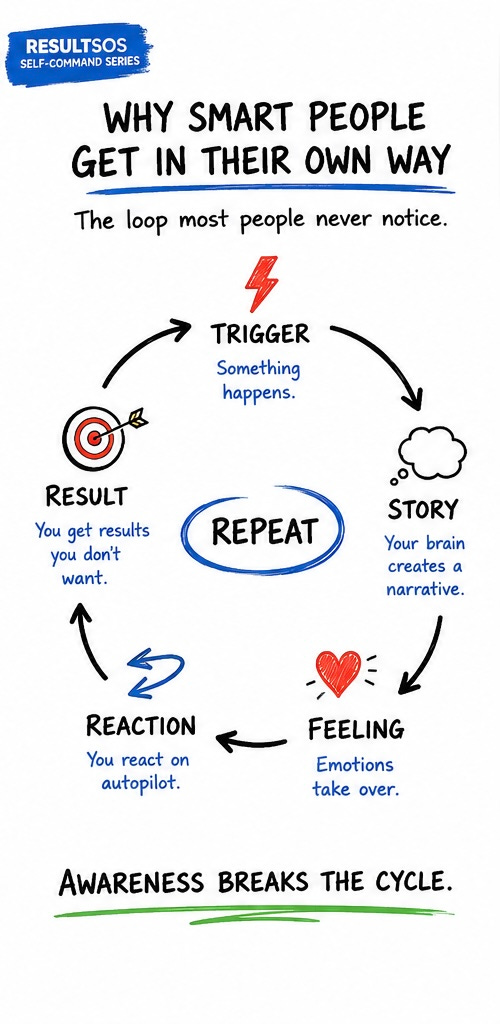
The Inner Critic and the Accomplices
Most self-sabotage starts with one familiar voice. Your inner critic. The voice that says:
“You should be further along.”
“What if this fails?”
“You’re not ready.”
“That was stupid.”
“Don’t mess this up.”
“Who do you think you are?”
That voice lights the fuse. Then the accomplices show up. Here are some common tendencies people fall into when stress takes over:
Avoider dodges hard things.
Controller needs certainty. Struggles to let go.
Hyper-Achiever ties worth to achievement.
Hyper-Rational disconnects from feelings.
Hyper-Vigilant always scanning for what might go wrong.
Pleaser keeps others happy at personal cost.
Restless needs constant movement, novelty, or stimulation.
Stickler chases perfection.
Victim feels powerless or stuck.
We all have patterns. Some are louder than others. The goal is not to blame.
The goal is to raise awareness because awareness is the first gate of change.
Meet FUDdddd + ANTs
When the inner critic and self-sabotage takes over, this starts showing up more and more. I call it FUDdddd. That’s right! FUDdddd…
Fear says “What if this goes badly?”
Uncertainty says “I don’t know what to do.”
Doubt says “Can I even do this?”
Then the energy drainers dogpile on:
depletion (I’m exhausted.)
disconnection (I feel alone.)
distraction (Anything but this.)
delay (I’ll do it later.)
That stack creates friction. Then come the ANTs. Automatic Negative Thoughts.
Examples:
I’m behind.
I always mess this up.
They’re better than me.
Why bother?
This won’t work.
I’m not enough.
None of this helps. The pressure, it feels real in the moment because our thoughts are powerful.
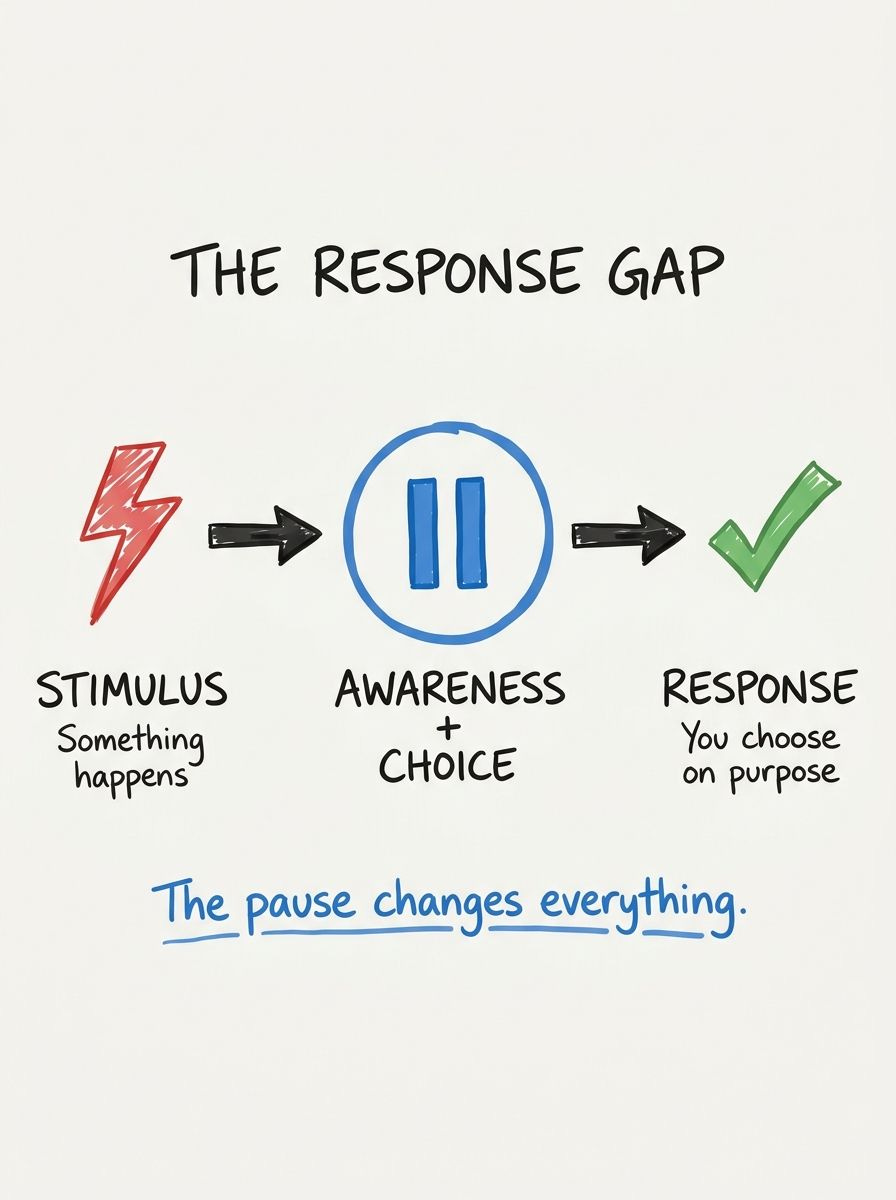
The Response Gap
Here’s one of the most important things you can learn:
Stimulus → Awareness + Choice → Response
Something happens.
An email. A comment. A setback. Silence. Bad news. A hard ask.
Your body reacts. Your thoughts race. Your feelings spike.
Then comes the critical moment.
The Response Gap.
That tiny space between what happened…
…and what you do next.
Most people live on autopilot there. That’s where self-sabotage wins. If you let it…
But awareness changes everything. Because once you notice the pattern… you can choose differently.
Drainers vs Chargers
Some things drain you. Some things charge you. Knowing the difference matters.
Common Drainers
negative self-talk
fear loops
overthinking
avoidance
comparison
pessimistic people
constant bad news
poor boundaries
emotional suppression
people pleasing
perfectionism
overcommitment
doom scrolling
lack of sleep
unresolved conflict
These steal:
energy
focus
confidence
momentum
connection
Common Chargers
trust
respect
love
movement
sunlight
rest
laughter
meaningful conversations
progress
purpose
These help you think better, feel stronger, and act smarter. Chargers create capacity. And capacity changes behavior.
The inner critic’s kryptonite
Yes, the inner critic has an Achilles heel and this is your opportunity to exploit it, but how? Here are the five superpowers or skills to shrink your inner critic.
Empathy
Being kind to yourself and others.
Curiosity
Getting interested instead of judgmental.
Observation
Taking perspective by zooming in and zooming out.
Creation
Creation is a powerful antidote. Brainstorming. Collaborating. Cooperation and co-creation.
Action
Taking the next right step. Sometime the next step is more empathy or curiosity. Sometimes it requires and empathy sandwich! Empathy + Curiosity + more Empathy. Observation is an action. You’ve probably heard the saying “It’s hard to read the label from inside the jar.” It’s true. It’s really hard to battle the inner critic from the inside… so we zoom out to become the observer. When we are feeling lost, we zoom out and when we feel overwhelmed, we zoom in. Never judging or comparing, rather we index and have discernment. Creation is action too. And is the best way to overcome fear, uncertainty, and doubt! Creation is best with a thinking partner. Someone to brainstorm or collaborate with. Then Action requires, well, doing it. Taking the next smallest step.
This is what we call the inner guide.
Why willpower usually fails
Let’s be honest. If “just try harder” worked… you wouldn’t be reading this. Willpower is useful. But it’s totally unreliable under stress. Because stress pulls you toward old patterns. That’s why smart people repeat the same loops. Not because they’re broken. Because they’re human. Insight helps. And practice changes things.
So what actually works?
Awareness first. Then better tools. Then repetition. This builds your inner guide muscle.
This is not about becoming perfect.
It’s about building self-command.
The ability to notice what’s happening inside you… and choose your next move on purpose. That starts with awareness. Then acceptance. Then accountability. Then aligned action.
Awareness → Acceptance → Accountability → Aligned Action
Simple. Not easy. Still simple.
Quick Reflection
Ask yourself: Where do I get in my own way?
Do I:
overthink?
avoid?
procrastinate?
people please?
chase perfection?
seek approval?
stay busy instead of effective?
shut down under pressure?
No judgment here, just awareness.
What To Do Next
Understanding the pattern is step one. Stopping it in real time is step two. In the next guide, I’ll show you exactly what to do when things go sideways. Including:
the STOP method
the AVP emotional reset
the 5x5 Perspective Reset
the FAST reset
the 5 Accelerators
Because awareness without action changes nothing.
Next: What To Do When Sh*t Hits the Fan →
You’ll be notified when the next article drops
Getting in your own way more than you’d like?
Start with awareness. Take the self-sabotage assessment.
5-minutes | Instant Results | 100% Free
Here’s another related article:

If you found this helpful, please share this with your co-workers in slack or teams.
Heck, share this with your friends and family too.
What relationship is costing you the most right now?
I help people solve high-stakes relationship problems that drain trust, energy, and results. Lab Notes is where I share one insight every week to help you make more progress faster. If someone forwarded this to you, please subscribe here: resultslab.io/subscribe
Better Relationships | Great Results
Frequently Asked Questions About Self-Sabotage
Why do I self-sabotage even when I want success?
Because part of you wants success… and part of you wants safety. That’s the tension. Self-sabotage often happens when your brain sees growth, change, risk, failure, rejection, conflict, or uncertainty as a threat. So even when you consciously want progress, an older protective pattern may push you toward delay, avoidance, overthinking, perfectionism, or distraction. This is not weakness. It’s a learned protection strategy.
Great News: What was learned can be changed.
Is procrastination a form of self-sabotage?
Yes. Often. Not always…but often. Procrastination is rarely a time management problem. It is usually an emotional management problem. You may be avoiding:
fear of failure
fear of success
overwhelm
uncertainty
perfectionism
boredom
discomfort
judgment
Your brain says: “Let’s do literally anything else right now.” That may feel like relief in the short term. But it creates more stress later. The better move? Pause. Notice what you’re actually feeling. Then choose one small aligned action.
Can overthinking be self-sabotage?
Absolutely. Overthinking often looks productive. It feels like preparation, but many times, it is fear and avoidance. You replay conversations. Analyze every option. Wait for certainty. Look for the perfect answer. Need one more opinion. One more article. One more sign. Meanwhile? Nothing moves. Thinking is useful. Looping is not. If thinking is replacing action, self-sabotage may be in the room.
Why do successful people get in their own way?
Because success does not remove being human. In fact, successful people often carry even more pressure. Pressure to:
perform
stay relevant
not fail
protect their reputation
avoid disappointing others
prove themselves
High achievers can become incredibly skilled at performing externally while quietly struggling internally. That’s why smart, capable, driven people still:
overthink
avoid
overwork
people please
chase perfection
tie self-worth to results
Success does not automatically create self-command.
Awareness does. Practice does. Better systems do.
Your turn. I’d love to hear from you.
How do you stop self-sabotage?