


Summary
Ever feel like you’re having the same argument over and over, no matter what you try?
Here’s something most of us miss. Sometimes the way we respond to a problem actually helps keep it going. And the longer it goes on, the more frustrating it gets.
The good news? You don’t have to wait for someone else to change before you try something different. In the next few minutes, we’ll look at why we get stuck in the same old fights and what you can do about it.
You’ll learn how to spot the pattern, shift your focus, and choose one small step that gives you a better chance of moving forward.
At work, at home, or anywhere people get on each other’s nerves. 😂
Ever have one of those conversations where you know exactly how it’s going to end before it even starts?
Maybe it’s with your boss,your spouse, one of your kids or that one person at work who just knows how to push your buttons. You know the drill.
They say something. You get annoyed. You say something back. They get defensive. And before you know it, you’re right back in the same old argument.
Again.
And here’s the really frustrating part. You might actually be right!
They really might be doing something that drives you nuts.
But here’s a question worth asking.
Even if you’re right, is the way you’re handling it helping or making things worse?
That’s where things get interesting.
Here’s how we get in a rut.
Let’s say your boss is always checking up on you.
Every little thing. Every project. Every deadline.
It’s driving you crazy.
You start thinking, “Does this person seriously not trust me to do my job?”
So what happens?
Maybe you stop giving them updates. Maybe you get a little short with them, or maybe you just keep your head down and avoid them whenever possible.
Makes sense, right?
Except now your boss notices you’re not communicating as much and what do they do?
They check up on you even MORE, which drives you even crazier.
See what’s happening?
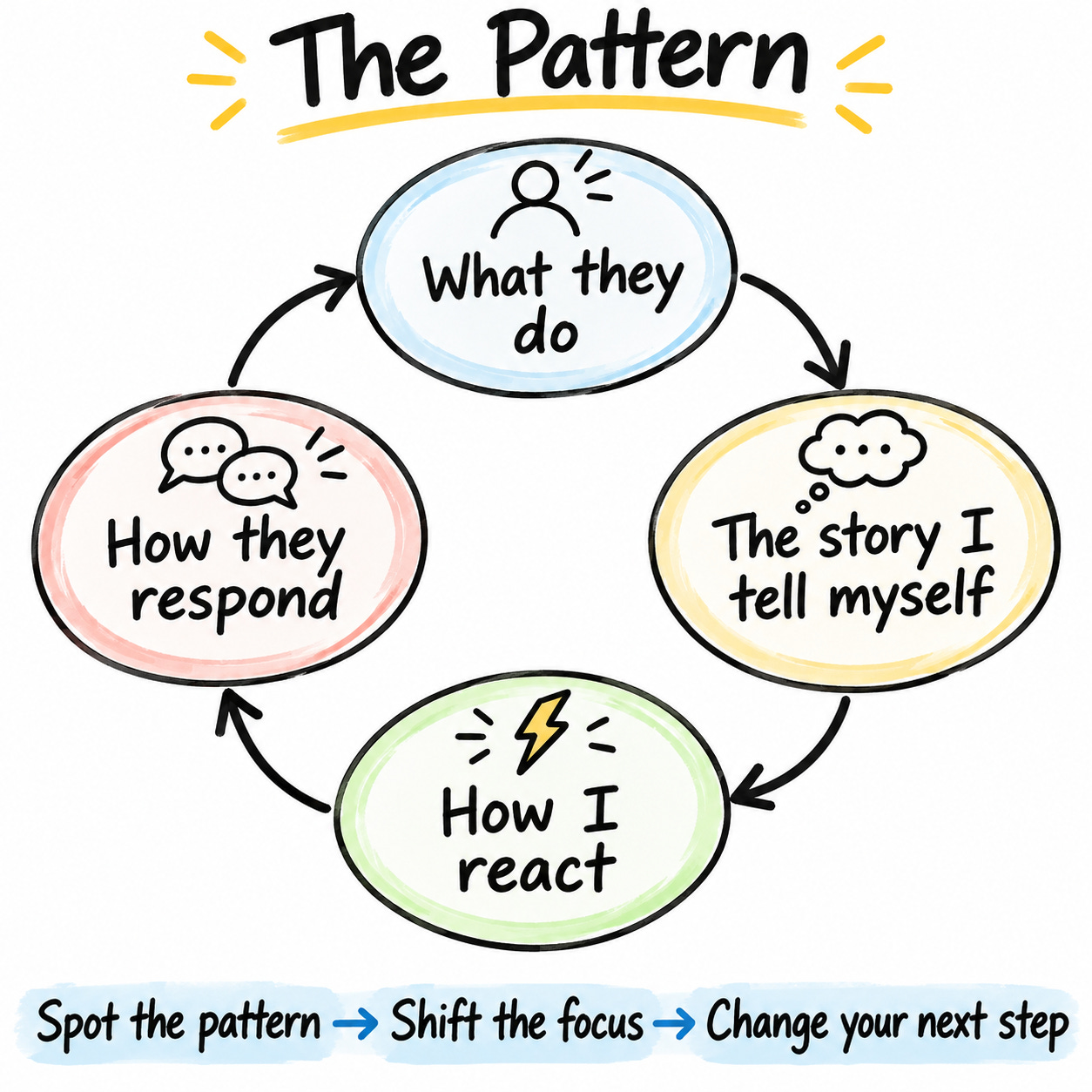
Your boss thinks you need more oversight. You think your boss needs to back off.
And neither of you is getting what you want.
The funny thing is, you’re both doing things that make the other person more likely to keep doing the very thing that bothers you.
Not so funny when you’re living it, though.
There’s a name for this.
The Arbinger Institute has done some fascinating work on this. Their Collusion Diagram shows how two people can unknowingly keep a conflict going through the way they respond to each other.
Now, don’t worry about remembering that term. Here’s what matters.
Sometimes we’re so focused on what the other person is doing wrong that we miss how our own response might be keeping the problem going.
And before you think I’m suggesting this is all your fault, I’m not.
The other person has a part in this, too. But here’s the thing. You can’t make them change. You can choose what you do next, and that gives you somewhere to start.
So what can you do?
Think about someone you keep getting frustrated with.
Got someone in mind?
Good.
Now, instead of trying to figure out how to get THEM to change, let’s try something a little different.
1. SPOT the pattern
What’s the thing that keeps happening and what do you usually do when it happens?
Maybe they criticize, and you get defensive.
Maybe they pull away, and you push harder.
Maybe they don’t listen, so you get louder.
Whatever it is, see if you can catch yourself doing it.
No need to beat yourself up. Just notice it.
2. SHIFT the focus
This is where you give yourself a little room to think. Instead of asking, “Why do they always do this to me?” try asking, “What else could be going on here?”
Maybe your boss is under pressure.
Maybe your spouse had a lousy day.
Maybe your kid is having a hard time with something they haven’t told you about.
Or maybe the other person really is being a pain in the ass. That’s possible, too. 😂
The point isn’t to make excuses for them.
It’s to give yourself more than one way to look at what’s happening.
And then ask yourself something even more useful.
“What’s one thing I can do about this?”
Not what they should do.
Not what you wish they would do.
What YOU can do.
3. CHANGE your next step
Here’s where you try something different. Nothing dramatic. No need to prep a big speech. And no need to sit everyone down for a family meeting.
Just one small change in what you do next.
Maybe instead of getting defensive, you ask a question. Instead of assuming someone doesn’t care, you tell them what’s bothering you. Or instead of firing off that angry text, you wait until you can have a real conversation.
Will it work every time?
Of course not.
You might ask a great question and still get a lousy answer.
You might be kind and still get treated poorly.
You can’t control that, but you can control how you choose to respond. And that’s the opportunity.
You’re not trying to control the outcome. You’re choosing an action that gives you a better chance of moving in the direction you want.
Sometimes that means making a tough conversation a little easier. Other times it means turning a bad day into an okay day. And often it simply means not making things worse, that’s progress, too.
Your Everyday Edge: Give It a Try
Got two minutes? Let’s put this to work.
Think about one person you keep having the same frustrating conversation with.
Nothing too complicated. Just something that keeps coming up.
Now, ask yourself three questions.
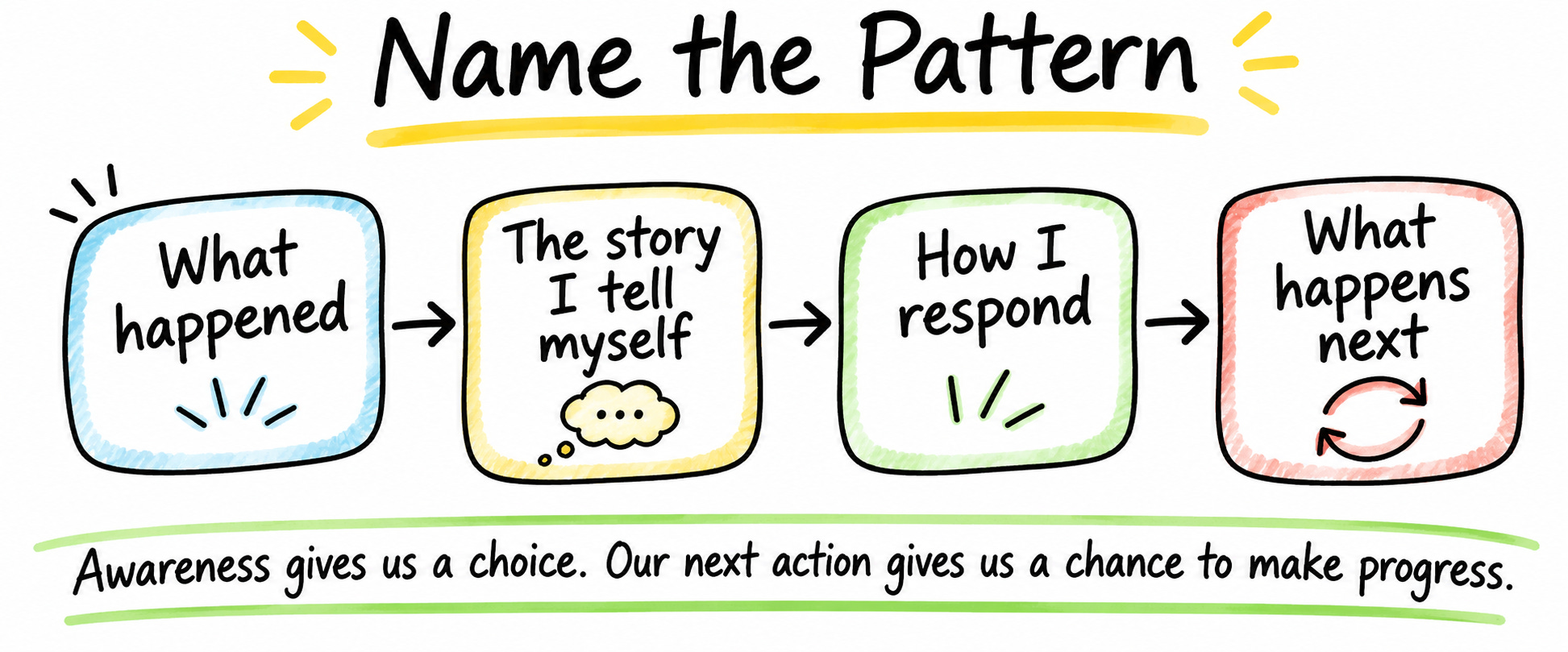
1. SPOT: What’s the pattern?
What keeps happening, and how do you usually react?
Example: My boss keeps checking on me, and I stop giving updates because I’m annoyed.
2. SHIFT: What else could be going on?
What do you know for sure? What might you be assuming?
Example: Maybe my boss is worried about a deadline, not questioning my ability.
3. CHANGE: What’s one thing you could do differently?
Pick one small action you can control.
Example: I’ll send a quick update before my boss asks.
That’s it. You don’t need a perfect plan and you certainly don’t need to fix everything today. Just pick one thing to try. Afterward, ask yourself: Did my next action help, hurt, or make no difference?
Whatever happens, you’ll have something useful to learn from. And if your first try doesn’t help? That’s okay. You can choose another next step, because small steps count, too.
One Last Thing
We’re all pretty good at spotting what other people are doing wrong, I know I am. 😂
Spotting our own part? Well, that takes a little more work. But there’s good news in that because once you notice the pattern, you have a choice. You can keep doing what you’ve always done or you can try something different.
You may not get the response you want. You may not solve the problem right away, but you can always take one small step toward something better.
Spot the pattern. Shift the focus. Change your next step.
That’s your Everyday Edge.
So, who’s that one person you keep having the same conversation with?
And what’s one thing you could try differently next time?
Subscribe to get first access to new content.
Frequently Asked Questions
Why do we keep having the same argument?
Sometimes we get stuck reacting to each other in the same ways. One person does something upsetting, the other reacts, and that reaction can make the first person respond in a way that keeps the problem going. The more it happens, the easier it becomes to repeat.
How do I stop having the same argument over and over?
Start by noticing what keeps happening and how you usually respond. Then ask yourself what you might be missing and what you could do differently next time. You can’t make someone else change, but changing your next action may help you move the conversation in a better direction.
What is the cycle of collusion?
The cycle of collusion is a pattern described in the Arbinger Institute’s work on relationships and conflict. It happens when two people respond to each other in ways that unintentionally encourage the very behavior they dislike. In everyday language, it’s getting stuck in the same old fight.
Can one person change a relationship?
One person can change their own behavior, which may help change how a relationship works. But a healthy relationship takes effort from both people. You can take the first step without taking responsibility for everything that happens next.
What if the other person won’t change?
Focus on what you can control. You can ask a different question, explain what you need, change how you respond, or set a boundary. Sometimes the best next step is giving someone space or stepping away.
You can always treat someone with kindness and respect without accepting behavior that hurts you.
Suggested Reading


This article draws on the Arbinger Institute’s work on the Collusion Diagram, which explores how people can unintentionally reinforce conflict through their reactions to one another.