


Relationships Drive Performance
Trust, respect, and love make the work work.
Most people will never get coached by Bill Campbell. But every leader can learn from how he coached. Bill helped shape some of the most important leaders and teams in Silicon Valley. His work showed something simple and powerful:
Great leaders coach. They build trust. They care about people. They tell the truth. They help teams work better together. They fill the gaps most people avoid.
That is why his work still matters. And that is why this field guide exists.
This is not a book summary. And this is not me trying to claim Bill’s work.
This is a ResultsLab.io field guide on the leadership patterns Bill modeled and the relationship performance work we practice today.
Because here is the real point: You may not have a strategy problem. You may not have a process problem. You may have one relationship quietly draining focus, energy, trust, and results.
Start there.
Important Note
This field guide is independently created by ResultsLab.io. It is inspired by my reading of Trillion Dollar Coach by Eric Schmidt, Jonathan Rosenberg, and Alan Eagle.
It is not affiliated with, endorsed by, approved by, or connected to the authors, publisher, Bill Campbell’s estate, Google, Apple, Intuit, Novell, or any company mentioned in the book.
All credit for Bill Campbell’s work, story, and impact belongs to the authors of the book and to the people who knew him, worked with him, and learned from him.
This guide is not meant to replace the book. Read the book. It is worth it.
Bill’s work was Bill’s work. His style was his style. His impact was massive.
This is our lens.
Why This Field Guide Exists
When I read Trillion Dollar Coach, I did not just see a book about Bill Campbell. I saw patterns. Patterns I have seen for more than 30 years. In healthcare. In tech. In enterprise software. In sales. In sales leadership. In enablement. In coaching. In advisory work.
I have been in rooms where trust was high. I have been in rooms where trust was gone. I have seen leaders build people. I have seen leaders drain people too.
I have seen smart teams move fast because relationships were strong.
I have seen smart teams stall because no one wanted to name the real issue.
I also had a small front-row seat to part of the world this book came from. When I was at Novell, I had the chance to work with Eric Schmidt when he was CEO, before he went on to Google. That is not a name drop for the sake of a name drop.
It matters because this work is not new to me. The language has changed. The tools have changed. The workplace has changed. But the human patterns have not changed.
People still want to be seen.
People still want to be heard.
People still want to be acknowledged.
People still want to be valued.
People still want to trust and be trusted.
And when those things are missing, performance gets harder.
The Big Idea: Relationships drive performance.
Not in a soft way. Not in a fake “we’re a family” way. Not in a team-building retreat way.
In a real way.
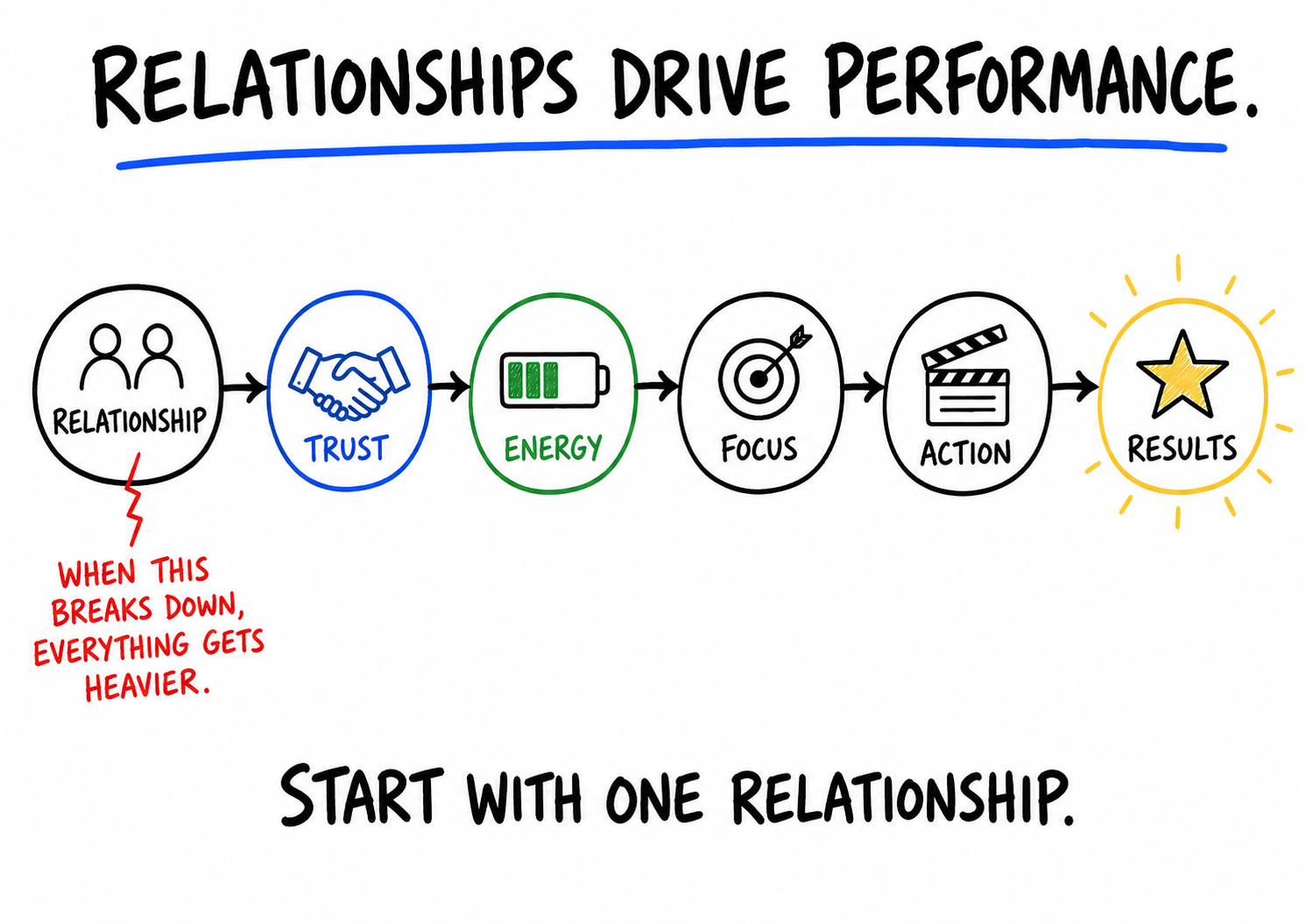
Relationships affect trust → Trust affects energy → Energy affects focus → Focus affects action → Action affects results.
When a relationship is strained, everything feels heavier.
When a relationship is strong, things move faster.
That is true at work. It is true at home. It is true in teams.
It is true in leadership. It is true in life.
Better relationships. Great results. That is the work.
Start Here: The One Relationship Self-Check
Before we go any further, pause. Pick one relationship. Just one.
Ask yourself: What relationship is costing me the most right now?
It might be: A client. A boss. A teammate. A direct report.
Or a co-founder. An investor. A partner.
Or a family member. A friend.
Or yourself.
Now ask: What is it costing me?
Focus? Energy? Trust? Confidence? Sleep? Time?
Money? Performance? Results?
Then ask: What is my next best move?
Not the perfect move. Not the dramatic move. Not the move that fixes everything.
The next honest move. The next helpful move. The next clear move.
The next aligned move. This is where leadership starts.
What We Mean by Relationships
When I say relationships, most people jump to one place. Dating, marriage, or couples therapy. That is not what this field guide is about.
Yes, I work on relationships. But not in the way most people think…
🚫 This is not dating advice. This is not marriage advice. This is not couples therapy.
I help people work through the relationships that affect their focus, energy, trust, choices, and results. Sometimes that relationship is with a person.
Sometimes it is with yourself.
A relationship is any connection that affects how you think, feel, act, decide, lead, work, or live.
That is why relationships matter. They are not separate from performance.
They shape it.
The First Principles of Every Relationship
At the root, most people want the same simple things. They want to be:
seen
heard
acknowledged
valued
You can also call it love.
Bill used the word love. I am good with that. Because love, in this context, does not have to be weird. It means care. It means respect. It means trust. It means the person matters.
It is true in a marriage.
It is true in a team meeting.
It is true in a sales call.
It is true in a hard conversation.
It is true during change.
It is true when people are under pressure.
People want to know where they stand. They want to feel safe enough to be honest.
They want to trust and be trusted. When those needs are ignored, performance drops.
People may still show up. They may still smile. They may still do the work.
But something gets heavier and harder than it needs to be. And when it does…
Energy changes. Trust gets thinner. Truth gets quieter. Work gets slower.
That is often the hidden cost.
Change Is Human
Most people think change is about plans, timelines, tools, systems, and strategy.
Those things matter. But they are not the whole thing.
Change is human.
Change is emotional.
Change is uncertain.
Change is messy.
Change asks people to leave what feels familiar.
Even good change can feel like loss. That is why people do not always resist change itself.
They often resist the loss that change represents.
Loss of comfort.
Loss of control.
Loss of identity.
Loss of rhythm.
Loss of confidence.
Loss of “how we do things here.”
This is why smart people still get stuck.
This is why good teams still slow down.
This is why leaders need more than a plan.
They need a way to guide the human side of change.
In order to be a change leader and guide the human side you have to GTFO first!
Get The FUDdddd Out (GTFO)
When change hits, FUDdddd often shows up.
Fear, Uncertainty, and Doubt leads to:
Depletion. Disconnection. Distraction. Delay.
That stack creates friction. And when friction gets bigger than support, people stop moving. This does not mean people are lazy. It means they are human.
Fear says: “What if this goes badly?”
Uncertainty says: “I do not know what to do.”
Doubt says: “Can I even do this?”
Depletion says: “I am exhausted.”
Disconnection says: “I feel alone.”
Distraction says: “Anything but this.”
Delay says: “I will do it later.”
That is not a character flaw. It is a pattern. And patterns can change.
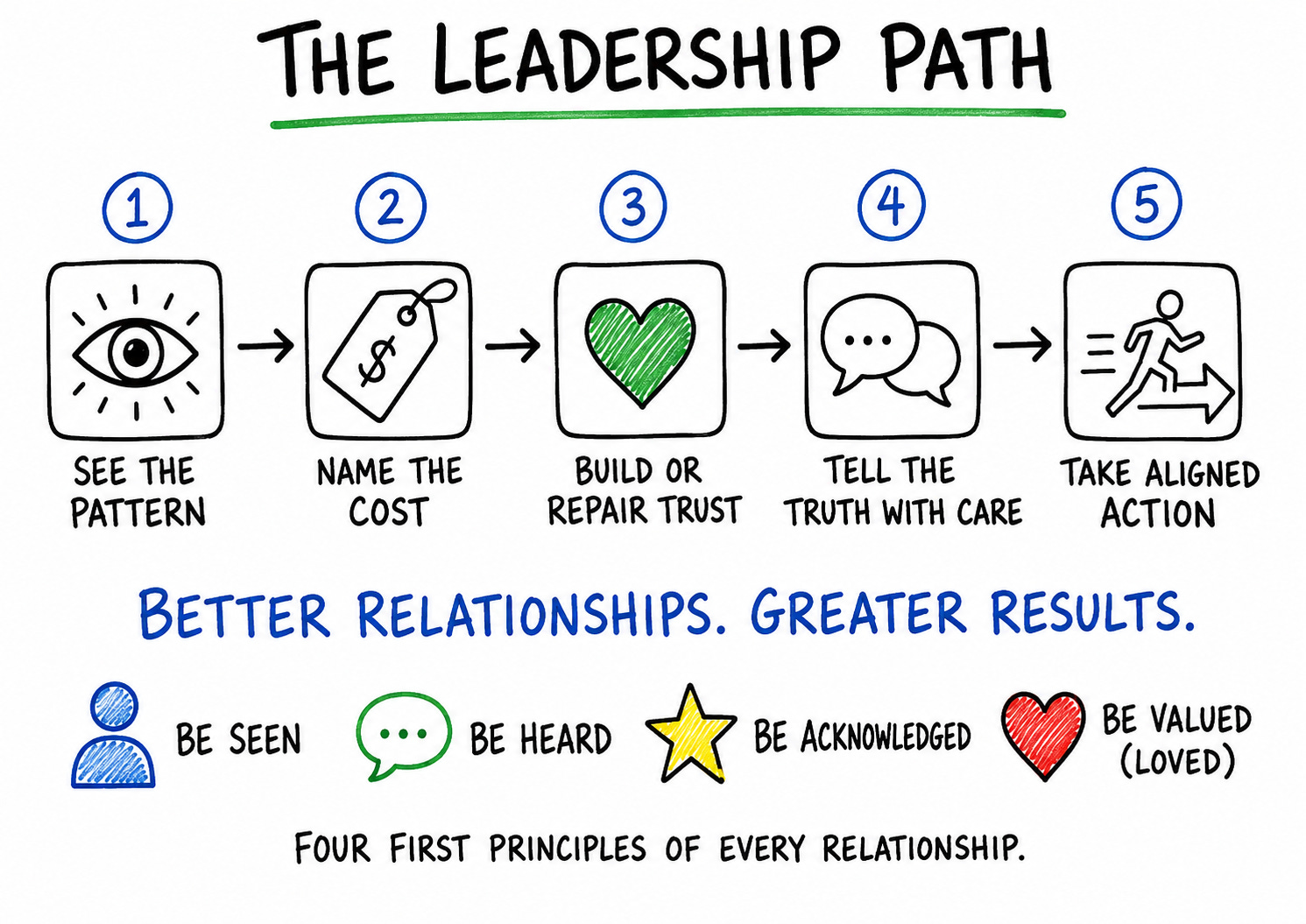
The One Relationship Leadership Path
When one relationship is affecting performance, use this path.
1. See the pattern
What is really happening?
Not the clean version. Not the surface story. The real pattern.
Where is trust low?
Where is energy leaking?
Where is truth missing?
Where is the relationship affecting the result?
You cannot shift what you cannot see.
2. Name the relationship cost
What is this costing?
Is it costing focus? Energy? Time? Sleep? Trust?
Money? Confidence? Progress? Results?
Naming the cost helps turn a fuzzy issue into a real one.
3. Build or repair trust
Trust is built in small moments. It is also lost in small moments.
A missed promise. A vague answer. The meeting after the meeting.
A hard thing left unsaid. A slack, text or email that should have been a conversation.
If trust feels low, start there.
4. Tell the truth with care
Truth without care can feel like attack. Care without truth can become avoidance.
The goal is both. Clear and human. Honest and kind. Direct and respectful.
5. Take aligned action
What is the next right move?
Not the perfect move. Not the dramatic move. The next honest, helpful, clear move.
That is how trust gets rebuilt. One aligned action at a time.
The 8 Field Notes
These are the Bill-inspired leadership lessons that connect most directly to our work at ResultsLab.io. Not because we agree with every word or style.
Because the patterns matter.
Field Note 1: Great Leaders Coach
Bill’s pattern: A great manager has to be a great coach.
Our perspective: Leadership is not just telling people what to do. It is helping people grow into what the work requires.
Real Talk
If people only hear from you when something is wrong,
that is not coaching. That is correction.
Coaching is ongoing. Support. Challenge. Care. Clarity.
Great leaders do not just manage the work.
They help grow the person doing the work.
Spot it
Where am I managing the task, but not coaching the person?
Try this
Ask one person: “What support would help you do your best work right now?”
Then listen. Do not fix too fast.
Field Note 2: People Are the Work
Bill’s pattern: People are the foundation of great companies.
Our perspective: The human system drives the business system.
Real Talk
You cannot ignore people and expect great performance.
That is like ignoring the roots and blaming the tree.
If the relationship is weak, the work gets harder.
If trust is low, speed slows down.
If people feel unseen, effort gets guarded.
This is not soft. This is how work actually works.
Spot it
Where am I treating a people issue like a process issue?
Try this
Start your next 1:1 with the person before the work.
Ask: “What has been taking up the most space for you lately?”
Then pause. Let the answer breathe.
Field Note 3: Trust Comes First
Bill’s pattern: Trust is the most important currency in a relationship.
Our perspective: Most performance problems have a trust problem, clarity problem, or communication gap underneath.
Real Talk
No trust. No truth.
No truth. No real progress.
Trust is built in small moments.
It is also lost in small moments.
A hard thing left unsaid can get louder over time.
Spot it
Where does trust feel low?
Where is there a gap between what was said and what happened?
What conversation keeps getting pushed off?
Try this
Use this line: “I want to clean something up before it gets bigger.”
Simple. Clear. Human.
Field Note 4: Candor Needs Care
Bill’s pattern: He gave hard feedback. And it worked because people knew he cared.
Our perspective: Truth without care can feel like attack. Care without truth can become avoidance.
Real Talk
Nice is not the same as kind. Kind tells the truth.
Kind also remembers there is a human being on the other side.
A lot of leaders avoid the truth because they do not want to hurt someone.
Then the issue grows.
Then the conversation gets heavier.
Then the damage gets worse.
Clear is kind. But only when clear is also human.
Spot it
Where am I avoiding a needed truth?
Where have I been clear, but not caring enough?
Where have I been caring, but not clear enough?
Try this
Use this 3-step frame:
“I care about you and the work.”
“Here is what I am noticing.”
“Can we look at this together?”
Field Note 5: Work the Team Before the Problem
Bill’s pattern: Before solving the problem, look at the team around the problem.
Our perspective: A lot of business problems are relationship problems inside the work.
Real Talk
The issue is rarely just the issue.
It is also:
Who is involved?
Who is not being heard?
Who feels blamed?
Who feels left out?
Who is avoiding the truth?
Who does not trust whom?
Who has gone quiet?
When the team is not right, the solution will not stick.
You can fix the process and still lose the people.
You can win the argument and still damage the trust.
You can ship the work and still leave the team weaker.
That is not a win.
Spot it
Are we trying to solve the work while avoiding the relationship?
Try this
Before solving the next big issue, ask:
“Do we have the trust and clarity to solve this well?”
Field Note 6: Fill the Gaps Between People
Bill’s pattern: He listened, observed, and filled the gaps between people.
Our perspective: Most messes grow in the gap.
Real Talk
The gap is where stories grow.
Someone says one thing. Someone hears another.
Someone goes quiet. Someone makes an assumption.
Someone reads tone into a text.
Someone thinks: “Well, if they cared, they would know.”
And now the work is not the only problem. The story is the problem.
This is where a coach helps. Not by taking sides.
By helping people see the pattern.
By helping people hear each other.
By helping people name what is real.
By helping people move from reaction to repair.
Spot it
Where are people making assumptions?
Where is a small issue becoming a bigger story?
Where am I filling in blanks with fear instead of facts?
Try this
Ask the gap-filler question:
“What do we need to make clear so this does not get weird later?”
Field Note 7: Leaders Give Energy
Bill’s pattern: Be the person who gives energy, not the person who takes it away.
Our perspective: Energy is not extra. Energy is part of performance.
Real Talk
You cannot drain people into greatness.
Your mood matters. Your tone matters. Your pace matters. Your stress can leak.
And when leaders leak stress, teams absorb it. That does not mean leaders need to be fake happy. It means leaders need self-command.
Pause → Notice → Choose → Then lead
A leader’s energy does not need to be perfect. It needs to be owned.
Spot it
Do people leave my conversations clearer or heavier?
Where is my stress leaking onto the team?
Who needs belief from me right now?
Try this
Give one person specific belief this week. Not vague praise.
Say: “I see the work you are putting into this. I also see the progress. Keep going. You are closer than it feels.”
Field Note 8: Care Belongs in Leadership
Bill’s pattern: He brought love into leadership.
Our perspective: Love at work does not have to be weird. It means care. It means respect. It means trust. It means you see the person, not just the role.
Real Talk
Care is not soft. Care is not weak.
Care is not avoiding hard things.
Care is what makes hard things possible.
If people do not feel valued, they protect.
If people feel safe, they open.
If people feel seen, they engage.
If people feel trusted, they take ownership.
That is why care matters. Not as a slogan. As a leadership practice.
Spot it
Who needs me to show up as a human, not just a leader?
Where have I made the work more important than the person?
Try this
Reach out to one person with no ask. Just care.
“Thinking of you today. I’m sending you some positive energy.”
From Field Notes to Practice
This all sounds simple.
Coach people.
Build trust.
Tell the truth with care.
Fill the gaps.
Lead with head, heart, and hands.
But simple does not always mean easy.
Because real leadership happens in real moments.
A tense meeting.
A short reply.
A hard conversation.
A trust gap.
A change people did not ask for.
A relationship that is taking up too much space.
That is when we need more than good ideas.
We need simple practices we can use in the moment.
That is where ResultsOS™ comes in.
Not as another big system to memorize.
As a set of simple tools to help you pause, see the pattern, and take the next aligned action.
Let’s start with S.T.O.P.
When Things Get Heated S.T.O.P.
When things get heated, most people move too fast.
Speed plus emotion usually creates damage.
So we start with STOP.
S: Slow Down
Pause. Take one breath. Then another. Create space.
T: Think
What is true?
What story am I adding?
What do I actually know?
O: Observe
What is happening in me?
What is happening in them?
What pattern is showing up?
P: Process
What matters most?
What is one next step?
What would better look like from here?
The goal is not to instantly feel better.
The goal is to stop making things worse.
That alone is a win.
Watch for the Cycle of Collusion
Smart, healthy, well-meaning people can still get stuck in loops.
The Cycle of Collusion is a repeating conflict pattern where two people reinforce each other’s behavior through blame, reaction, and justification.
It usually sounds like this:
“They always do this.”
“They never listen.”
“I have to push because they avoid.”
“I avoid because they push.”
“I shut down because they get intense.”
“I get intense because they shut down.”
Round and round.
The way out is not blame.
The way out is awareness.
See the pattern.
Own your part.
Separate facts from assumptions.
Change your response.
That is leadership.
ResultsOS™ Tools When You Need Them
Ideas do not change people. Practice does. That is where ResultsOS™ comes in.
ResultsOS™ helps people think clearly, act simply, and get better results with more margin. Margin for what matters most. Use these tools when you need them. Do not overthink them.
Pick the one that helps.
GREAT: Use this to reflect
GREAT helps you see the whole picture.
Growth & Gratitude
What is growing in me?
What can I be grateful for in this challenge?
Relationships
Which relationship needs attention right now?
How am I showing up?
Energy
What is charging or draining the room?
What energy am I bringing?
Aspiration
Who am I becoming as a leader?
What kind of leader does this moment require?
Time
Where am I investing time in the relationships that matter?
Where am I wasting time avoiding the real issue?
FASTER: Use this to act
FASTER helps you move.
Focus
What matters most right now?
What needs to be filtered out?
Aligned Action
What action fits the leader I want to be?
Who owns the next move?
Strategic Step
What is the smallest, simplest, smartest next step?
Target + Timebox
What result matters?
By when?
Essential + Energy + Empowered
What matters most?
What will sustain me?
What builds confidence?
Review → Realign → Refocus
What worked?
What did not?
What is next?
OPPS: Use this when it is a team or business issue
OPPS helps you scale the thinking.
Outcomes
What does success look like?
People
Who needs clarity, support, or accountability?
Process
Where is friction slowing us down?
Systems
What rhythm keeps this from becoming chaos again?
The Simple Leadership Practice
When a relationship is affecting performance, use this process.
Pause
Do not react too fast. Slow down. Notice what is happening in you.
Recognize the pattern
What is really going on?
Trust issue? Clarity issue?
Energy issue? Accountability issue?
Avoidance? Fear? A hard conversation?
Understand the principle
What matters here?
Being seen?
Being heard?
Being acknowledged?
Being valued?
Trust? Respect? Love? Valued?
Apply the process
Use empathy.
Use curiosity.
Take perspective.
Co-create the next step.
Take aligned action.
Practice
Do it again. And again. And again.
That is how leadership becomes second nature.
What To Do Next
If this helped, choose the next step that fits where you are.
No pressure. No weird pitch. Just the next right step.
1. If you want to understand how we work
Read: What It’s Like to Work Together
Best if you want to know what ResultsLab actually feels like before you take a step.
2. If one relationship is costing you too much
Explore: Relationship SOS
Best if one relationship is draining your focus, energy, trust, or results.
3. If you want a simple place to start
Start Here: Start With One Relationship
Best if you want to bring one relationship, slow it down, sort it out, and find your next best move.
4. If you want private, direct support
Learn More: The 1:1 VIP Experience
Best if you want speed, privacy, and direct access.
Subscribe to get first access to new content like this.
This is NOT 🚫another newsletter.
We don’t gate our content.
Closing Thoughts
Bill Campbell showed that the best leaders are not just smart. They are human. They build trust. They tell the truth. They care deeply. They coach people. They strengthen teams. They fill the gaps most people avoid. That is why his work still matters. And that is why this work matters now.
Because Relationships Drive Performance.
At work. At home. In teams. In leadership. In life.
If one relationship is draining trust, energy, focus, or results, that is not a side issue. That may be the issue. And the next step does not have to be big. It just has to be honest. Clear. Human. Aligned. That is how we lead like a coach.
That is how we get help you get GREAT Results FASTER.
Learn more about Mike D’Angelo
and why this work is so important to me.
Quick Answers
What does it mean to lead like a coach?
To lead like a coach means you help people grow, not just get tasks done. You listen. You ask better questions. You build trust. You tell the truth with care. You help people take the next right step.
Why are relationships important in leadership?
Relationships affect trust. Trust affects energy. Energy affects focus. Focus affects action. Action affects results. If relationships are strained, performance gets harder.
Is this field guide about Bill Campbell?
It is inspired by Bill Campbell’s work and the book Trillion Dollar Coach.
It is not a summary of the book. It is a ResultsLab field guide on the leadership patterns we see in Bill’s work and in our own work with leaders.
Is this relationship coaching?
Yes, and not in the way most people think. This is not dating advice, marriage advice, or couples therapy. This is about the relationships that affect your focus, energy, trust, choices, and results.
What is the first step if a relationship is draining me?
Name it. Ask: “What relationship is costing me the most right now?”
Then look at what it is costing you. Focus? Energy? Trust? Confidence? Results?
Once you name it, you can choose your next best move.
Why is change so hard?
Change is hard because change is human. It creates fear, uncertainty, doubt, depletion, disconnection, distraction, and delay. People do not always resist change. They often resist the loss, pressure, or confusion that comes with change.
What is the ResultsLab approach?
We help people move through four gates:
Awareness. First, see the pattern.
Acceptance. Then accept what is real.
Accountability. Then own your part.
Aligned action. Then take the next right step.
How do I know if I need a coach, guide, or mentor?
If you have been thinking about the same issue for weeks, if you know what to do but are not doing it, or if one relationship is draining too much energy, support may help.
You may not need more information. You may need a clear place to think.
Start with one relationship
Answer 3 quick questions, then choose a time to talk.
What relationship is costing you the most right now?
I help people solve high-stakes relationship problems that drain trust, energy, and results. Lab Notes is where I share one insight every week to help you make more progress faster. If someone forwarded this to you, please subscribe here: resultslab.io/subscribe
Better Relationships | Great Results
Have questions?
See our Complete FAQ Guide
ResultsLab.io | Complete FAQ Guide